For zero liquid flux the reduced gradients are and . Their ratio givesIntegrate to obtain the requested implicit height profile:The endpoint relation is , and the same expression at fixes . For it simplifies tosoThis zero-liquid-flux surfactant film grows to the right from a formal dry edge, with there. Its dimensionless velocity isThe lower two thirds flow left, the upper third flows right, and the integrated liquid flux is zero. Surface advection carries the positive surfactant flux, with .
The flux curve obeys . It increases throughout the interval and reaches its formal maximum at . Larger depletion strengthens the Marangoni driving, so increasing transport is plausible. But finite flux at a zero-concentration endpoint is a singular prediction: and the height gradient diverge there. Neglected diffusion, capillarity or an endpoint region must regularize the physical limit, and can alter its maximum. The dry initial edge is likewise outside a uniform small-slope approximation.
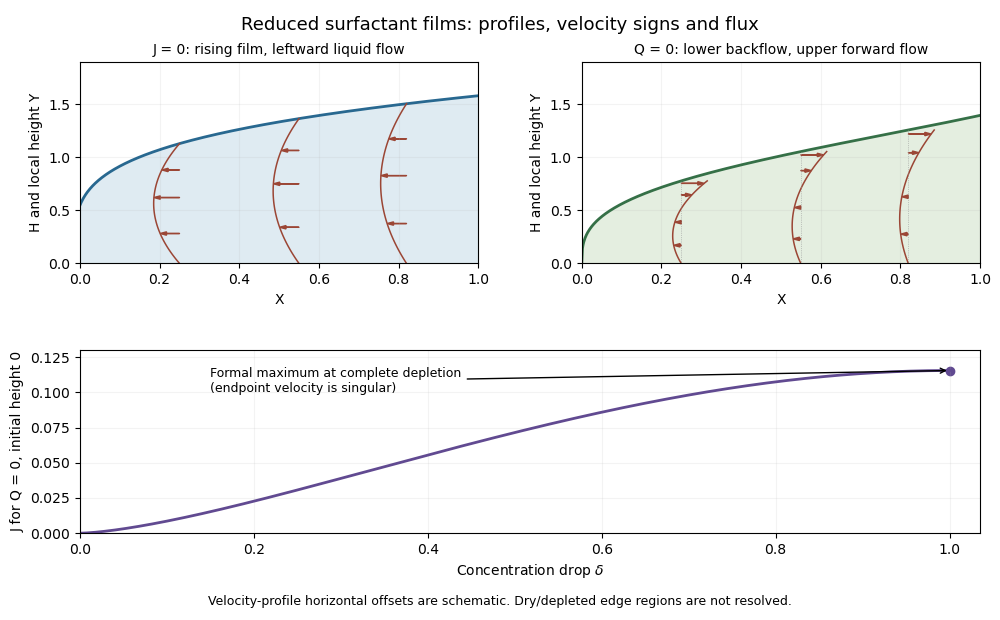
Zero-surfactant-flux and zero-liquid-flux film shapes with velocity profiles, and the reduced surfactant-flux curve versus depletion
. The profiles and velocity arrows illustrate the opposing interior-flow directions and the formal endpoint maximum; neither sketch treats the singular edges as resolved lubrication regions.
Articles by others on the same topic
There are currently no matching articles.