Use for height above the horizontal wall. In the lubrication approximation, vertical momentum is hydrostatic and the interfacial stress balance with variable surface tension givesThe horizontal equation is , with and . ThusIntegrating across the film and adding surface diffusion to surfactant advection gives the dimensional thin-film mass flux and insoluble surfactant flux:These include Marangoni stress, hydrostatic leveling, capillarity and surface diffusion with their signs fixed by the surface traction. In particular the derivative acts on the product of surface tension and curvature, not just on curvature.
Choose and . The dimensionless definitions areTogether with the stated concentration and horizontal scales, these giveIn steady flow are constants by liquid and surfactant conservation.
With capillarity and diffusion neglected, solve these two linear equations for the gradients, in the region :For positive , the phase plane nullclines are for and for . Above both lines, trajectories go left and upward; between them they go left and downward; below both they go right and downward. There is no positive-quadrant equilibrium. The axes are singular boundaries of this positive-flux reduction, not regular equilibria.
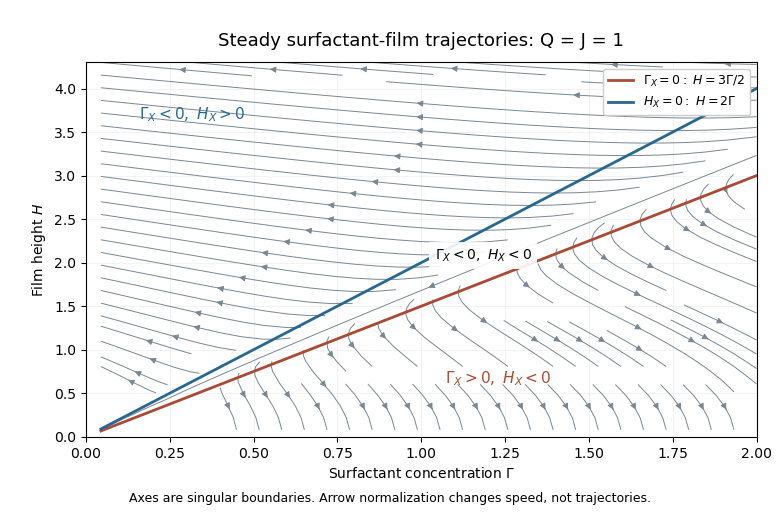
Steady positive-flux surfactant-film phase portrait, showing both nullclines and trajectory directions for Q=J=1
. Details. 
The phase portrait shows these trajectories for one choice of positive fluxes; the two nullcline slopes rescale with .
With zero surfactant flux and positive concentration, the nondiffusive surface velocity is zero. The reduced equations become , . Integrating, with the prescribed initial height and concentration, givesAt the far end, the imposed concentration drop fixes , henceThis steady surfactant film with zero surface flux rises to the right while its concentration decreases. The liquid flux is negative, despite the rightward Marangoni traction: the adverse hydrostatic gradient is strong enough to immobilize the surface and drive the interior leftwards.
In dimensionless height , the velocity profile isIt vanishes at both boundaries and is negative in the interior when . Its integral is . For , the nondegenerate film is flat and stationary. If its initial thickness is zero, the formal edge has an unbounded slope, so the lubrication approximation applies away from that edge rather than at the exact dry point.
For zero liquid flux the reduced gradients are and . Their ratio givesIntegrate to obtain the requested implicit height profile:The endpoint relation is , and the same expression at fixes . For it simplifies tosoThis zero-liquid-flux surfactant film grows to the right from a formal dry edge, with there. Its dimensionless velocity isThe lower two thirds flow left, the upper third flows right, and the integrated liquid flux is zero. Surface advection carries the positive surfactant flux, with .
The flux curve obeys . It increases throughout the interval and reaches its formal maximum at . Larger depletion strengthens the Marangoni driving, so increasing transport is plausible. But finite flux at a zero-concentration endpoint is a singular prediction: and the height gradient diverge there. Neglected diffusion, capillarity or an endpoint region must regularize the physical limit, and can alter its maximum. The dry initial edge is likewise outside a uniform small-slope approximation.
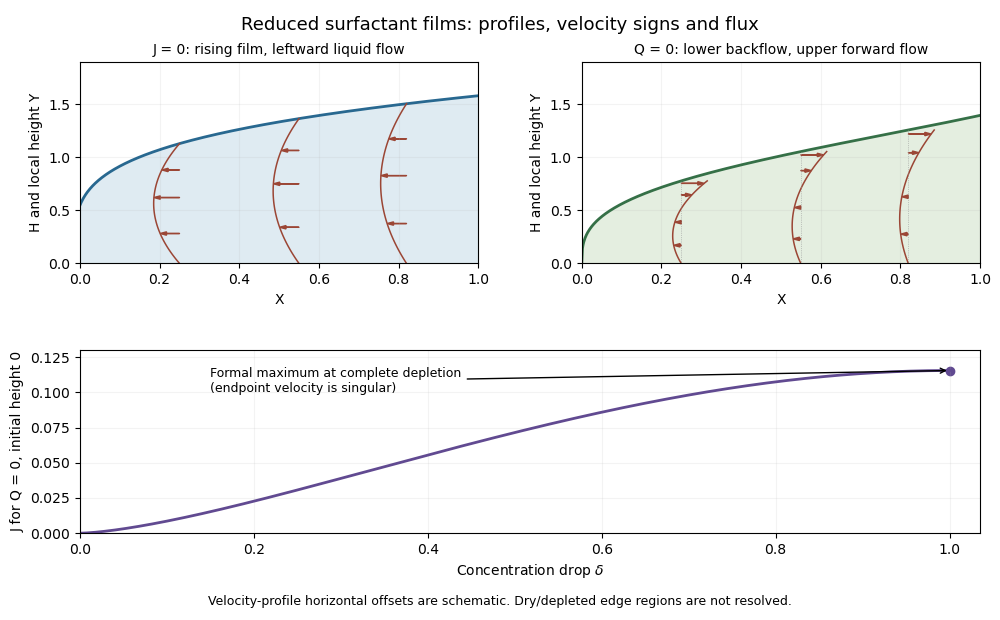
Zero-surfactant-flux and zero-liquid-flux film shapes with velocity profiles, and the reduced surfactant-flux curve versus depletion
. Details. 
The profiles and velocity arrows illustrate the opposing interior-flow directions and the formal endpoint maximum; neither sketch treats the singular edges as resolved lubrication regions.
Articles by others on the same topic
There are currently no matching articles.