Write and , where . Macroscopic occupation permits , with relative commutator corrections of order . Keep the fixed-total-number correction before replacing by .
The four-condensate term is . Its leading expansion gives . Terms with two condensate operators give normal scattering and conversion of two condensate particles into opposite-momentum excitations, with coefficient . The normal contribution cancels against the change of condensate energy at fixed . Hence the number-conserving Bogoliubov quadratic Hamiltonian isUse a real even interaction transform, , as for a real inversion-symmetric pair potential. The constant is the condensate interaction energy; the diagonal part combines particle kinetic energy with condensate scattering; the anomalous pair terms create and annihilate correlated opposite momenta while transferring particles to or from the condensate.
At fixed volume, counting replaced condensate operators gives quadratic vertices proportional to , omitted cubic vertices proportional to and quartic vertices with no condensate factor. There are also the finite- correction in and corrections from the condensate-number expansion. Their physical control parameter is small depletion, , together with weak interaction; simply dropping them is not justified by low temperature in a strongly interacting gas. This is the weakly interacting Bose gas approximation.
Put and , and assume the homogeneous condensate is stable, so for nonzero modes. A real Bogoliubov transformation isThe canonical condition preserves the bosonic canonical commutation relations. Cancellation of pair terms requires . ThereforeThe sign of follows that of . Normal ordering the transformed operators gives the bosonic Bogoliubov zero-point shift:Rearranging the last two terms is exactly the requested form. Each momentum appears in the sums, so opposite-momentum pairs are not counted again separately.
The Bogoliubov quasiparticle dispersion is linear at low momentum when :It is a gapless phonon of the condensate, unlike the free-particle quadratic spectrum. For a contact repulsion , the healing length controls crossover to the particle regime . A momentum-dependent potential can modify the higher-energy curve; the sketch uses the contact case and does not assume every interaction has that entire shape.
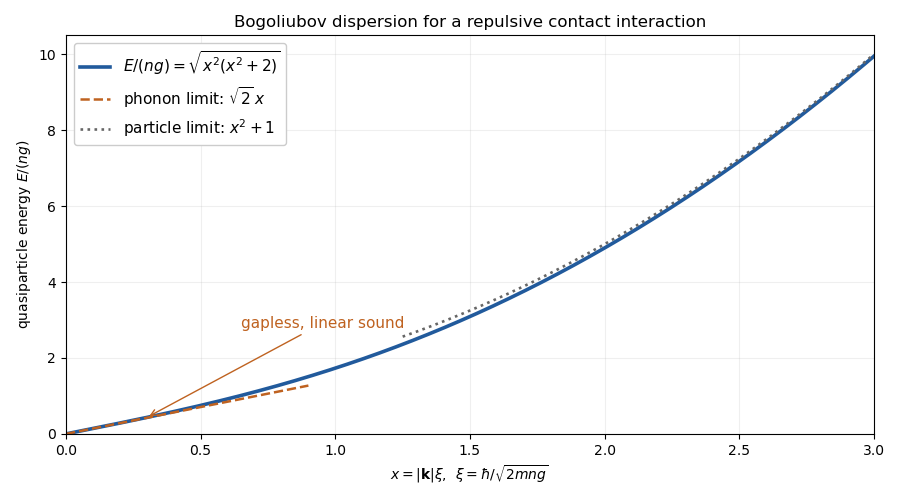
Gapless phonon-to-particle crossover of the Bogoliubov dispersion for a repulsive contact interaction
. Details. 
In the ground state of the diagonal Hamiltonian, . The Bogoliubov transformation therefore gives . Summing all nonzero momenta proves the quantum depletion of a Bose condensate:The nonzero depletion arises from correlated pairs in the interacting quasiparticle vacuum, not thermally populated quasiparticles.
The printed expression is the zero-temperature result. At a nonzero temperature the complete leading-order expression instead hasThe additional term is thermal depletion and cannot be discarded merely because the gas is condensed.
Articles by others on the same topic
There are currently no matching articles.