A quasiparticle is a collective excitation that can be described approximately by particle-like quantum numbers and dynamics, even though it is not an isolated elementary particle. Excitons and polaritons are examples.
A Bogoliubov quasiparticle is an excitation created by the diagonal mode operator obtained through a Bogoliubov transformation. Its vacuum can contain particles in the original modes because creation and annihilation operators mix. Examples include antiferromagnetic spin waves, Bose-gas phonons and paired-fermion excitations.
For a normalized spinless paired ground state , its mean fermion number is . The canonical Bogoliubov quasiparticle creation operator produces , containing exactly one fermion. With BCS coherence factors , the change in mean fermion number is . This need not be an integer because the pairing Hamiltonian preserves fermion parity while failing to conserve the original fermion number operator. Every measurement of that number operator still has integer outcomes.
A polariton is a hybrid light–matter excitation formed by strong coupling between a photon and a material excitation. For an exciton-polariton, the material component is an exciton.
A phonon polariton is a normal mode mixing an electromagnetic field with a polar optical lattice vibration. In a lossless isotropic oscillator model, . With , its two transverse branches obey . The nearly flat longitudinal optical mode is distinct from the upper transverse branch.
An exciton is a bound state of an electron and an electron hole. Their opposite electric charges attract through the Coulomb potential, producing a neutral quasiparticle with internal relative motion and motion of its center of mass. In a semiconductor, promoting an electron from the valence band into the conduction band leaves an electron hole; the pair can occupy either an exciton bound state or an unbound scattering state. Merely creating the two charge carriers does not establish binding. A neutral exciton can transport excitation energy without transporting net electric charge. Coupling this material excitation strongly to a photon can form a polariton.
The striking optical consequence is that an exciton optical transition can absorb a photon with less energy than the threshold for creating unbound electrons and electron holes. The difference is the exciton binding energy, not an extra one-electron energy band inside the band gap. The Wannier-Mott exciton supplies a useful large-radius model; the Frenkel exciton describes the opposite, tightly localized limit.[ref]
Excitons in Semiconductor Quantum Dots by Matjaž Humar. §3, printed pp. 4–6: bound pairs, effective masses and localized contrast
A characteristic transport length before exciton decay, commonly in a diffusion-decay convention. A root-mean-square displacement over a fixed time has dimension-dependent factors and is not automatically this same convention.
The attractive electrostatic interaction between an electron and an electron hole. In a screened effective-mass approximation its potential has the displayed form. It can bind an exciton and reduce its optical excitation energy below the corresponding unbound-pair threshold.
The reduced band mass for relative electron–hole motion, . It differs from the total mass that controls centre-of-mass motion.
A biexciton is a two-electron, two-electron hole excitation. If and are total excitation energies relative to the empty emitter, the cascade emits photons of energies and . Define its binding energy by . The first cascade photon then has energy . Positive binding shifts that line below the single-exciton line; confinement can also produce negative binding, shifting it above. The cascade does not emit a single photon of twice the exciton energy.
The exciton binding energy is the positive energy needed to separate a bound electron and electron hole into the relevant unbound scattering states. Compare the exciton energy with the continuum threshold at the same total crystal momentum and for the same energy bands. The negative internal energy eigenvalue and the positive separation cost are different sign conventions for related quantities. An exciton may move freely through a perfect crystal while remaining internally bound: “free exciton” does not mean an unbound pair.
Thermal energy comparable with an exciton binding energy promotes dissociation and often washes out narrow bound-exciton resonances. Comparing with binding energy is a scale estimate, not an exact disappearance criterion: densities, screening, oscillator strength and linewidths also matter.
A Wannier-Mott exciton has an internal wave function extending over many unit cells. Its simplest model assumes a three-dimensional bulk crystal, approximately parabolic valence band and conduction band, positive isotropic scalar effective masses , a constant scalar relative permittivity , and a dilute pair population. Replace microscopic crystal forces by those effective masses and dielectric screening, and neglect exchange corrections and coupling to phonons. These assumptions must hold on the spatial and energy scales of the particular exciton.
With relative coordinate , the internal Hamiltonian operator is the three-dimensional hydrogen atom problem with a reduced mass and a screened Coulomb potential:Here is the elementary charge, the vacuum permittivity, and the reduced Planck constant. The internal energy eigenvalues, radius scale, and exciton binding energies areThe principal quantum number is . This reduction and these scales are derived in Excitons in Semiconductor Quantum Dots by Matjaž Humar (§3, printed pp. 5–6, equations (13)–(26)).
To check the scales by dimensional analysis, write , which has units of energy times length. Then is a length and is an energy. Rescaling makes , the dimensionless hydrogen atom operator. The Bohr radius is a wave function scale, not the radius of a classical orbit; for this model's lowest internal bound state, the mean separation is .
For the diagrams' hypothetical inputs , , and , where is the free electron mass, independent substitution gives , and . Here electronvolts express energy. The exciton binding energies for are approximately , and . These are model calculations, not measured material parameters. The large-radius approximation additionally requires to be much larger than the crystal's unit cell length scale. In a thin layer, with anisotropic effective masses, or with spatially varying dielectric screening, this three-dimensional formula is not generally valid.
In the envelope approximation, a quantum well confines electron and hole motion perpendicular to the plane. Averaging their screened attraction over the confinement envelopes gives the displayed effective in-plane potential. Its narrow-well limit approaches the ideal two-dimensional exciton; finite width softens the short-distance attraction. Dielectric mismatch, nonparabolic bands and strong electron–hole confinement mixing require more than this single-subband model.
In the ideal screened-Coulomb model confined to a plane, the relative-motion energies are for , where . The ground-state binding is rather than the three-dimensional value . Finite-width wells need not be exactly planar.
The first two optically active hydrogenic levels have separation in the planar model, versus in the bulk model. The separation cancels an uncertain common continuum threshold, making it useful when rounded band parameters do not reproduce every absolute peak energy.
The characteristic relative-motion length of a hydrogenic Wannier-Mott exciton, with dielectric screening and exciton reduced mass . Comparing a quantum dot's dimensions with this scale helps distinguish strong carrier confinement from confinement of a comparatively intact bound pair.
The hydrogenic sequence of bound relative electron–hole energies below the free-pair threshold, where . The effective-mass, screened-Coulomb approximation and optical selection rules limit the model.
The dimensionless ratio of a medium's permittivity to vacuum permittivity. The constant scalar value used in a Wannier-Mott exciton is an approximation to the relevant material response.
The generally complex, frequency- and wavevector-dependent relative permittivity describing linear polarization response. Its imaginary part represents dissipative response with the sign fixed by the time convention; optical prefactors connect it to an absorption coefficient.
The static independent-electron density response of a uniform three-dimensional, two-spin Fermi gas, combined with self-consistent Poisson equation screening, gives the displayed dielectric function. For bare electron mass and vacuum background, andHere , by continuous extension, and at large . A host dielectric background and band effective mass require replacing the vacuum parameters appropriately. This nonlocal response contains Friedel oscillations, which its long-wavelength Thomas-Fermi screening limit misses.
The three-dimensional static screening function is finite at , but its derivative diverges logarithmically. Expanding the explicit static Lindhard dielectric function gives the title's nonanalytic term. The singularity comes from particle–hole excitations connecting opposite parts of the Fermi surface. It produces a Friedel density tail from a derivative singularity; analogous electronic response can cause a Kohn anomaly in a coupled lattice vibration.
Modification of the interaction between electric charges by a medium's electrical response. In the simplest Wannier-Mott exciton model, the Coulomb potential is reduced by a constant relative permittivity; actual screening can depend on spatial and temporal scales.
For a point source and the Fourier transform convention , self-consistent screening gives . Angular inversion yields . The factor includes the inverse-transform normalization and spherical angular integral. Perfect long-wavelength screening implies total induced charge .
The sharp Fermi surface gives a nonlocal oscillatory electronic response around an impurity. In a three-dimensional isotropic metal its far-field oscillations have characteristic wavevector and algebraically decaying amplitude. They are absent from the purely exponential Thomas-Fermi screening potential. The local screening formula is a useful long-wavelength model, not an exact asymptotic expression at every distance.
A single isotropic three-dimensional valley with two equal spin populations has . A density oscillation at wavevector therefore has the wavelength in the title. This depends on carrier density, independently of effective mass and dielectric screening strength. Extra valley degeneracy, spin polarization or reduced dimensionality changes the state-counting relation.
For the radial induced-charge screening kernel, integrate the sine transform twice by parts, with and vanishing remaining endpoint terms. This gives . A Cauchy principal value singularity at contributes to that integral: set and use for . Smoothly localizing around justifies the large- extension of the limits. In a three-dimensional isotropic Fermi gas, .
In the long-wavelength static response of a degenerate conductor, a small electric potential changes the electron density by , where is the spin-summed density of states per volume per energy. The induced charge is therefore . With background permittivity , Poisson equation becomesA point charge then has . Larger electronic density of states gives stronger screening. This local response approximation does not capture the microscopic oscillatory tail of Friedel oscillations.[ref]
https://www.damtp.cam.ac.uk/user/tong/em/el6.pdf. Sections 7.7.3–7.7.5: Thomas-Fermi screening and its nonlocal corrections
The Thomas-Fermi screening length is the exponential decay scale of a statically screened potential in the local degenerate-electron approximation. For a three-dimensional parabolic free electron model, , so . At fixed mass and background permittivity it scales as , rather than the classical Debye density power at fixed temperature.
A Frenkel exciton is an exciton whose internal excitation is concentrated on the scale of one molecule or unit cell. The local excitation can transfer between sites; localized internal structure does not require an immobile center of mass. The large-radius Wannier-Mott exciton approximation cannot simply be extrapolated to this limit.[ref]
Excitons in Semiconductor Quantum Dots by Matjaž Humar. §3, printed p. 6: small-radius Frenkel contrast
For the ideal Wannier-Mott exciton in energy bands whose edges occur at the same crystal momentum, the pair excitation energy, measured from the unexcited crystal, isHere is the pair's total crystal momentum; the last term is center of mass kinetic energy. For a permitted photon absorption transition with negligible recoil energy, . An electric-dipole selection rule and a nonzero transition matrix element are still needed: a bound state need not produce an observable spectral line. If the relevant energy band edges have different values of crystal momentum, a phonon can also be needed to conserve crystal momentum; subtracting a binding scale from a band gap alone does not specify the optical threshold.
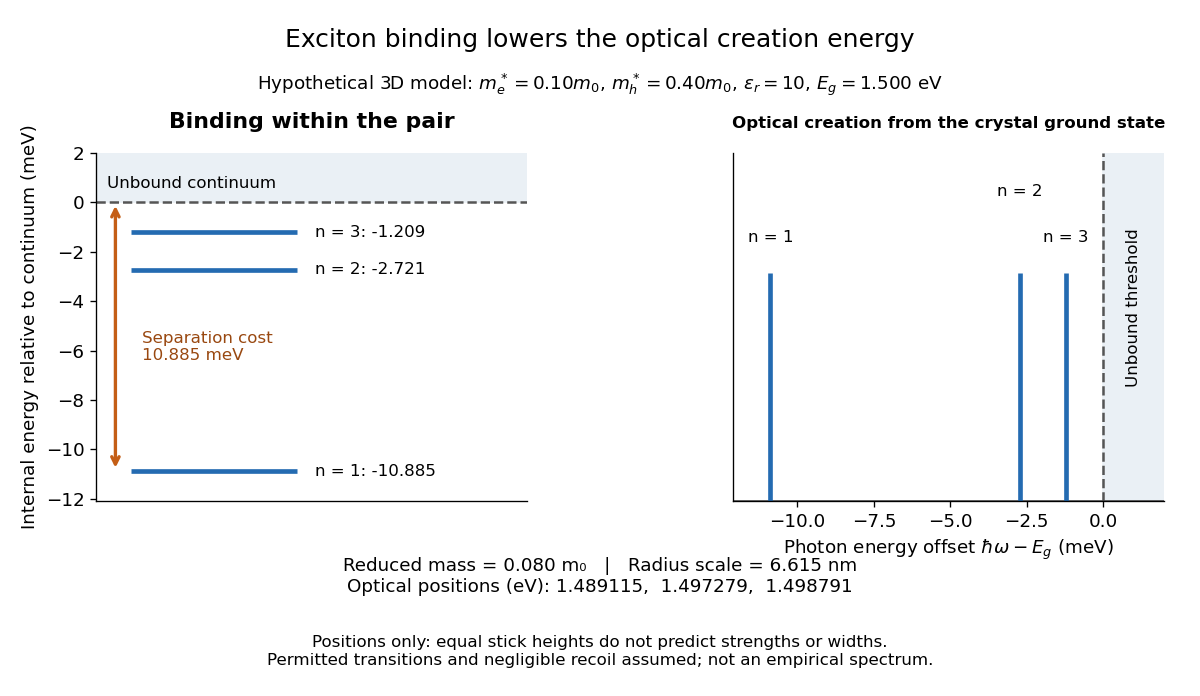
For example, the lowest internal bound state in this hypothetical model costs to create optically, yet needs only more to dissociate. The large creation energy and the small exciton binding energy answer different physical questions. An electron-hole recombination event can instead release excitation energy by photon emission or to other degrees of freedom; an emitted photon need not reproduce the original absorption energy if relaxation intervened.
In Giant Rydberg Excitons in Cuprous Oxide by Tomasz Kazimierczuk and others, a polished copper(I) oxide crystal was mounted without strain at . A tunable single-frequency dye laser scanned photon energy; balanced detection compared transmitted light with a reference beam. Transmission dips resolved spectral lines assigned to bound excitons through principal quantum number . Their convergence towards an unbound threshold supports a hydrogen-like internal series, with small systematic deviations.[ref]
Controls mattered: restricting broadband illumination improved resolution of high- excitons; lowering laser power or expanding its spot reduced interaction-induced suppression. Balanced detection suppressed source fluctuations. The measurement probes optical resonances, not individual electron-electron hole trajectories or directly imaged radii. Electric-dipole selection rules favor P-envelope states in this material, unlike the hypothetical permitted lowest-state transition above. Finite resolution and crystal inhomogeneity affect spectral lines; the inferred binding series requires a continuum threshold and a model.[ref]
Giant Rydberg Excitons in Cuprous Oxide by Tomasz Kazimierczuk and others. pp. 3–5; supplement pp. 2–4 and 6–7, figure S3: selection rules, illumination tests, line corrections and deviations
An electron hole is an unoccupied electron quantum state in an otherwise nearly full energy band, often the valence band. “Filled” refers to occupation of the allowed quantum states, not to filling all space with a continuous fluid of electrons. Each state, including its spin label, can hold at most one electron by the Pauli exclusion principle. The almost full energy band and its few missing occupants are therefore simpler to describe as a background plus a few electron holes. The electron hole is a quasiparticle, not a Positron inserted into the crystal.
Removing an electron of electric charge changes the background's electric charge by . Thus an electron hole carries positive electric charge relative to that background. Promoting an electron into the conduction band creates an electron hole without changing the whole crystal's electric charge: . An unbound pair still consists of two separate charge carriers; only a bound state of their relative motion is an exciton.
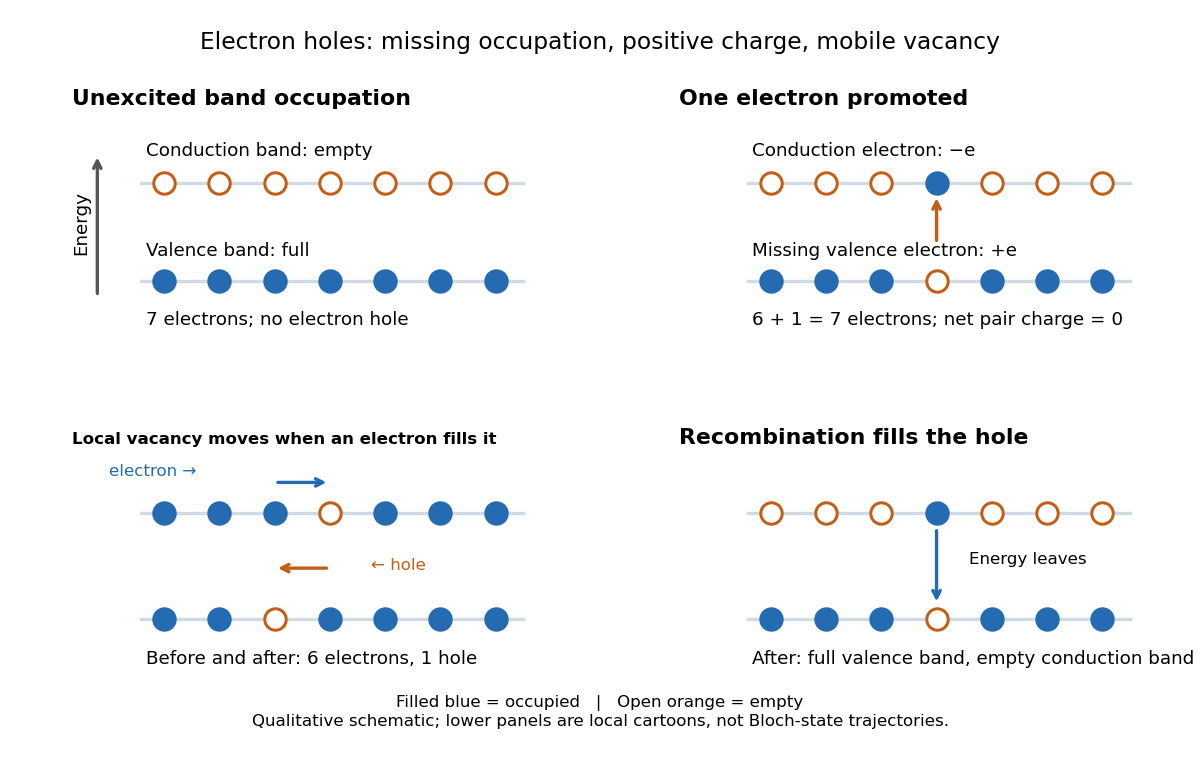
The local cartoon explains why a vacancy can move: when a neighboring electron fills it, another vacancy appears where that electron was. The vacancy has moved opposite to that particular transfer of an electron. In an extended Bloch state, use crystal momentum instead of imagining a permanently empty atomic site. For a completely filled energy band the summed electric current vanishes. Omitting one electron with group velocity removes its contribution , leaving a contribution . This fixes both the positive electric charge and the velocity convention of the electron hole.
More precisely, near a parabolic valence band maximum, set its energy as reference and define the electron hole wave vector by . ThenThe occupied electron branch has negative curvature there, while the electron hole branch has positive effective mass . The velocity equality compares the electron hole with the missing Bloch state's group velocity; it does not contradict the opposite vacancy motion in a local transfer cartoon. The sign conventions are listed in Phys 460 Lecture 17.
A hole in the , valence branch near a specified axis. Its curvature and effective mass differ from those of the heavy-hole branch; confinement and strain can split branches that are degenerate at the bulk zone centre.
A hole in the upper valence manifold associated near a chosen propagation axis with the , branch. Its band curvature is relatively small, hence its effective mass relatively large. The label is direction dependent in a general anisotropic band structure.
An electron-hole pair consists of an excited electron and the unoccupied valence state described as an electron hole. Promoting a valence electron across a semiconductor band gap creates such a pair without changing the total electric charge. The carriers can separate under an electric field, or undergo electron-hole recombination. A bound electron-hole pair is an exciton; an arbitrary unbound pair need not be an exciton.
An electron filling an electron hole removes both excitations relative to the filled-band background. Their electric charges cancel, consistent with charge conservation; the remaining electrons are still present. The released energy can leave through photon emission or other channels, including phonons. Formation of an exciton instead retains the excited electron and electron hole as a bound pair; recombination removes the pair. A valence band electron filling a nearby vacancy merely moves the electron hole and does not remove the total vacancy count.
In a weak-injection regime where the majority population is nearly fixed, a small excess minority charge carrier population often relaxes exponentially with time constant . This lifetime describes carrier removal by recombination. It differs from the momentum relaxation time governing charge carrier mobility: many momentum-scattering events can occur before a carrier recombines. Traps and spatial transport can make a single exponential inadequate.
In a semiconductor, a conduction electron fills a vacant valence state and emits a photon. In a simple nondegenerate model the recombination rate is , while the equilibrium reverse generation rate is ; their difference gives the displayed net pair-loss rate. This subtraction enforces detailed balance at thermal equilibrium. Photon momentum is small on the scale of a Brillouin zone, so a direct band gap permits a direct transition while an indirect band gap generally requires a phonon or another source of momentum.
In Auger recombination an electron-hole pair annihilates while transferring its energy to another electron or hole rather than to an emitted photon. The hot recipient subsequently loses energy, commonly to phonons. In a simple nondegenerate carrier-density model the rate is , with electron and hole number densities and material-dependent coefficients. This makes the process especially important at high carrier injection. It is the reverse type of energy transfer to impact ionization, although detailed thresholds and matrix elements depend on the bands.
In the simple semiconductor description, the highest occupied energy band of the unexcited crystal at zero temperature. A missing occupant is an electron hole.
Spin-orbit coupling separates the valence states from the upper manifold at the zone centre in common cubic semiconductors. If its maximum lies below the upper valence band edge, its thermal electron hole population is suppressed by apart from effective density of states factors. Neglect requires ; it is not valid at every temperature or in every material.
Near the zone centre of many cubic semiconductors, the upper valence bands have different curvatures and hence different band effective masses. In the isotropic approximation, the states with angular-momentum projection magnitude along the propagation direction form the heavy-hole branch; projection magnitude gives the light-hole branch. A flatter downward electron dispersion corresponds to a larger positive electron hole effective mass. Crystal anisotropy, strain and confinement can mix these branches, so the labels do not imply direction-independent exact masses.
The initially empty energy band above the band gap in the simple semiconductor description. Excited electrons in it can carry electric current; they can also bind to valence band electron holes as excitons.
An electron occupying an extended state in a conduction band. Its response to an applied electric field depends on its band group velocity, occupation and scattering. Merely counting such electrons does not by itself determine electrical conductivity.
Articles by others on the same topic




The opposite of elementary particle.