Use dimensionless spin angular momentum operators, so their commutators have no additional . A fully polarized state is an exact ground state of the Heisenberg ferromagnet, with . On each bond the largest eigenvalue of is , obtained in the two-spin total-spin- sector. Hence the bondwise lower bound on the Hamiltonian is attained by this state.
The ferromagnetic ground-state multiplet has total spin . Applying the global lowering operator , , generates its magnetic states; their linear combinations are also ground states. Global spin rotations generate polarized ground states pointing in arbitrary directions and span the same multiplet. Uniform reorientation therefore costs no energy. Slowly varying orientations give gapless ferromagnetic magnons, with quadratic rather than linear long-wavelength dispersion. In the ordered thermodynamic ground state, the two broken spin generators are canonically paired because , producing one type-B Goldstone boson. For a finite chain the zero-wavevector motion remains inside the exact ground multiplet; nonzero wavevectors have a finite-size spacing that vanishes as . This is a ground-state statement, not a claim of finite-temperature long-range order in one dimension.
The Holstein–Primakoff transformation acts on the physical number-state subspace . Its operator ordering matters: lowers the number first. Thereforewhile . The square roots vanish at the appropriate ends, so the spin operators preserve the Holstein–Primakoff occupation constraint. The bosonic Fock space outside this subspace is not part of the spin- representation.
These matrix elements give . The two products on are and , respectively, so their difference is . ThusAlso . The transformation therefore has both the correct algebra and the correct spin Casimir operator, not just its small-occupation approximation.
For occupation much smaller than , expand the square root in the Holstein–Primakoff transformation. To leading order , and . ConsequentlyPeriodic boundaries count each occupation in two bonds. The linear spin-wave approximation is thereforeThe displayed fluctuation Hamiltonian is bilinear and conserves boson number. The omitted terms are magnon interactions, quartic at the first omitted order. With occupation held of order one, they are smaller by than the order- quadratic terms. The polarized vacuum has no zero-point depletion in this ferromagnetic expansion.
Use with , choosing distinct values modulo in the Brillouin zone. The lattice spacing is one; for spacing the dimensionless variable here would be . Orthogonality of the discrete Fourier modes diagonalizes the bilinear Hamiltonian:This is the nearest-neighbour ferromagnetic magnon dispersion. The printed expression is missing a factor of four for the stated exchange Hamiltonian. If denotes a physical frequency, ; setting does not remove that factor. The printed coefficient would require an exchange constant in the original Hamiltonian.
An independent check uses one spin lowering at site . The exact one-magnon Hamiltonian relative to has diagonal element and off-diagonal elements at , giving the same Fourier eigenvalue. At small , , and the state belongs to the degenerate ground multiplet. The quadratic low-energy branch is the ferromagnetic type-B Goldstone boson.
Repeat the linear spin-wave approximation for bonds of lengths one and two. The polarized energy is and each bond length contributes its own lattice Laplacian. ThusThe next-nearest-neighbour ferromagnetic magnon dispersion remains nonnegative for the stated positive exchanges and has its only zero at modulo when . At small , : longer-range ferromagnetic exchange increases the stiffness.
At this harmonic order, a bosonic occupation configuration has energy . The one-magnon dispersion is also exact. General multi-magnon energies acquire the interactions omitted in the large- expansion; the formula does not claim an exact diagonalization of the full interacting many-spin Hamiltonian.
Write and , where . Macroscopic occupation permits , with relative commutator corrections of order . Keep the fixed-total-number correction before replacing by .
The four-condensate term is . Its leading expansion gives . Terms with two condensate operators give normal scattering and conversion of two condensate particles into opposite-momentum excitations, with coefficient . The normal contribution cancels against the change of condensate energy at fixed . Hence the number-conserving Bogoliubov quadratic Hamiltonian isUse a real even interaction transform, , as for a real inversion-symmetric pair potential. The constant is the condensate interaction energy; the diagonal part combines particle kinetic energy with condensate scattering; the anomalous pair terms create and annihilate correlated opposite momenta while transferring particles to or from the condensate.
At fixed volume, counting replaced condensate operators gives quadratic vertices proportional to , omitted cubic vertices proportional to and quartic vertices with no condensate factor. There are also the finite- correction in and corrections from the condensate-number expansion. Their physical control parameter is small depletion, , together with weak interaction; simply dropping them is not justified by low temperature in a strongly interacting gas. This is the weakly interacting Bose gas approximation.
Put and , and assume the homogeneous condensate is stable, so for nonzero modes. A real Bogoliubov transformation isThe canonical condition preserves the bosonic canonical commutation relations. Cancellation of pair terms requires . ThereforeThe sign of follows that of . Normal ordering the transformed operators gives the bosonic Bogoliubov zero-point shift:Rearranging the last two terms is exactly the requested form. Each momentum appears in the sums, so opposite-momentum pairs are not counted again separately.
The Bogoliubov quasiparticle dispersion is linear at low momentum when :It is a gapless phonon of the condensate, unlike the free-particle quadratic spectrum. For a contact repulsion , the healing length controls crossover to the particle regime . A momentum-dependent potential can modify the higher-energy curve; the sketch uses the contact case and does not assume every interaction has that entire shape.
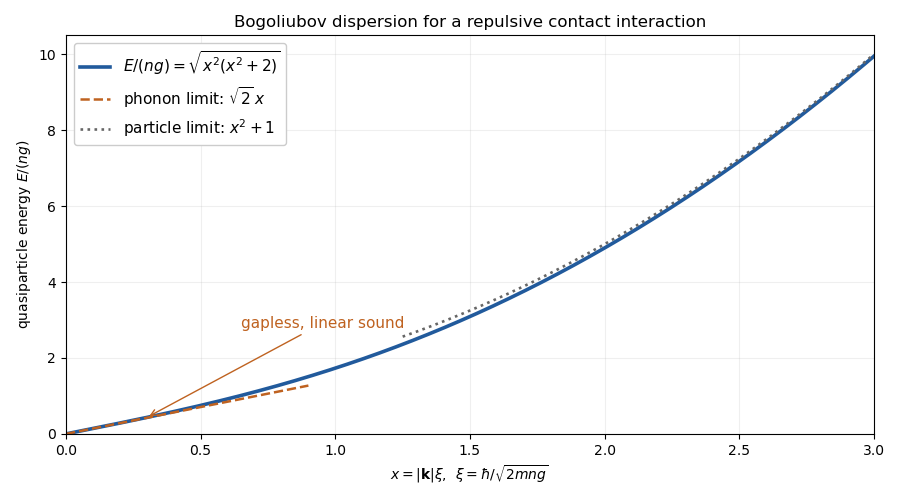
Gapless phonon-to-particle crossover of the Bogoliubov dispersion for a repulsive contact interaction
. Details. 
In the ground state of the diagonal Hamiltonian, . The Bogoliubov transformation therefore gives . Summing all nonzero momenta proves the quantum depletion of a Bose condensate:The nonzero depletion arises from correlated pairs in the interacting quasiparticle vacuum, not thermally populated quasiparticles.
The printed expression is the zero-temperature result. At a nonzero temperature the complete leading-order expression instead hasThe additional term is thermal depletion and cannot be discarded merely because the gas is condensed.
Single-valued rotor wavefunctions are periodic in . The normalized eigenfunctions are with integer , angular momentum and energy . The quantum rotor consequently hasThe nonzero levels have the degeneracy; the ground state is . No twisted boundary condition or applied flux has been introduced.
The propagator is the quantum amplitude for evolving from one angular position to another. It evolves a wavefunction by . The path integral weights each trajectory by , with . Since the configuration space is a circle, paths must include all possible lifts of the final angle to the real line.
Take by Wick rotation. Let , which runs from zero to , and let the dot denote . The dimensionless Euclidean exponent is then . Tracing the kernel identifies final and initial angles modulo , while the lift can change by . Thus the rotor winding-sector path integral isThe integration measure is fixed by the short-time free-rotor kernel. The dot on is essential; it is present in the PDF but lost in the TeX aid.
In sector , separate the stationary winding path from its endpoint-fixed fluctuations:The cross term integrates to . HenceThe Gaussian fluctuation integral is independent of and . Denoting it by , integration over the starting angle givesThe rotor return-kernel fluctuation prefactor is the coincident-point free-particle kernel on the lifted line, or the return amplitude density from zero-net-winding paths. It is not the angular-momentum contribution: winding number and momentum quantum number label different descriptions.
Analytically continue the free-particle return kernel using and . This fixesSet . The Gaussian Fourier integral in Poisson resummation isApplying it to the winding sum gives . The prefactors cancel exactly, , and . Thereforein agreement with the spectral trace. This is momentum-winding duality of the quantum rotor. At low temperature the momentum ground state dominates; at high temperature the winding-zero sector gives .
For smooth phase differences, . After integrating the angular momenta in the same inverse-energy time coordinate , the coupled quantum rotor chain has the fluctuation actionUnit spacing replaces the lattice sum and difference by their continuum limits. The constant energy per bond contributes an overall factor , suppressed when describing fluctuations. The phase is compact; the Gaussian action describes its smooth sector.
There is an imaginary-time normalization for a coupled rotor chain issue in the printed formula. Factoring out from the action above places , not , in its spatial bracket. The printed bracket is therefore correct in units, or with its spatial coefficient redefined as . With the same dimensional as in the Hamiltonian, it lacks that factor.
In physical real time the wave equation is . The harmonic phase mode of a quantum rotor chain consequently hasThe lattice expression is . The mode is a gapless phase wave analogous to sound in a superfluid, with rotor angular momentum conjugate to its phase. In one dimension this harmonic regime has strong long-distance phase fluctuations rather than true continuous-symmetry long-range order; compact phase slips can change the infrared phase outside the smooth-phase approximation.
Let . On a site, empty and doubly occupied states have spin zero, while either singly occupied state has spin . ThusThe on-site spin-square normal-ordering identity rewrites the interaction as . Its contact coefficient is in this parameterization, rather than the convention often used for the Hubbard model.
Using a fermionic coherent-state trace and time slicing, replace each normal-ordered monomial by its Grassmann field symbol. With ,The independent fields have antiperiodic thermal boundary conditions. Normal ordering is crucial: the explicit subtraction removes the spin-square contraction, so there is no extra chemical-potential shift from it.
At , use fermionic Matsubara frequencies . The fermionic Gaussian integral has inverse propagator . With its thermal normalization, the determinant for one single-particle level is , as also follows from its empty and occupied states. Two spin species therefore giveThe expression labeled Helmholtz free energy in the PDF is the grand potential, since the trace contains . The thermodynamic Helmholtz free energy at a prescribed electron number is , with fixed by . The Matsubara determinant requires a normalization prescription; a raw infinite sum of logarithms is not an ordinary convergent sum.
Define and . The Pauli matrix completeness identity, or direct evaluation of its three components, gives . Consequently the quartic action is .
The Hubbard–Stratonovich decoupling follows by completing a three-component square at each site and time slice:The constant is absorbed into the normalized auxiliary-field measure, and ensures convergence of the real Gaussian integral. Thus the spin-vector Hubbard–Stratonovich decoupling yieldsIntegrating out reconstructs the normal-ordered interaction exactly. The auxiliary field is periodic in imaginary time, while the fermionic fields remain antiperiodic.
In the homogeneous spin-field sector, choose . The fermionic levels become , where is the Pauli eigenvalue. The fermionic one-level thermal determinant can be applied independently to every momentum and spin, while the field cost is . Hence the homogeneous spin-field effective action isThe remaining homogeneous-field integral is in this mean-field restriction. Orientation and fluctuation-independent measure factors do not alter the displayed extensive action or its stationary equation. The two bands are exchange split by ; has energy units and is proportional to the spin polarization, rather than being an electron number itself.
Differentiate the homogeneous spin-field effective action:At a stationary field, . Define the spin-summed density of states per lattice site byThen the requested form isThe factor one half fixes the spin convention. With a single-spin density of states , the prefactor would instead be . In terms of site occupations, the same equation is . The Fermi distribution includes the chemical potential in its argument definition; it must not be subtracted a second time.
The spin-independent term cancels in the signed sum. The linearized stationary equation becomesThe even powers vanish because the equation is odd under . Equivalently, the mean-field action has curvatureThus the unpolarized stationary point becomes unstable whenAt low temperature, the derivative of the Fermi distribution samples a narrow window around , so for a smooth density of states. Measuring energy from the Fermi level gives , the Stoner criterion in the spin-summed convention fixed above. This identifies local instability of the paramagnetic state; the detailed transition order also depends on higher terms in the action.
In the isotropic ordered phase of itinerant ferromagnetism, continuous spin-rotation symmetry leaves a degenerate direction of magnetization. Its transverse fluctuations produce one gapless, quadratically dispersing mean-field itinerant ferromagnetic Goldstone mode, . The two broken spin generators form a canonical pair, as for the type-B Goldstone boson of the localized ferromagnet. The system also remains metallic, with exchange-split Fermi surfaces and low-energy spin-conserving particle-hole excitations. Longitudinal-amplitude fluctuations and the spin-flip continuum are distinct from the long-wavelength magnon; their energy and damping scales depend on the band structure. Spin anisotropy, if added, could gap the transverse mode, but it is absent from the stated Hamiltonian.
Articles by others on the same topic
There are currently no matching articles.