For a spherical system, use the spherical shell theorem with shell mass . Inner shells contribute to the gravitational potential, while an outer shell contributes its constant interior potential . With , assuming the required integrals converge,On differentiation, the two terms containing cancel. Hence , where . Radial balance for a circular orbit gives .
For a razor-thin axisymmetric astrophysical disk, the element of mass is , where is the surface density. Superposing Newtonian gravitational potentials therefore givesAxisymmetry permits . Unlike the spherical case, an exterior annulus generally exerts a radial force: enclosed mass does not determine a disc rotation curve.
For the Legendre expansion of thin-disk gravity, split the radial integral at . In the inner part the kernel expands in , while in the outer part it expands in . The angular integrals of odd Legendre polynomials vanish, and those of even degree equal , whereIntroduce and . The gravitational potential becomesWhen differentiating each bracket, the moving-limit terms cancel: and . Since , this givesThe zeroth term has and . Separating it provesThe inner correction is inward, while the exterior correction is outward. For a smooth surface density, the original potential singularity at coincident points is integrable. Its radial force is understood through a symmetric Cauchy principal value or a vanishing-thickness regularization; the paired interior and exterior terms above retain the cancellation at . This avoids treating the two singular local force contributions separately.
For an exponential galactic disk, write , so and . At large , the missing mass and exterior-ring terms are exponentially small. The leading nonspherical interior term is , with and . Consequently the exponential-disk Keplerian asymptotic isThe positive leading correction shows that the rotation curve approaches the Keplerian limit from above. The finite-order large-radius expansion is sufficient here; an infinite moment expansion need not converge for a disk extending to infinity.
A useful special example is the Mestel disk, with surface density for , . It has . For every positive even ,All the nonspherical corrections cancel, givingThus the Mestel disk has a perfectly flat galaxy rotation curve.
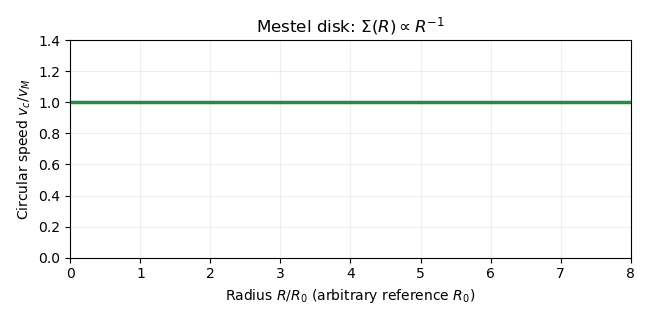

This example has infinite total mass and a singular central surface density. The absolute gravitational potential cannot be set to zero at infinity, but the radial force exists as a limit of disks with increasing outer cutoff. Potential differences are . The earlier potential integral is therefore interpreted up to a radius-independent divergent constant for this example; the force calculation remains valid. Truncating the Mestel disk gives a more physical finite system but changes the exact flat curve near its edges.
Articles by others on the same topic
There are currently no matching articles.