The mapping-out function of a compact H-hull is the unique conformal bijection from onto the complex upper half-plane with hydrodynamic normalization at infinity:The nonnegative coefficient is the half-plane capacity of . The leading coefficient one and constant term zero remove the affine ambiguity of a half-plane map. In the compact H-hull convention, is bounded and relatively closed in , and its complement is a simply connected domain; boundary attachment points can be included in its closure.
We will use these standard properties explicitly: and its inverse extend holomorphically by Schwarz reflection principle across real intervals outside the hull's real attachment region; their real boundary restrictions are strictly increasing; and their normalized Laurent series hold in a full reflected neighbourhood of infinity. In particular, when lies in the unit disc, these extensions exist across and .
Set . The hydrodynamic normalization at infinity givesThe real interval under consideration lies outside the hull, so the reflected boundary map sends it monotonically to . Conformal invariance of planar Brownian motion transports its harmonic measure to the half-plane. By the Poisson kernel for the upper half-plane,The endpoints are fixed and finite. On this interval,uniformly, using and . Integrating gives the interval-length limit:
Compare the hull with the empty hull and the filled unit half-disc . Their mapping-out functions of compact H-hulls are and , the latter also giving the half-plane capacity of a half-disc.
Use one planar Brownian motion started at , with . For , exiting through entails avoiding , while exiting through this interval entails reaching it before exit from the whole half-plane. Thus the tail harmonic measures satisfyFor any of these fixed hulls , the Poisson kernel for the upper half-plane gives the exact tail formulaSubtract from , multiply by , and take the limit. The inequalities reverse, yielding the real boundary bounds:Applying this result to the reflected hull also givesThe comparison is of Brownian exit events, so it does not assume that arbitrary conformal maps are pointwise ordered by domain inclusion.
Write and . We use the real boundary bounds for a unit-disc H-hull from part (c), including their reflected version. SetStrict monotonicity and those bounds give and . The inverse extends across and maps these intervals onto and .
Consider the holomorphic function on . If approaches a real outside , its inverse tends to a real with . Part (c) givesIf , every cluster point of as lies in the closed unit disc. To justify this without a boundary regularity assumption, first note that cannot tend to infinity for bounded , since there. An interior cluster point in would be mapped to the real number , impossible for . A real cluster point with would, by the reflected extension and strict monotonicity, have outside , also impossible. All remaining finite boundary points lie in or in , hence in the unit disc.
It follows for every such thatFinally at infinity, so there. Apply the maximum modulus principle on large upper half-discs, using the boundary limsup just obtained, to conclude everywhere in . Taking proves the sharp displacement bound for a compact H-hull, including irregular hulls:
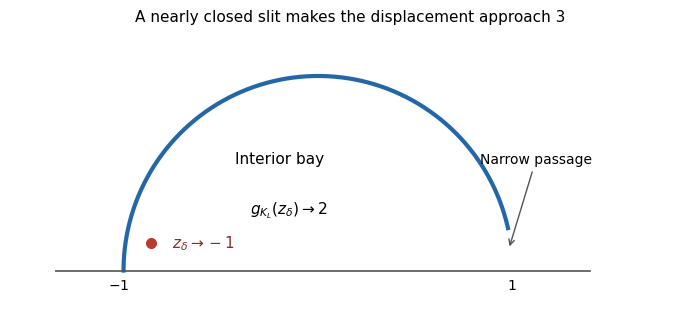
A nearly closed semicircular slit makes the constant sharp. PutThis is the unit-circle arc attached at and ending just short of . Its complement is a simply connected domain. There remains a narrow passage near connecting the interior bay to infinity. Thus is a compact H-hull inside the closed unit disc.
For an explicit check, let and let denote the mapping-out function of a vertical slit applied to , with the branch asymptotic to its argument in the slit half-plane. Its normalized map isThe final Möbius transformation takes the image of the original infinity to infinity and gives hydrodynamic normalization at infinity. For a fixed in the open unit half-disc, , so and as . Now take , with . First let , then let . The nearly closed semicircular slit givesEvery constant smaller than three therefore fails for some member of this family and some interior point. The bound need not be attained at an interior point of a single fixed hull.

Articles by others on the same topic
There are currently no matching articles.