Take the convention that the coordinates of planar Brownian motion are independent standard real Brownian motions, so its infinitesimal generator is . Define the forward conformal Brownian clockSince a conformal bijection has nonzero derivative, is a strictly increasing continuous map from onto . The time used inside the original path is its inverse:Thus the interval direction for is the inverse-clock direction.
Write . The Cauchy-Riemann equations and the Itô formula make continuous local martingales, withIndeed both components are harmonic functions, and their gradients are orthogonal with the same squared norm. After the time change of a continuous process by , their quadratic variations are and their quadratic covariation is zero. The Lévy characterization of multidimensional Brownian motion therefore identifies as planar Brownian motion started at , up to its lifetime.
It remains to identify that lifetime as the exit time, rather than merely produce a local Brownian path. Boundedness of gives almost surely. For every compact subset , its inverse image under is compactly contained in . As , continuity gives , so eventually leaves . Consequently the transformed path leaves every compact subset of at its lifetime. If , its Brownian extension has a finite limit, and that limit is outside ; if , the path never exits. In both cases its maximal lifetime is precisely the exit time from .
A finite original exit time alone does not imply that the integral defining the conformal Brownian clock is finite. To establish this, let . On the event , the Brownian path of part (a) lives forever in , while its inverse clock satisfiesChoose a closed disc compactly contained in . Its radius may be decreased so that on . Recurrence of planar Brownian motion, together with the Strong Markov property, gives infinite total Brownian occupation time in : return repeatedly to a smaller concentric disc, and use the fixed positive probability of remaining in for a fixed positive duration. The successive trials imply infinitely many such durations. This is the same mechanism as the divergence of a positive planar Brownian occupation integral.
Hence, on any infinite-lifetime Brownian path,This contradicts . Thus is finite almost surely, and equality in law from part (a) gives finite exit from a conformal image of a bounded planar domain:This asserts almost-sure finiteness, not finiteness of the expected exit time.
No such conformal bijection exists. A prescribed point is a polar point for planar Brownian motion: a planar Brownian motion started away from zero hits zero with probability zero. For example, inside an annulus the probability of reaching radius before radius isby the harmonic function and the optional stopping theorem. For fixed this tends to zero as . Any finite-time visit to zero would occur before leaving some sufficiently large disc; the countable union over integer still has probability zero.
The exit time from is therefore infinite almost surely, contradicting part (b) if this were the image of a bounded domain. Equivalently, a hypothetical inverse would be bounded and holomorphic. The Riemann removable singularity theorem extends it over zero, and the Liouville theorem makes it constant, contradicting bijectivity.
Use the Green function of killed planar Brownian motion, normalized as the density of expected occupation with respect to area:for nonnegative measurable . Equivalently, , where is the killed Brownian transition density. With generator , the distributional normalization is , and the singularity is plus a locally harmonic function. This fixes the normalization of the Dirichlet Green function explicitly.
By conformal invariance of planar Brownian motion and its conformal Brownian clock,The Jacobian determinant of a conformal map is . Changing the area variable to givesUniqueness of the occupation density proves the desired equality almost everywhere. Both functions are continuous and harmonic away from their pole, so it holds at every . The Green function is conformally invariant:If the Dirichlet Green function is instead normalized for , both kernels are divided by two and the invariance statement is unchanged.
The mapping-out function of a compact H-hull is the unique conformal bijection from onto the complex upper half-plane with hydrodynamic normalization at infinity:The nonnegative coefficient is the half-plane capacity of . The leading coefficient one and constant term zero remove the affine ambiguity of a half-plane map. In the compact H-hull convention, is bounded and relatively closed in , and its complement is a simply connected domain; boundary attachment points can be included in its closure.
We will use these standard properties explicitly: and its inverse extend holomorphically by Schwarz reflection principle across real intervals outside the hull's real attachment region; their real boundary restrictions are strictly increasing; and their normalized Laurent series hold in a full reflected neighbourhood of infinity. In particular, when lies in the unit disc, these extensions exist across and .
Set . The hydrodynamic normalization at infinity givesThe real interval under consideration lies outside the hull, so the reflected boundary map sends it monotonically to . Conformal invariance of planar Brownian motion transports its harmonic measure to the half-plane. By the Poisson kernel for the upper half-plane,The endpoints are fixed and finite. On this interval,uniformly, using and . Integrating gives the interval-length limit:
Compare the hull with the empty hull and the filled unit half-disc . Their mapping-out functions of compact H-hulls are and , the latter also giving the half-plane capacity of a half-disc.
Use one planar Brownian motion started at , with . For , exiting through entails avoiding , while exiting through this interval entails reaching it before exit from the whole half-plane. Thus the tail harmonic measures satisfyFor any of these fixed hulls , the Poisson kernel for the upper half-plane gives the exact tail formulaSubtract from , multiply by , and take the limit. The inequalities reverse, yielding the real boundary bounds:Applying this result to the reflected hull also givesThe comparison is of Brownian exit events, so it does not assume that arbitrary conformal maps are pointwise ordered by domain inclusion.
Write and . We use the real boundary bounds for a unit-disc H-hull from part (c), including their reflected version. SetStrict monotonicity and those bounds give and . The inverse extends across and maps these intervals onto and .
Consider the holomorphic function on . If approaches a real outside , its inverse tends to a real with . Part (c) givesIf , every cluster point of as lies in the closed unit disc. To justify this without a boundary regularity assumption, first note that cannot tend to infinity for bounded , since there. An interior cluster point in would be mapped to the real number , impossible for . A real cluster point with would, by the reflected extension and strict monotonicity, have outside , also impossible. All remaining finite boundary points lie in or in , hence in the unit disc.
It follows for every such thatFinally at infinity, so there. Apply the maximum modulus principle on large upper half-discs, using the boundary limsup just obtained, to conclude everywhere in . Taking proves the sharp displacement bound for a compact H-hull, including irregular hulls:
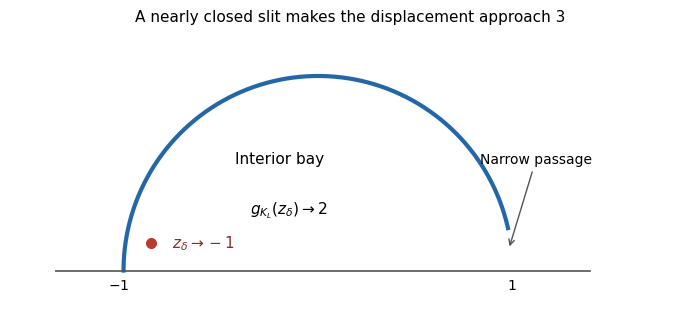
A nearly closed semicircular slit makes the constant sharp. PutThis is the unit-circle arc attached at and ending just short of . Its complement is a simply connected domain. There remains a narrow passage near connecting the interior bay to infinity. Thus is a compact H-hull inside the closed unit disc.
For an explicit check, let and let denote the mapping-out function of a vertical slit applied to , with the branch asymptotic to its argument in the slit half-plane. Its normalized map isThe final Möbius transformation takes the image of the original infinity to infinity and gives hydrodynamic normalization at infinity. For a fixed in the open unit half-disc, , so and as . Now take , with . First let , then let . The nearly closed semicircular slit givesEvery constant smaller than three therefore fails for some member of this family and some interior point. The bound need not be attained at an interior point of a single fixed hull.

In the half-plane-capacity parameterization, let be standard real Brownian motion and put . Solve the Chordal Loewner equationThe points for which this flow ceases to exist form the growing compact H-hulls , with half-plane capacity . The process is an SLE trace when its initial segments generate these hulls andThe limit is the continuous trace of a Loewner chain started at zero. If the curve disconnects a region from infinity, that region is included in ; the hull is not generally just the visited curve. For the driver is identically zero and the trace is the deterministic vertical slit .
Use the following deterministic boundary fact from the Chordal Loewner equation. For a continuous trace of a Loewner chain started at zero and generating its hulls, the real flow at has a boundary swallowing time . Until that time it is the reflected boundary value of , andA finite is its first collision with the driver, as . Topologically, the boundary point is then visited or separated from infinity precisely when the trace has reached some point in . A boundary crosscut can swallow an interval, so this is not a claim that the trace visits the particular point .
Consequently the SLE boundary swallowing criterion isFor the SLE driver this real flow obeysup to its first hit of zero. This is the Boundary-point Bessel flow for SLE.
For , divide the Boundary-point Bessel flow for SLE by and replace by . The resulting Bessel process has dimensionsince its drift is . The Hitting-zero classification for a Bessel process suggests the threshold , or . Here is a direct verification including accessibility in finite time.
The infinitesimal generator of is . An increasing scale function of a one-dimensional diffusion isIt satisfies . For , the boundary hitting probability from a diffusion scale function, or optional stopping theorem applied to , givesFor , , so this probability tends to zero as . A finite zero hit has a bounded path before the hit and hence precedes for some integer ; taking a countable union proves that zero is never hit.
For , write . Taking the inner boundary to zero gives . This limit really concerns a finite zero hit: the Itô formula givesStopped on , it impliesuniformly in . The increasing limit of these exit times is finite almost surely; the stopped squared process has a continuous extension, so its limiting lower endpoint is zero. ThusLet to obtain . When , the explicit solution is , which stays positive.
Combining this with the SLE boundary swallowing criterion gives the critical parameter and the two regimes:
For , each event has probability zero by part (c). Every positive real point lies in one of these intervals. The countable union therefore has probability zero, proving simultaneous avoidance of the entire positive real axis:For , every event has probability one. Their countable intersection still has probability one. On that event the set of positive real points visited contains a point at least for every integer , so the visited positive boundary set is unbounded:This uses countably many SLE boundary swallowing criteria; no intersection over an uncountable family of probability-one events is needed.
At , the Boundary-point Bessel flow for SLE has dimension two. Its scale function of a one-dimensional diffusion is , givingThe same bounded-path and countable-union argument as in part (c) excludes a finite zero hit. Hence the critical case belongs to the boundary-avoiding regime:The countable argument of part (d) gives no visits to any positive real point almost surely. By Reflection invariance of Brownian motion, reflected SLE has the same law, so no negative real point is visited either. Thus the set of real points visited is exactly . Recurrence of a two-dimensional Bessel process near zero does not mean that it hits zero.
A conformal automorphism of the upper half-plane is a real Möbius transformationwith coefficients determined up to a common nonzero factor. The boundary interval is the oriented real boundary arc from infinity to , namely the finite real interval . The map must take the left endpoint to infinity and the right endpoint infinity to , while fixing zero. These three boundary values determine the Möbius transformation uniquely:Its determinant is positive, , and on its derivative is . Its endpoint limits are at and at , so it has exactly the required boundary extension.
The scale is precisely the inverse conformal map:By definition, a chordal SLE in a specified scale in is a curve whose image under is the half-plane-capacity-parameterized SLE from zero to infinity. Hereand the right-hand side is the given . Equivalently, this is Conformal invariance of SLE, with the target point transported from infinity to . Thus is in in scale , using the original parameter . This scaled parameter is distinguished from the ordinary half-plane-capacity parameterization of its image hulls used next.
Put and . The given conformal change of half-plane capacity makes the image mapping-out equationIndeed its capacity speed is , and the stated Loewner local growth property identifies the indicated single driver. For , differentiate the conjugacy identityat a fixed original point. The Chordal Loewner equation then gives the conformal conjugacy derivative for the chordal Loewner equationThe change of variable covers the whole upper half-plane. The conformal automorphism of the upper half-plane is a real Möbius transformation. Its pole is the image of the still-unswallowed boundary point , so it is holomorphic in a neighbourhood of before .
To evaluate the apparent singularity, write , and . The Taylor series isThus the first term in the derivative is , while the second is . Their poles cancel and their constant terms differ by . Therefore
For the SLE driver , apply the Itô formula to . At a fixed spatial point, has finite variation locally in time by the derivative formula in part (c); there is no extra spatial martingale term. ConsequentlyThis exact cancellation is the target-change locality of SLE6. For a general parameter the transformed SLE driving function would have drift .
Define the increasing clock and its inverse byThe derivative is real and strictly positive before , so this is a valid continuous time change of a continuous process. The driver is a continuous local martingale with quadratic variation and initial value zero. The Dambis-Dubins-Schwarz theorem gives a standard Brownian motion such thatIf the terminal clock is finite, the Brownian motion may be extended beyond that stopping time; only its stopped part is used here. Reparameterizing the image maps givesThese are exactly the defining Chordal Loewner equation and half-plane-capacity parameterization for . The trace is . Hence the image curve is also ordinary chordal after this time change, up to the specified stopping time:
Articles by others on the same topic
There are currently no matching articles.