The initial table of content was limited to the first level because it is larger than 1000 articles. There are 2027 articles in total. Expand a branch to load its children.
The Laurent polynomial ring is a localization of a ring:The Hilbert basis theorem makes a Noetherian ring, and Localization of a Noetherian ring preserves this property. Thus .
For separating finite Laurent support by an integer weight, take a nonzero Laurent polynomial and let be its finite set of exponent pairs with nonzero coefficients. Choose an integer such thatwhere the maximum is zero if has only one member. Set . If , thenso and then . Consequently all powers of in are distinct. The linear independence of the Laurent monomials prevents cancellation, givingThe choice depends on the finite support of ; a single fixed substitution need not detect every nonzero element.
For Noetherianity of subalgebras of a one-variable Laurent polynomial ring, let be a unital -subalgebra of . If , it is already a Noetherian ring. Otherwise we find a nonconstant and an ambient ring containing such that is a finitely generated module over .
If , choose a nonconstant polynomial in , where . Then is an integral element over , since it satisfies the monic polynomial equationThus is a finitely generated module over , generated by . The case is identical after replacing by .
In the remaining case is contained in neither of these two polynomial rings. There is an element with a positive exponent and an element with a negative exponent. If either already has both, use it as . Otherwise their sum has both, since the positive powers of the first and the negative powers of the second cannot cancel. We obtainMultiplying this identity by gives a polynomial equation for with leading coefficient :Dividing by makes it monic. Similarly, multiplication by gives a monic equation for after division by . Both generators are therefore integral elements over , so is a finitely generated module over .
In all three cases is a Noetherian ring, as a quotient of a one-variable polynomial ring. The subalgebra is also a -submodule, so it is a Noetherian module. Every ideal of is a -submodule of and is therefore finitely generated over , hence over . This proves
For the final request, take the following subalgebra of the two-variable Laurent polynomial ring:Let , an ideal of . We haveas -vector spaces. In particular, the classes of , for , are linearly independent. If had finitely many generators as an -module, their classes would span over , contradicting its infinite dimension. Hence is not finitely generated and is not a Noetherian ring. This illustrates why the preceding result is special to one Laurent variable.
The Weak Hilbert Nullstellensatz states that if is an algebraically closed field, every maximal ideal of isEquivalently, every proper ideal has a common zero. We prove the more general field statement, the Zariski lemma: a field finitely generated as a -algebra is a finite field extension of .
Write such a field as . Choose a maximal set of algebraically independent elements among these generators and denote the remaining generators by . Each is an algebraic element over , so is a finite field extension. Clearing the denominators in their monic equations, choose a nonzero such that each is an integral element overBecause is a field and , we have . Thus is an integral extension of .
A subring over which a field is integral must itself be a field. Indeed, for , an integral equation for multiplied by expresses as an element of . But if , the ring is not a field: choose an irreducible polynomial which does not divide . There are infinitely many monic irreducible polynomials in , by the usual product-plus-one argument, whereas only finitely many can divide the nonzero . The prime ideal stays proper after inverting , so has no inverse in . Therefore , proving that is a finite field extension, and in particular an algebraic field extension.
Apply the Zariski lemma to the residue field of a maximal ideal. When is an algebraically closed field, this field is itself. The images of then give , proving the Weak Hilbert Nullstellensatz.
For the real Laurent polynomial ring, the same argument applies because it is the finitely generated algebraEvery residue field at a maximal ideal is consequently a finite field extension of , and so is or . Here we use the fundamental theorem of algebra, which makes the algebraic closure of of degree two. The images of must be nonzero since these elements are units. It follows that the answer iswith and defining the same maximal ideal. If both coordinates are real, evaluation has image ; otherwise its image is . Thus every displayed kernel is maximal, and the Zariski lemma shows that this list is exhaustive.
For explicit generating sets of an ideal, there are three cases. For real nonzero ,If and with ,If with and , thenThe last two quotients are ; the nonzero coordinate condition ensures that the Laurent inverses exist in them. There are no further coincidences in the classification: equal kernels induce an -isomorphism between the evaluation image fields. The only -automorphisms of are the identity and complex conjugation, so the two pairs must agree or be conjugate.
To prove the intersection assertion, fix a prime ideal and an element . The integral domain has nonzero image . Its localization of a ring is nonzero and still a finitely generated algebra over , so it has a maximal ideal . By the Zariski lemma, the field is finite over .
The image of in is a subring containing and is a finite-dimensional -vector space. It is an integral domain, hence a field: multiplication by any nonzero element is an injective linear map of a finite-dimensional vector space and therefore surjective. The kernel of is thus a maximal ideal which avoids , since is invertible in . Its inverse image in is a maximal ideal containing but avoiding . As this works for every ,This is the Jacobson ring property for this Laurent polynomial ring.
For a nonzero finitely generated module , its set of associated primes isHere is the annihilator of the element. The Laurent polynomial ring is a Noetherian ring, so the nonempty collection of annihilators of nonzero elements of has a maximal member, say . It is proper because .
If and , then andMaximality forces , hence . Thus is a prime ideal, proving . This argument in fact only needs that is Noetherian, not the finite generation of .
A proper ideal is -primary when its radical of an ideal is andEquivalently, and imply ; equivalently, every zero divisor of is nilpotent. These formulations distinguish the actual primary ideal property from the weaker assertion that there is only one minimal prime ideal.
For the final example, set and . ThenSince is an integral domain, is a prime ideal. Moreover and , so . Consequently is the unique minimal prime ideal over .
Nevertheless , while and no power of belongs to . For the first assertion, reduce modulo : the image of is in , and is not a multiple of because is a nonunit in this integral domain. For the second, , so for every . Thus is not a -primary ideal: a unique minimal prime does not imply primary. In , the nonzero class of is killed by , a zero divisor which is not nilpotent.
Put and . Evaluation at is surjective, andso its kernel is the prime ideal . In particular is naturally an -module, generated by the classes of .
For integers , including negative integers, reduction modulo givesFor negative powers, this follows from and ; the mixed product vanishes modulo . Therefore a Laurent polynomial satisfiesThe formal derivatives obey the product rule, so . If , both terms vanish. Hence both vanish on and define a mapIt sends to and to , and the displayed expansion gives its inverse. Thus the conormal module has the explicit basis
Let be the localization at a prime ideal, with maximal ideal . Every nonzero integer lies outside and is therefore inverted. The residue field isIndeed there is an explicit identificationinverting and has no effect in this local ring, and a polynomial denominator lies outside precisely when its constant term is nonzero. Conversely, clearing rational denominators turns every such fraction into a fraction from .
For the Krull dimension, the prime ideal correspondence for localization preserves the strict chainof prime ideals in . They are prime because the successive quotients are the integral domains , , and . They remain distinct after localization at a prime ideal because they are all contained in . Hence .
For the upper bound, is a Noetherian ring by the Hilbert basis theorem and Localization of a Noetherian ring. Since is generated by two elements, the Krull height theorem gives . The prime ideal correspondence for localization identifies with , so
A Noetherian local ring with residue field is a regular local ring ifBy the Nakayama lemma, the dimension on the left is the minimal number of generators of ; this is also called the embedding dimension.
The localization of a module is exact and commutes with quotients and products of ideals. Applying it to the already computed conormal module gives the cotangent space of a local ringIts dimension is two, equal to . Therefore . Notice that has a basis over , whereas the localized cotangent space of a local ring has a basis over the residue field .
An integral domain is an integrally closed domain if every element of its fraction field which is an integral element over belongs to . Explicitly, if satisfiesthen . Thus .
Suppose is a unique factorization domain and is integral, with , , and with no common irreducible element as a factor. Multiplying its monic equation by givesHence divides . Every irreducible element dividing is a prime element, so it would divide , contrary to the choice of the fraction. Therefore is a unit, and . We have proved
The going-down theorem is the following. Let be an integral extension of integral domains with an integrally closed domain. IfthenWe first prove this for a module-finite ring extension and then remove that extra hypothesis. We use the Lying-over theorem, the going-up theorem, and the incomparability theorem for integral extensions: primes exist over every base prime, prime chains can be extended upwards, and distinct primes over the same base prime cannot contain one another. The going-up theorem follows by applying the Lying-over theorem to the quotient by the lower prime. These results concern arbitrary integral extensions; none assumes the going-down theorem.
For the finite case, let and . Since is module-finite, is a finite field extension. Take a finite normal field extension containing , obtained as a splitting field of the minimal polynomials of finitely many field generators. The extension need not be a separable field extension. Let be the integral closure of in . Then , and is integral over both and .
We need one auxiliary fact: the finite group acts transitively on the prime ideals of over any fixed prime ideal of . First observe that an element fixed by all of is a purely inseparable algebraic element over . Indeed, all -embeddings of into an algebraic closure extend to -automorphisms of the normal field extension . Hence the minimal polynomial of an algebraic element has only one distinct root. In characteristic zero this says ; in characteristic it says for some .
Now let be primes of over , and suppose is different from every , . By the incomparability theorem for integral extensions, is contained in none of these conjugate primes. The prime avoidance lemma suppliesThe productis fixed by , is integral over , and lies in because one factor is . Choose an exponent equal to in characteristic zero, or a power of in characteristic , such that . Since is an integrally closed domain, . It also lies in , hence in . Because is a prime ideal, some factor lies in . This means , contradicting our choice. Thus for some , proving transitivity. The power accounts for the possible purely inseparable field extension and makes the argument valid in every characteristic.
Lift the prescribed to a prime of by the Lying-over theorem for . Separately, choose a prime over and use the going-up theorem to find over . Transitivity gives with . ThenContracting to gives with the required contraction. This proves the going-down theorem for the module-finite case.
For a general integral extension , consider and the idealWe claim that is disjoint from . Otherwise, clearing the finitely many denominators in an expression for an element givesThe subalgebra is a module-finite ring extension of , since all its generators are integral elements. Apply the finite case to : there is a prime contracting to . The displayed identity puts in , but . Thus , a contradiction.
Localize further at the multiplicative subset . The extension of is a proper ideal, by the disjointness just proved. Choose a maximal ideal containing it and contract back to a prime ideal of . This prime contains and avoids . Its contraction to lies inside by the prime ideal correspondence for localization, and its contraction to is exactly . This completes the proof of the going-down theorem without any finite generation assumption on .
The Artin-Rees lemma states that, for a Noetherian ring , an ideal , a finitely generated module , and a submodule , there is such thatThus the filtration on induced from the I-adic filtration of is eventually determined by one of its terms.
For the proof, form the Rees ring and its Rees module:Since is a Noetherian ring, write . Then , so it is a Noetherian ring by the Hilbert basis theorem. Generators of in degree zero generate as a module over , so this is a Noetherian module.
The graded submoduleis therefore finitely generated. Choose homogeneous generators with for some . For , taking degree- components givesThe same generators show that the final sum is exactly . This proves the Artin-Rees lemma. If , one may simply take .
Now letIt is a submodule of the Noetherian module , hence a finitely generated module. Apply the Artin-Rees lemma with and . Since is contained in every (including ), its conclusion reduces toWrite generators as . There is a matrix with entries in such that . Multiplication by the adjugate of shows thatThe determinant is congruent to modulo , so it is for some . This determinant trick produces a single such element annihilating all of , and in particular annihilating each . If , use .
Conversely, if with , then . Iterating gives for every . Hence the exact description isIn a local ring with contained in the maximal ideal, every is a unit, so this also yields the usual vanishing form of the Krull intersection theorem.
For a failure without the Noetherian ring hypothesis, let and use the semigroup algebraIts elements are finite sums of formal monomials , with multiplication . Each ring in the union is a polynomial ring and the inclusions are injective, so is an integral domain. It is not a Noetherian ring, sinceIndeed the generator on the left is the square of the next generator, while division in the opposite direction would require a negative exponent, which is unavailable in .
Let be the ideal of elements with zero constant term, equivalentlyIt is proper because taking the constant term gives . Every generator is , with , so . Thus this is a nonzero idempotent ideal, with for every . TakeFor every , the constant term of is , so . Since is an integral domain and , we have . This gives all three requested objects and proves that no element of the required form annihilates .
For a finitely generated module over the graded ring , with each of degree one, its Poincare series of a graded module isThis is also its Hilbert series. One usually takes ; allowing an integer grading also permits finitely many negative degrees. Homogeneous generators of degrees give a surjection , where the graded shift is defined by . Consequently every is a finite-dimensional vector space and for all sufficiently negative .
The Hilbert-Serre theorem in the standard grading saysFor a nonnegatively graded , the numerator is in . Equivalently, the only possible pole of this rational expression is at , with order at most .
We prove the Hilbert-Serre theorem by induction on the number of variables. For , and is a finite-dimensional graded module; thus is a Laurent polynomial. Suppose and putThe Hilbert basis theorem makes a Noetherian ring, so is a finitely generated module, as is . Both are graded modules killed by , hence finitely generated over .
The graded exact sequenceidentifies the kernel and cokernel of multiplication by . Taking the alternating sum of the finite-dimensional degree components yieldssoBy induction the right side has denominator , which proves the required denominator . Since has no negative powers when is nonnegatively graded, its Laurent polynomial numerator is an ordinary polynomial in that case.
For , this also implies the usual Hilbert polynomial consequence. Writing and usinggives, for all sufficiently large ,a polynomial in of degree at most . For , the graded pieces are eventually zero.
For the final request, a free resolution of is an exact sequencewith each a free module. In the graded setting we take finite direct sums of shifts and maps preserving degree. The resolution has length at most if for every . The syzygy modules are the successive kernels which record the relations among generators, then relations among those relations, and so on.
Put , the homogeneous maximal ideal with . Choose a homogeneous -basis of and lift it to . These lifts generate by the graded Nakayama lemma: a bounded-below graded module satisfying must be zero, since a nonzero homogeneous element of least degree could not be a sum of variables times elements of lower degrees. Apply this to the quotient by the submodule generated by the chosen lifts. This gives a surjection inducing an isomorphism modulo .
Its kernel is finitely generated because is a Noetherian ring. Repeat the construction for that kernel, then for each subsequent kernel. We obtain a minimal graded free resolution, meaningIndeed, at each stage the free cover induces an isomorphism modulo , so its kernel lies in times its source. The sequence is exact by construction, though it may at first appear infinite.
The Koszul complex on iswith basis vectors given degree one, and differentialThe hat means omission of that factor. Every pair of terms in cancels with opposite signs, so this is a chain complex. The sequence is a regular sequence: after quotienting by the first variables, the next variable is a non-zero-divisor in the remaining polynomial ring.
The Koszul complex is consequently exact in positive degrees and has , so it is a Koszul resolution of of length . For completeness, one proves this by induction: for one variable it is . Appending constructs the mapping cone of multiplication by on the previous chain complex. Its homology is zero in positive degrees because acts injectively on ; its degree-zero homology is the further quotient. Here a mapping cone combines a chain complex with a shifted copy and adds the given multiplication map to the differential, thereby measuring its kernel and cokernel on homology.
The Tor functor is defined as the degree- homology of for a free resolution of . It can equally be computed as the homology of , using the Koszul resolution of . To see the equality, form the double complex . Taking homology first along leaves , since each is a free module; taking homology first along leaves , since each is free. The finite sums along each total degree identify both with the homology of the total complex. This also explains the symmetry used in computing the Tor functor.
Since for , we have for . On the other hand, all differentials of the minimal graded free resolution become zero after tensoring with , soThus for , and the graded Nakayama lemma implies for those . We have proved the required Hilbert syzygy theorem:where some initial may be zero. The argument supplies finitely generated graded free modules, which is stronger than merely giving an ungraded free resolution.
Over the complex numbers, every finite-dimensional representation of a solvable Lie algebra has a basis in which every representing matrix is upper triangular. The Lie theorem is often stated first as the existence of a common eigenvector in every nonzero finite-dimensional Lie algebra representation of a solvable Lie algebra. Applying that assertion successively to quotient representations gives an invariant complete flag, and hence the upper triangular form. The same proof works over any algebraically closed field of characteristic zero.
We prove the common eigenvector assertion by induction on , writing the action as . The zero Lie algebra is immediate. If is solvable, its derived series of a Lie algebra shows that . Choose a codimension-one ideal of a Lie algebra containing , and choose . By induction there are and a linear functional such that for all .
Let be the span of . If , the first of these vectors form a basis, and is -invariant. We claim that for each ,For this is the definition of . For the induction step, use and . Applying the induction hypothesis to both and proves the claim. Consequently is -invariant, and every acts on by an upper triangular matrix with all diagonal entries .
Since both and preserve , the matrix trace of their commutator on is zero. The claim applied to givesHere characteristic zero is essential: in the field, so . Now the common weight spaceis nonzero and -invariant. Indeed, for ,An endomorphism of a nonzero finite-dimensional complex vector space has an eigenvector, so choose an eigenvector of in . It is a common eigenvector for . This proves the Lie theorem.
For the printed matrices in characteristic , , and there is no common eigenvector. Index the standard basis by . The cyclic entry in the PDF givesThe diagonal eigenvalues of are distinct in . Thus every eigenvector of is a scalar multiple of a single . Since , is never a scalar multiple of , proving the assertion even when is not an algebraically closed field.
For ,At the cyclic boundary,Hence . The two-dimensional Lie subalgebra has derived algebra , whose own derived algebra is zero, so it is solvable. It nevertheless has no common eigenvector, including after extending to its algebraic closure. This is a failure of Lie theorem in positive characteristic. In the proof above, the obstruction is precisely that can vanish as a scalar in .
The derived algebra of a complex solvable Lie algebra is nilpotent. First suppose . By the Lie theorem, put every element of in upper triangular form. The diagonal of a commutator of upper triangular matrices is zero, so consists of strictly upper triangular matrices. The Lie algebra of all such matrices is a nilpotent Lie algebra: if consists of matrices whose entries vanish whenever , thenTherefore the lower central series of a Lie algebra of reaches zero. Alternatively, every element of is a nilpotent linear map, and the Engel theorem states that a finite-dimensional Lie subalgebra consisting of nilpotent linear maps is a nilpotent Lie algebra.
For an abstract complex solvable Lie algebra , apply the preceding result to its Adjoint representation. The Lie algebra is nilpotent. Since is central in , some term of the lower central series of a Lie algebra of lies in that central ideal; the next term is zero. Thus itself is nilpotent.
Conversely, every nilpotent Lie algebra is solvable, since its derived series of a Lie algebra is contained term by term in its lower central series of a Lie algebra. If is nilpotent, it is therefore solvable, and is Abelian. More directly, the derived series of a Lie algebra of , after its first term, is the derived series of a Lie algebra of . Consequently the derived algebra nilpotence criterion is
The form attached to is . More generally, for a Lie algebra representation , the Trace form of a Lie algebra representation isThe unqualified Killing form is the special case of the Adjoint representation,The distinction matters: a Trace form of a Lie algebra representation can be degenerate even when is semisimple, for example on the trivial Lie algebra representation.
The Trace form of a Lie algebra representation is bilinear and symmetric, because . It is an invariant bilinear form on a Lie algebra:This follows by expanding both commutators and cyclically permuting factors under the matrix trace. Equivalently,Its radical of a bilinear form is an ideal of a Lie algebra, since if , then . The Killing form is also preserved by every automorphism of a Lie algebra, because the corresponding adjoint operators are conjugate. On a complex finite-dimensional Lie algebra, the Cartan criterion for semisimplicity says that the Killing form is nondegenerate exactly when the Lie algebra is semisimple. The Cartan solvability criterion says that is solvable exactly when .
We next construct the sl2 subalgebra associated with a root. Use the root-space decompositionFor , , invariance of the Killing form givesThus unless , and for nonzero . Nondegeneracy of on now implies that is a root and that pairs and nondegenerately.
Nondegeneracy of defines a unique byChoose and with . Their Lie bracket lies in the zero root space, namely , andTherefore .
The essential nonisotropic root lemma is that . Suppose instead that it vanished. Then , so would be a solvable Lie algebra with derived algebra . Apply the Lie theorem to its action on by the Adjoint representation. The commutator is strictly upper triangular in a suitable basis, hence nilpotent. But , so the root-space decomposition makes diagonalizable. A diagonalizable nilpotent linear map is zero. Thus is central in . The center of a Lie algebra of a semisimple Lie algebra is zero; equivalently a central element lies in the radical of the Killing form. This forces , contradicting .
Writing , defineThe root-space decomposition and giveThe three vectors are linearly independent because they lie in the distinct summands , , and . Their span is therefore a copy of the sl2 Lie algebra.
The weight lattice consists of the functionals integral on all coroots. With the coroot above, the weight lattice iswhere the fundamental weights satisfy for the simple roots . Here lies in the real span of the roots, viewed inside .
The classification of finite-dimensional sl2 representations says that every finite-dimensional complex sl2 Lie algebra representation is a direct sum of irreducibles , , on which the standard has eigenvalues . Restrict any finite-dimensional Lie algebra representation of to each sl2 subalgebra associated with a root. If has weight , then , so is an integer. Thus every weight lies in . The same restrictions show that the commuting simple coroots act diagonalizably, justifying the simultaneous weight-space decomposition.
For , the roots are , , and . Work on with the alternating bilinear form having matrixThe symplectic Lie algebra isUsing the matrix units , take the Cartan subalgebraDefine . A regular diagonal element of has centralizer precisely , and every element of acts diagonalizably. Thus it is a Cartan subalgebra. The requested Cartan decomposition is the root-space decompositionChoose positive roots , , , . The symplectic root sl2 triple are given explicitly byFor the negative root spaces, use the corresponding . These eight root vectors, together with , form a basis: the block description above has dimension , and the ten listed vectors are independent. Finally, the matrix unit identityverifies for every row. The diagonal differences verify and . Thus each row supplies a basis of the required sl2 subalgebra associated with a root.
Schur's lemma says that a nonzero intertwiner between irreducible representations is an isomorphism; over , every endomorphism of a finite-dimensional irreducible representation is scalar. To prove the Schur lemma, let be a intertwining operator between irreducible representations. Its kernel and image of a linear map are invariant. If , irreducibility forces and . This proves the first assertion over any field. In particular the endomorphisms of an irreducible representation form a division ring.
When is finite-dimensional over an algebraically closed field, an endomorphism has an eigenvalue . The endomorphism has nonzero kernel. By the first assertion it must be zero, so . Consequently, for complex finite-dimensional irreducible representations, the space of intertwining operators has dimension zero for nonisomorphic representations and dimension one for isomorphic representations.
Every finite-dimensional representation of a complex semisimple Lie algebra is completely reducible. We prove the Weyl complete reducibility theorem using the allowed Casimir operator facts, without assuming a splitting in advance. For dual bases with respect to the Killing form, the Casimir elementis central in the universal enveloping algebra. Hence its Casimir operator commutes with the action on every Lie algebra representation and is compatible with subrepresentations, quotient representations, and intertwining operators. On the trivial Lie algebra representation it acts by zero. On every nontrivial finite-dimensional Irreducible Lie algebra representation it acts by a nonzero scalar.
For clarity, the last fact can be expressed by the Casimir eigenvalue formula: on an irreducible with dominant integral weight , the scalar is , with the inner product induced by the Killing form and the half-sum of positive roots. On the real span of the weights this inner product is positive definite, and the scalar is positive for . For a semisimple Lie algebra with several simple factors the scalars add, so a nontrivial representation still gives a nonzero scalar. These are properties of the Casimir operator being used here.
First establish Casimir splitting of a trivial quotient. Supposeis a short exact sequence of finite-dimensional Lie algebra representations, with trivial quotient. The generalized eigenspaces of are invariant, soEach with maps to zero under : applying a sufficiently large power of and using gives . Thus .
Take a composition series of a module of . The Casimir operator is nilpotent on , so its scalar on every irreducible composition factor is zero. The stated Casimir operator property makes every such factor trivial. In a basis adapted to the composition series of a module, the image of on therefore consists of strictly upper triangular matrices, so that image is solvable. The allowed fact that a semisimple Lie algebra acts trivially on every one-dimensional representation implies that is a perfect Lie algebra: otherwise a nonzero linear functional on would define a nontrivial one-dimensional Lie algebra representation. Thus , and its image is consequently a perfect Lie algebra too. A perfect Lie algebra that is also a solvable Lie algebra is zero, since its derived series of a Lie algebra is constant until it vanishes. Hence acts trivially on . Choose with . The map is an invariant section, proving the split short exact sequence assertion.
Now let be any nonzero subrepresentation. On the Hom representation the action isConsider the invariant subspaceRestriction produces a short exact sequenceSurjectivity follows by extending to a linear map on . The quotient is trivial, because commutes with the action on . The preceding Casimir splitting of a trivial quotient yields an invariant with . Thusand is invariant. The zero subrepresentation also has a complement. Repeatedly splitting off an irreducible subrepresentation now gives a direct sum of irreducibles, proving the Weyl complete reducibility theorem.
A derivation of a Lie algebra is a linear map satisfying the Leibniz ruleThe space is a vector subspace of . Equip it with the commutator . Expanding the Leibniz rule twice givesSubtracting proves that is again a derivation of a Lie algebra. Antisymmetry and the Jacobi identity hold for the commutator in every associative endomorphism algebra, so this defines the derivation Lie algebra.
The Jacobi identity says that is a derivation of a Lie algebra. Moreover, for ,soThis makes an ideal of a Lie algebra in .
Finally suppose is semisimple. Let act on by . The Weyl complete reducibility theorem supplies an invariant complement to . For , invariance gives , while the ideal identity above gives . Their intersection is zero, so for every . The center of a Lie algebra of a semisimple Lie algebra is zero, hence for every , and . ThereforeEvery derivation of a Lie algebra is inner, and the element giving it is unique because the center of a Lie algebra vanishes.
Start with the tensor product of Lie algebra representations, whose action isWriting , the two tensor factors commute, so . This verifies the Lie algebra representation identity over every field.
The exterior square and symmetric square are the quotient vector spacesIn the exterior square, expanding shows that , including in characteristic two. Both defining relation spaces are invariant under the tensor product action: is an exterior relation, and the image of a symmetric relation is a sum of symmetric relations. Thus the quotient actions are well-defined and satisfyFor the printed basis , bases are with and with . Their dimensions are and respectively.
If is invertible in , as representations. Define the flip . It commutes with the Lie algebra action and satisfies . Thereforeare complementary invariant linear projections. The mapsidentify with and with . Their inverses are the corresponding quotient maps restricted to these subspaces. This proves the assertion for every field of odd characteristic, and also for characteristic zero.
Over every field, . The symmetric square of a direct sum isomorphism sends the first two summands into products within and within , and sends to the mixed product . If and are bases, the monomial basis of is the disjoint unionThus the map is bijective, with no division by needed. The Leibniz rule for the action preserves each of these three summands and agrees with its usual Lie algebra representation action, proving equivariance.
For , is trivial and has dimension . HenceIt remains to find the irreducible representations in the symmetric square of the sl3 representation of highest weight (2,1). We give the formal character calculation explicitly.
Let be the defining special linear Lie algebra representation. In Dynkin labels, its weights are , , and ; the dual representation has their negatives. The equivariant contractionis surjective. Its kernel has dimension . The tensor is a highest-weight vector of highest weight in that kernel. By the Weyl complete reducibility theorem, the kernel contains the irreducible representation , whose Weyl dimension formula gives dimension ; therefore the kernel equals . This yieldsMultiplying the six weights of by the three weights of and subtracting those of gives the following full weight multiplicity list:The multiplicities sum to .
For any finite-dimensional weight-space decomposition, a weight of multiplicity contributes to weight in its symmetric square. Distinct weights contribute to . Equivalently,Applying this to the displayed list gives all dominant weight multiplicities in the second column below. The remaining columns are the weight multiplicities of the candidate irreducible representations:For an explicit way to compute each irreducible column, set and use the Weyl character formula in the formA monomial has Dynkin labels . Equivalently, the quotient is enumerated by Semistandard Young tableaux of shape with entries , weakly increasing across rows and strictly increasing down columns; the exponents count the three entries.
The five irreducible columns sum to the column. These are all its dominant weights, and all five candidate characters have no other dominant weights. Every Weyl group orbit meets the dominant chamber, and weight multiplicities are constant on Weyl group orbits. Thus the table proves equality of the full formal characters, and the Weyl complete reducibility theorem givesThe Weyl dimension formula checks the result:Consequently the requested decomposition isIts total dimension is .
An abstract root system, in the reduced crystallographic convention, is a finite subset of a finite-dimensional real Euclidean space satisfying the following conditions:
- and spans .
- For each , ; this is the reduced condition.
- The root reflection preserves .
- Every Cartan integer is an integer.
The root system is irreducible if it is not a union of two nonempty mutually orthogonal root systems. The integrality condition is essential for the finite angle list below; arbitrary finite reflection systems need not satisfy it.
The possible angles are , , , , , , , , and . For roots , putBoth are integers, they have the same sign when nonzero, andIf the roots are linearly independent, strict Cauchy-Schwarz inequality gives . Hence . These values give, respectively,For the last column, the possible absolute pairs are , , and , up to interchange, and . Parallel roots are equal or opposite by reducedness, giving or . Thus the list is exhaustive, and the rank-two root systems realize each nonparallel possibility.
Now suppose two simple roots have angle . Distinct simple roots have nonpositive inner product. Here is a proof from their defining sign property: if , then with a positive Cartan integer . This would be a root whose coefficients in the root basis include both a positive and a negative coefficient, which is impossible. Therefore, after normalizing the simple roots to unit length, any nonzero off-diagonal inner product is at most , by the angle list.
Let , , so . If there were a third simple root with unit vector , write and . Independence of the simple roots makes their Gram matrix positive definite, soIf either or were nonzero, its absolute value would be at least . Since , the displayed determinant would then be nonpositive. Thus . Every other simple root is orthogonal to both and : a triple bond isolates a G2 component.
Indeed, the root reflections in preserve their plane and fix its orthogonal complement; the root reflections in the other simple roots preserve that complement and fix the plane. The given facts that these reflections generate the Weyl group and that every root is Weyl group-conjugate to a simple root imply that every root lies entirely in one of those two orthogonal subspaces. If there were any other simple root, this would make reducible. Therefore irreducibility forces rank two.
Up to interchanging the simple roots, take short and long. The squared-length ratio is . Choose a scale and orthonormal coordinates so thatThe Cartan integers are and . In coefficient coordinates , the two root reflections areTheir orbits of and are, respectively,These sets are closed under both displayed reflections; for example , , , and . The assumption that every root is conjugate to a simple root now determines all twelve roots, with no further ones possible.
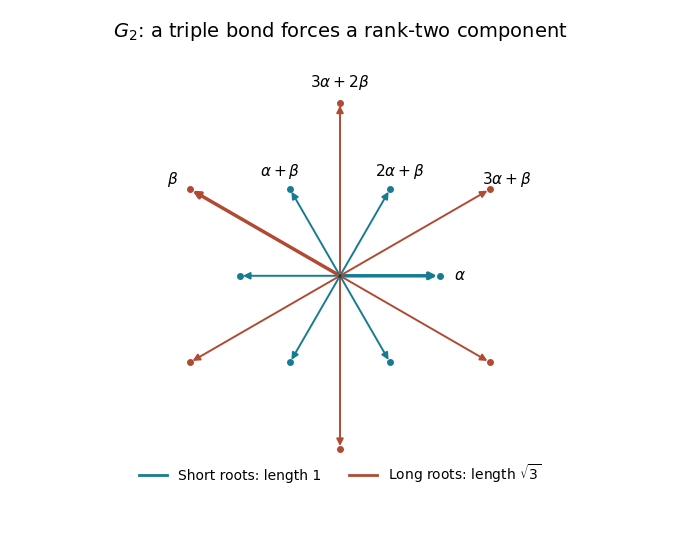

For completeness, this twelve-element set really is a root system. It is finite, spans the plane, and is reduced. The six short roots have length and directions spaced by ; the six long roots have length and interleaved directions, also spaced by . Their mutual Cartan integers are integral: within either length class they are , , or as applicable, and between the two length classes they are , , or . Closure under all root reflections follows by conjugating the two simple reflections, since every listed root lies in a simple-root orbit. The nonorthogonal simple roots make it irreducible. We have therefore proved existence as well as uniqueness, up to isometry and overall scale:
A smooth vector field on a smooth manifold is a smooth section of the tangent bundle: it assigns to each , smoothly in local coordinates. In a coordinate chart it has the form , with smooth coefficients . Equivalently, it acts on smooth functions as a derivation, .
For a Lie group , write for Left translation on a Lie group. A left-invariant vector field satisfiesThus it is determined by its value at the identity. Given the printed , first translate it to the identity:The unique left-invariant vector field with value at isThe smoothness of multiplication makes this a smooth vector field, the chain rule proves left invariance, and setting gives .
We prove the completeness of left-invariant vector fields: this left-invariant vector field is a complete vector field. The Picard-Lindelöf theorem, applied in a local chart, gives a unique local integral curve of a vector field through . For every , the curve is an integral curve of a vector field through , becauseCrucially, the same interval works for every initial point.
Let be the maximal integral curve of a vector field through , with maximal interval . If , choose with . The curveexists on and agrees with on the overlap by uniqueness of the local ordinary differential equation. It extends past , a contradiction. The same argument at a finite excludes that possibility. Thus , and uniqueness on overlapping intervals gives uniqueness on all of .
After establishing completeness, uniqueness also gives the one-parameter subgroup law for the global curve through :Both sides, as curves in , are integral curves of a vector field through at . Defining the Exponential map of a Lie group by , the answer is
The identity component is an open normal subgroup, and every open identity neighbourhood generates it. Let be the connected component of . The product of connected spaces is connected, so the image of under multiplication is connected and contains . It is therefore contained in . Inversion has the same property. Thus is a subgroup.
A smooth manifold is locally connected. In particular, a coordinate neighbourhood of can be chosen homeomorphic to an open ball, so there is a connected open neighbourhood of contained in . Its translates , , are open and lie in , and cover . Therefore the identity component of a Lie group is open in . Conjugation by any is a homeomorphism fixing , so it maps into itself; conjugation by gives the reverse inclusion. Hence is a normal subgroup.
If is an open neighbourhood of in , let , allowing inverses in the meaning of generated subgroup. For each , is open and lies in , so is open in . Every other left coset of is also open. Thus is both open and closed in the connected space . It is nonempty, so .
A quadratic form on is a function for a symmetric bilinear form . Equivalently, and the polarizationis a bilinear map. In coordinates there is a unique real symmetric matrix with . No assumption of nondegeneracy or positive definiteness is needed.
An element stabilizes when for every . By the polarization identity, this is equivalent to preserving , or in coordinates toThis is a closed Matrix Lie group. The Lie algebra of a quadratic-form stabilizer isTo prove necessity, differentiate along any smooth curve in with , . The derivative at zero is .
To prove sufficiency, suppose and consider the matrix exponential . ThenIts value at zero is , so for every real . This curve has derivative at zero, proving the claimed tangent space description even for a degenerate quadratic form.
Equivalently, the condition is for all . For a nondegenerate quadratic form it is the corresponding Special orthogonal Lie algebra. To see the degenerate case explicitly, choose a basis withWriting , the condition becomeswhile are arbitrary. Thus the nullspace of the quadratic form is invariant, but arbitrary infinitesimal maps into it are allowed. When , the formula correctly gives and .
Work over , with the standard inclusions fixing the letters . In the group algebra, the Young–Jucys–Murphy elements areThus adds all transpositions involving the newest letter. Conjugating by merely permutes the summands, so commutes with . In particular, if , then and . Hence the whole family is commuting.
Put , the transposition conjugacy-class sum in , with . ThenThis identity will connect the Young–Jucys–Murphy elements with the centres of the successive group algebras.
For an increasing chain of finite groups , regard every as a subalgebra of . The Gelfand–Tsetlin algebra is the unital algebra generated by their centres:For this paper the chain is , so these centres are . The generators commute: if , an element of commutes with all of , including . Thus the Gelfand–Tsetlin algebra is commutative. Its joint eigenspaces record successive choices in the restriction of an irreducible representation down the chain.
The relevant centralizer of a subalgebra isEquivalently, it is the fixed subspace of under conjugation by . We prove the Olshanskii centralizer lemma directly, without assuming multiplicity-free restriction.
A permutation has one cycle containing , of some length . Let record the lengths of its other nontrivial cycles, omitting fixed points. Two permutations are conjugate under exactly when these data agree: a relabelling of the other letters identifies the distinguished cycles and all remaining cycles. Hence the sums over these conjugation orbits form a basis of .
Filter these orbit sums by the number of moved letters other than :If , the permutation fixes , and is already a conjugacy-class sum in . For , let be the class sum with nontrivial cycle lengths . ExpandTerms in which the star transpositions use distinct letters, disjoint from the support of the chosen term of , produce precisely , each with coefficient one. Indeed, a cycle through has a unique expression as an ordered product of star transpositions using each of its other letters once; the remaining cycles uniquely determine the term of .
Every other term moves fewer than letters outside . A repeated letter uses at most distinct such letters in the star product, and an overlap with the support of likewise reduces the size of their union. Since the whole product commutes with , these remaining terms are a linear combination of lower-filtered orbit sums. ThusInduction on , starting with the identity, puts every orbit sum in . The reverse inclusion holds because both proposed generators commute with . ThereforeIn particular this centralizer of a subalgebra is commutative: is commutative and commutes with it.
The identity from part (a) shows that each Young–Jucys–Murphy element belongs to the Gelfand–Tsetlin algebra. Conversely, lies in the centralizer of in . Applying the preceding Olshanskii centralizer lemma at level givesInduction, beginning with , proves . ThusHere every generated algebra is unital; causes no problem.
To deduce simple branching, use Maschke's theorem: complex representations of finite groups are semisimple modules. The Artin–Wedderburn theorem identifieswhere runs over the irreducible -modules. Write their restrictions asBy Schur lemma, the centralizer in the displayed algebra iswith zero multiplicities omitted. Part (i) makes this algebra commutative, whereas a full matrix algebra of size at least two is noncommutative. Consequently every restriction multiplicity is or . This proves multiplicity-free restriction at each step, with no use of the branching rule in the centralizer proof.
Let be the coordinate vectors and chooseThese vectors lie in the sum-zero standard representation of the symmetric group. They are mutually orthogonal for the usual Hermitian inner product, with , so they form a basis of its -dimensional space.
If , every transposition in exchanges two coordinates equal to , so each fixes . If , summing the transpositions gives coordinate in each of positions and coordinate in position , hence . Finally, if , the th coordinate of is zero. In the sum of the transpositions, any coordinate in its support retains its original value in terms and becomes zero in the remaining term; the th output coordinate is the sum of the original first coordinates, which is zero.
Thus all actions are diagonal in this basis:This supplies an explicit Gelfand–Tsetlin basis of the standard representation.
For , take the three vectors from part (iii):Their joint Young–Jucys–Murphy element weights, in the order , areThey are distinct, and part (ii) says that these operators generate . Therefore a Gelfand–Tsetlin basis isIf an orthonormal basis is desired, use , , and . The corresponding standard Young tableaux have shape , with the second-row entry respectively . Their contents agree with the three displayed weights.
The Young lattice, or Young poset, has one vertex for each partition of an integer, including the empty partition, ordered by inclusion of their Young diagrams. A diagram covers another exactly when it adds one box. The Young branching graph is its graded graph: vertices at level are the partitions of , and edges join diagrams differing by one box.
A descending path from to determines a standard Young tableau: label the successive removed boxes , then label the remaining box . Every removed box is a Removable node of a Young diagram, so the resulting labels increase along rows and columns. Conversely, deleting boxes in decreasing label order from a standard Young tableau gives the path. Extending by the unique edge from to the empty diagram yields the usual path-to-tableau correspondence.
For the operator identity, compare the coefficients of each in and . If , a common upper cover exists exactly when a common lower cover exists, and each is then unique: the two diagrams differ by exchanging one box, their union is the upper cover and their intersection the lower cover. Since unions and intersections of partition diagrams are again partition diagrams, these off-diagonal coefficients agree.
The coefficient of in is the number of addable nodes of a Young diagram; its coefficient in counts the choices of a Removable node of a Young diagram. Along the diagram's boundary the two types of corners alternate, beginning and ending with addable corners. Hence there is exactly one more addable than removable corner. For the empty partition the counts are and .
Therefore the up and down operators satisfyor at level . At level zero, interpret and the lowering contribution as zero. This makes the Young lattice a differential poset.
Use the normal ordering identity for up and down operators, placing every before every . The commutator from part (a) impliesby induction on . Multiplying the normal-ordered expansion on the left by therefore giveswhere negative indices have coefficient zero and .
We prove that unless and for some integer , and otherwiseThe formula holds at . For the next step with , the three contributions in the recurrence, after factoring out , are respectively , , and . Terms with a negative index or are simply absent. Their sum is , giving the required numerator. Parity and nonnegativity exclude every remaining case. This proves the coefficient formula.
Apply the identity to the empty partition. Since , only terms with survive. To finish at , only can contribute, and its coefficient of is , by the Young branching graph correspondence with standard Young tableaux. For ,Here is the odd double factorial, with . ThusThe operator counts oscillating tableaux, allowing both upward and downward steps. A strictly upward path to level would necessarily have length ; the printed operator specification is what determines when .
The joint spectrum consists of the tuples of simultaneous eigenvalues of occurring in irreducible complex -modules. A Gelfand–Tsetlin basis is a Gelfand–Tsetlin basis: its vectors lie in the one-dimensional joint eigenspaces selected by successive restrictions. The weight of is when for every .
Define to be the integer tuples satisfying the content vector of a standard Young tableau conditions: ; for , at least one of occurs earlier; and between any two occurrences of the same integer , both and occur. We will justify their tableau interpretation in part (iv).
Here is the local spectral rules for Young–Jucys–Murphy elements calculation used in this question. Average a positive definite Hermitian inner product over , making the representation unitary. The are commuting self-adjoint operators because transpositions are self-adjoint involutions. Put and . The group-algebra relations areFor a unit weight vector , the first relation gives . Thus , , andhas the weight obtained by swapping , with . If , then and . If , then , providing an admissible spectral swap in the same irreducible module.
For the proposed three consecutive weights , these rules give and . But the braid relation in a Coxeter group would implya contradiction. Hence the proposed tuple is not in . The same argument, with the signs reversed, excludes as well.
Since , every joint weight has . In , acts by on the trivial representation and by on the sign representation, which exhaust the irreducible representations. ThusThe content vector of a standard Young tableau conditions similarly require the second coordinate to be a neighbour of , soThese vectors correspond respectively to the single-row tableau of shape and the single-column tableau of shape .
For , define when their Gelfand–Tsetlin basis lines occur in the same irreducible representation. This is well defined: contains the centre of , whose primitive central idempotents separate the irreducible modules, and part 1(ii) says these central elements are polynomials in the . Consequently the same weight cannot label two different irreducible modules.
For content vectors of standard Young tableaux, an admissible adjacent swap of a standard Young tableau exchanges coordinates whose difference has absolute value greater than . Define as the equivalence relation generated by such swaps within .
Equivalently, after reconstructing the tableaux, means that the two tableaux have the same final Young diagram. Indeed, an admissible swap exchanges consecutive entries in incomparable cells, preserves the diagram and leaves a standard Young tableau. Conversely, tableaux of a fixed shape are linear extensions of a partially ordered set, with the cells ordered by their row and column requirements; any two linear extensions are connected by adjacent swaps of incomparable elements. We explain this connectivity and its spectral consequence in part (v).
We verify all three content vector of a standard Young tableau conditions using the spectral rules proved in part (i).
The first coordinate is zero by part (ii). For the neighbour condition, suppose some has neither nor among earlier coordinates. Try moving successively to the left. Each encountered difference is not ; if it is zero, we have an impossible adjacent equality, while otherwise the local spectral rule permits the swap. If , this procedure must encounter the original first coordinate and give that contradiction. If , it moves to the first position, contradicting . Therefore an earlier neighbour always exists. Starting from , this also proves inductively that every coordinate is an integer.
For the repeated-value condition, suppose it fails and choose a failing pair of equal coordinates with the shortest interval. There is no intervening , since a shorter pair would then also fail. There must be at least one intervening neighbour: otherwise the right-hand could be moved next to the left-hand by admissible swaps. Suppose, for example, that is missing. There cannot be two occurrences of in the interval: between them the required neighbour is missing, producing a shorter failing pair. Thus there is exactly one . All other intervening values differ from by more than , so the two copies of can be moved towards that unique neighbour until the forbidden consecutive pattern appears. Part (i) excludes it. The case in which is missing is identical, using . Both neighbours must therefore occur.
For completeness, these conditions really encode standard Young tableaux. If occurs for the th time, place the next label inThis is the next unfilled cell on diagonal of content . On the first occurrence of a positive diagonal, the earlier-neighbour condition forces its first left predecessor to exist: earlier diagonal values form an interval containing , so a first positive can only be reached through . The negative case uses the predecessor above. On later occurrences, the two neighbours appearing since the previous occurrence ensure that the new cell's left and upper predecessors have already been filled. For diagonal , the same two-neighbour condition supplies both predecessors after the first box. Thus each addition is an addable node of a Young diagram, and the labels form a standard Young tableau.
Conversely, a standard Young tableau starts at ; any later cell has a left or upper predecessor of neighbouring content. Two cells on one diagonal have the cells immediately to the right and below the earlier one between them in the tableau order, supplying both neighbours. Hence its content vector of a standard Young tableau satisfies precisely the stated conditions. The next position on a diagonal is unique, so this construction is a bijection between content vectors of standard Young tableaux and standard Young tableaux.
Use the tableau representation supplied by Young seminormal form, stated explicitly in Question 5, or its normalized Young orthogonal form. It constructs the complex Specht module with one basis vector for each standard Young tableau of shape . Its adjacent-transposition matrices imply the content eigenvalues directly.
Indeed, start with and use . On an admissible pair , set , , , and . In the orthogonal basis, is andMultiplication givesFor a nonadmissible swap, and the next content differs by the same , giving the same conclusion. Induction therefore proves . Every content vector of a standard Young tableau, reconstructed as a standard Young tableau in part (iv), is consequently a spectral weight. Together with the reverse inclusion,
An admissible adjacent swap has nonzero off-diagonal coefficient in Young orthogonal form, and the local spectral calculation in part (i) keeps it inside one irreducible representation. Thus implies .
Two standard Young tableaux of one shape are connected by admissible swaps. Regard each as a linear extension of a partially ordered set of cells. Move the first cell of the desired extension to the front of the other extension: every cell it crosses is incomparable with it, since otherwise their order would be forced in both extensions. Repeat after fixing that first cell. Each step swaps consecutive labels in incomparable cells. Such cells lie strictly northeast and southwest of each other, so their contents differ by at least in absolute value. These are exactly admissible swaps.
This also establishes irreducibility of the constructed tableau representations. A submodule is invariant under the commuting and hence under their joint spectral projections; since their weights are distinct, it is a sum of tableau lines. A nonzero off-diagonal coefficient propagates any included line along every admissible edge, and connectivity then includes all lines. Different shapes give nonisomorphic modules, since their content-vector sets are disjoint and content reconstruction determines the shape. Finally, the Robinson–Schensted correspondence gives , and the sum of squares of irreducible degrees leaves room for no other irreducible representations.
Thus within each irreducible module the weights are exactly the tableaux of one shape, so implies . Hence the two equivalence relations coincide.
For a cell in a Young diagram, its hook of a Young diagram consists of , all cells to its right in row , and all cells below it in column . If is the conjugate partition, its hook length isThe hook-length formula is
In the Greene–Nijenhuis–Wilf hook walk, a walk at a noncorner cell chooses uniformly one of the other cells in its hook, and stops at a corner. Moves are strictly rightwards or downwards, so termination is certain. A terminal cell must be a Removable node of a Young diagram. For a chosen corner , its probability is zero unless the start satisfies and .
For a start in that northwest rectangle, defineThe corner conditions are and , so , and all earlier are positive. DefineandThen the closed conditional probability isIn particular, if both inequalities are strict, this isThe separate definitions of handle starts in the terminal row, in the terminal column, or at the corner itself without division by zero.
To prove the formula, the product definitions give the identitieswith the terminal zero identities interpreted as empty sums. For example, summing the recurrence backwards gives . AlsoThe first-step equation for the hook walk terminal probability isJumps beyond the target rectangle contribute zero. Substituting proves this equation, and gives its boundary value. Since every step increases a coordinate, backward recursion determines the probability uniquely. This proves the claimed expression.
For , the product is empty and equals the identity, the only -cycle in . Suppose the cycle-sum identity for Young–Jucys–Murphy elements holds at :Multiplication by gives terms . With permutation products acting right to left, this inserts immediately after in the cycle of : the arrows become , with the other arrows unchanged.
Conversely, in any -cycle there is a unique predecessor of . Delete and join that predecessor to the successor of ; this uniquely recovers and the factor . Hence every -cycle occurs exactly once, and no other permutation occurs. Induction provesThus is a conjugacy-class sum in , although it need not be central in when .
Let be a standard Young tableau of shape , and let be the shape formed by its entries . Since Young–Jucys–Murphy elements act by contents, the eigenvalue of on its Gelfand–Tsetlin basis vector isIf is not a hook partition, it contains , whose content is zero, so this product is zero. If with , its nonzero contents are and . Their product is independent of the order of the labels. Therefore the eigenvalue isThe empty product at gives . When , , giving exactly the hook-versus-nonhook distinction suggested by the hint. For , it is the intermediate shape , rather than the final shape , that controls the answer.
There are -cycles in , and each has the same character value of a representation on . Taking traces in the cycle-sum identity for Young–Jucys–Murphy elements yieldsOnly tableaux whose first entries form a hook partition contribute.
Write such a shape as , for . There are ways to fill it: choose which of the labels go below the first box. There are ways to fill the remaining skew diagram with the labels , in standard order. The eigenvalue from part (ii) is , so the factoris . Therefore the general character value isHere counts standard skew Young tableaux, and is zero when is not contained in . In particular, for a full -cycle,For , the general formula gives , the character value at the identity, as it should.
Set , for . These are distinct nonnegative integers with . Using the falling factorial, the matrix entry can be writtenWhen , the falling factorial vanishes, agreeing with the stipulated convention for a negative factorial argument.
The column polynomials are monic of successive descending degrees. Subtracting lower-degree combinations of columns turns them into without changing the determinant. The Vandermonde determinant therefore givesThe positive sign comes from reversing the usual increasing-degree Vandermonde columns at the same time as writing the differences as .
We now match this denominator with the hook-length formula. The hook lengths in row are preciselyTo verify the claim, the first hook in the row has length . As the column index passes from to , its hook length drops by plus the number of lower rows ending at column . The skipped lengths are exactly for those rows: if , then . At the right-hand end, lower rows having the same length as row account for the missing smallest lengths by the same formula. This describes all omitted values, and the remaining count is .
ConsequentlyCombining the two identities with the hook-length formula proves the determinantal dimension formula
For a standard Young tableau , let when its entry lies in cell . Its content vector of a standard Young tableau is . We use the following sign convention for axial distance in a Young tableau:This is the axial distance from to . In particular, write for the adjacent transposition .
Here is Young orthogonal form, with one orthonormal basis vector for each standard Young tableau of a fixed shape:If is not standard, omit that term. In this case occupy adjacent cells in one row or column, so or , respectively, and the scalar action is or . On a standard pair , and the matrix isThis is a real orthogonal involution.
To prove the formula, explicitly use the permitted Young seminormal form theorem: the Specht module has a tableau basis whose vectors are joint eigenvectors of the Young–Jucys–Murphy elements, and whose actions, on an admissible pair oriented so that tableau length increases from to , areNonadmissible swaps have the scalar actions just described. The theorem supplies these as one globally consistent representation, not as independently chosen two-dimensional blocks.
Average a positive definite Hermitian inner product over . Distinct tableau lines are orthogonal because their commuting self-adjoint Young–Jucys–Murphy elements have distinct joint weights. Also is self-adjoint, so the two seminormal equations implyUpon setting , the coefficient from to becomes ; the reverse coefficient is the same. All phases are consistent because the seminormal basis was global, and the group relations remain true under this change of basis. This proves Young orthogonal form.
For , there is exactly one standard Young tableau, the row . Its content vector of a standard Young tableau isEvery adjacent distance is , so for every . Thus is the trivial representation.
For , there is exactly one standard Young tableau, the column with entries from top to bottom. Its content vector of a standard Young tableau isEvery adjacent distance is , so Young orthogonal form gives for every . Thereforethe sign representation.
Assume . The standard Young tableaux of shape are , for : the sole second-row entry is , and the first row isThis lists all of them, since must occupy the first box and the rest of the first row is forced to increase. Their contents areWrite . The only nontrivial adjacent swaps exchange the lower entry with or . Substituting the content differences into Young orthogonal form yields all generator actions:In the first line at , the square-root coefficient is zero and the action is , so no vector is needed. The second line is used only when , since the generator does not exist.
The corresponding Specht module is the sum-zero standard representation of the symmetric group:A concrete orthonormal realization isPermuting coordinates gives exactly the actions above, linking this orthogonal tableau basis with the Gelfand–Tsetlin basis found in Question 1. Here the printed are the adjacent Coxeter generators, rather than products of all generators.
A near Young tableau is a filling of a Young diagram by distinct entries from a totally ordered alphabet, increasing along rows and down columns; the entries need not be . For row insertion of , scan the first row for its leftmost entry larger than . If one exists, replace it by and insert the displaced entry into the next row by the same rule. Otherwise append to the row and stop. Continue until a new outer-corner box is appended.
The Robinson–Schensted correspondence inserts the letters of a permutation successively to form . Whenever the th insertion creates a new cell, put in that cell of a second tableau . Row insertion preserves increasing rows and columns, so is standard; the sequence of growing diagrams makes standard, with the same shape. To reverse the construction, remove the box carrying the largest label in , and reverse the bumping in : in each row above, exchange the carried entry with the rightmost smaller entry, continuing up to the first row. The final expelled entry is the last letter of the permutation. Repeating recovers the whole permutation, establishing the bijection with pairs of standard Young tableaux of a common shape.
For the bumping inequality, each displaced entry is the first entry strictly larger than the incoming one. Thus every step replaces a larger entry with a smaller entry and carries that larger value downwards. Consequently the bumped values strictly increase:
Suppose an entry is bumped from column of row . If row already contains a cell in column , its entry is greater than by the strict column condition in the original near Young tableau. When is inserted into that row, the first entry greater than therefore occurs in a column at most .
If the next row is shorter than , either a bump occurs earlier or is appended in column . This also handles the final appended box. Each successive bumping position is therefore weakly to the left of the previous one. The bumping columns satisfyThis is the row-insertion bumping-path monotonicity needed to preserve the Young-diagram shape and column order.
Every old box either remains untouched or has its entry replaced by a strictly smaller incoming value. Thus on all boxes of the original diagram,The appended box has no old entry to compare; equivalently, extend the old filling by outside its diagram if the inequality is to be written for every position.
We now prove the unheaded longest increasing subsequence assertion. After any prefix of the permutation has been inserted, write the first-row entries as . The useful invariant is: is the smallest possible final value of an increasing subsequence of length in that prefix, and is the greatest possible subsequence length. It holds for the empty prefix.
Suppose the next letter enters the first row in column . Then , if , while if column already exists. A subsequence of length ending at can be extended by , giving a subsequence ending at of length ; for , the singleton suffices. A longer subsequence ending at would have an earlier length- prefix ending below , contradicting the minimality of . If , the previous prefix has no subsequence longer than , giving the same upper bound.
Replacing by , or appending it at , preserves the invariant. It lowers the smallest final value at length . At smaller lengths, existing minima are already below , so they cannot improve; no subsequence of greater length can end at . The lower rows do not change this first-row update. Induction proves that the longest increasing subsequence ending in has length exactly the column in which first enters.
Taking the maximum over all letters gives Schensted's first-row theorem:This concerns the column of the incoming letter in the first row, not the column of the new box that eventually appears at the end of the bumping path.
A generalised permutation is a finite multiset of pairs from two ordered alphabets, written as a two-row array, or biword. It may equivalently be specified by a finite-support matrix of nonnegative integer multiplicities . The condition that no column is repeated means : each ordered pair occurs at most once. It does not forbid repeated entries in either individual row.
For this class use the dual Robinson–Schensted–Knuth correspondence. Order the columns by nondecreasing top entry , and by strictly decreasing bottom entry when the top entries agree. Insert the bottom entries in that order by ordinary semistandard row insertion, which bumps the leftmost entry strictly greater than the incoming entry. Record the corresponding top entry in each newly created cell. Let be the insertion tableau and the recording tableau.
Ordinary row insertion permits repeated entries, preserving weak increase along rows and strict increase down columns; therefore is a semistandard Young tableau. The recording entries are inserted in nondecreasing order, so weakly increases along both rows and columns before considering strictness. Within one block of equal top entries, the bottom entries are strictly decreasing. The standard row-bumping comparison lemma says that a later, smaller input creates a new box strictly below the box created by the preceding input. Thus the boxes carrying one repeated top entry form a vertical strip, with at most one in each row. Consequently has strictly increasing rows and weakly increasing columns, so is semistandard.
Knuth's generalized insertion theorem, in this dual ordering, makes the map a bijection between finite - matrices and these pairs. Its reverse description is also transparent: remove the largest recording entry, choosing its lowest box when it repeats, and reverse row insertion in . Repeating recovers bottom entries in the reverse of the specified ordering. Equal top entries recover distinct bottom entries, which is exactly the no-repeated-column condition. ThusThe descending tie rule matters; the usual ascending tie rule would instead give two ordinary Semistandard Young tableaux.
Finally, the type of a tableau means its entry-multiplicity vector. Row insertion rearranges and bumps entries without changing their multiplicities. HenceThus the bottom-row multiplicities of the generalised permutation give the type of , while the top-row multiplicities give the type of ; transposing does not change its type.
The free product is obtained by taking disjoint copies of the elements of the two groups as generators and imposing precisely their internal multiplication relations. Equivalently, if with disjoint , thenA nontrivial free product has both factors different from the trivial group.
The normal form theorem for a free product says that every element has a unique expressionwhere the empty expression represents the identity. The are called syllables in a free product. Thus nonempty alternating products cannot be the identity, and the natural maps of the factors into the free product are injective.
For existence, multiply adjacent syllables from the same factor and delete identity syllables until the word alternates. Each change uses a defining relation and decreases the number of syllables. To establish uniqueness without assuming that these reductions are confluent, let be the set of alternating nonidentity syllable sequences, including the empty sequence. For , define a permutation of by prepending , multiplying into the first syllable if it belongs to , and deleting it if that product is the identity; for , do nothing.
The multiplication law inside gives for , and . This can be checked at the first syllable: if a product deletes it, the next syllable belongs to the other factor and is treated as a new first syllable. Hence the defining relations give a group action of on . An alternating word sends the empty sequence to its own syllable sequence. Two such words representing the same group element induce the same permutation, and therefore have identical sequences. This proves the normal form theorem for a free product.
The universal property of a free product states that, for group homomorphisms , there is a unique group homomorphism extending both. Explicitly,The internal multiplication relations are respected because each is a group homomorphism, so this assignment descends from words to the presented group. Alternatively, multiplication of two normal forms is concatenation followed by precisely those internal relations, which do not change its value in . Uniqueness holds because the two factors generate the free product.
If and belong to different factors, the powers have distinct normal forms of length . Every nontrivial free product is therefore an infinite group, whereas the alternating group is a finite group of order .
In a nontrivial free product, nonidentity elements from different factors satisfy , since these are distinct alternating normal forms. Such a group is not an abelian group, whereas the free abelian group is abelian.
Eliminate using . The remaining relation becomes , which follows from . These Tietze transformations giveBoth factors are nontrivial, so this is a nontrivial free product. Conversely, in the definition satisfies both conjugation relations, confirming that eliminating loses no relation.
A topological graph is a CW complex with only zero-dimensional and one-dimensional cells: its vertices form the zero-skeleton, and each edge is a copy of an open interval attached by its two endpoints to vertices, possibly the same vertex. It has the weak topology of a CW complex. A subgraph is a CW subcomplex, obtained by choosing vertices and edges and retaining the endpoints of every chosen edge. Loops and multiple edges are allowed.
A spanning tree is a connected spanning subgraph containing no cycle in a graph. To construct one in any connected topological graph , consider all acyclic spanning subgraphs, ordered by inclusion; the subgraph with every vertex and no edges is one. The union of a chain is still acyclic, since any cycle uses only finitely many edges and would already occur in a member of the chain. The Zorn lemma therefore gives a maximal such subgraph .
If were disconnected, a finite edge path in between vertices of two of its components would contain an edge joining different components. Adding that edge creates no cycle, contradicting maximality. Thus is a spanning tree. Fix a root vertex. Each point of has a unique finite path to the root; give every edge length one and move the point a fraction of the way along that path at time . This defines a contraction of a topological space of . On each closed edge times , the construction takes place in a finite tree and is continuous. Since the interval is a locally finite CW complex, the product with has the corresponding weak topology of a CW complex, so these restrictions establish continuity globally. ConsequentlyThis argument includes infinite graphs and does not assume local finiteness of .
If is a covering map, take as the vertices upstairs. Each component of the inverse image of an open edge is an open interval mapping homeomorphically to that edge, because an interval is simply connected. Its parametrization lifts along the closed edge to attach its endpoints to lifted vertices, by path lifting theorem. Small star neighborhoods at vertices are lifted homeomorphically by the covering map, and give exactly the neighborhoods of the resulting topological graph. Thus the cell structure has the topology of the original covering space. The total space may be disconnected, but every component is a topological graph.
The Nielsen–Schreier formula isFor a proof, realize as the fundamental group of the wedge sum of circles. Construct its connected covering graph with vertices the right cosets , and an oriented edge labeled from to for each free generator . There is exactly one incoming and one outgoing edge of each label at every vertex, which establishes the local covering map property. Reading a word from ends at its coset, so the closed paths at give exactly the words in . The induced map of fundamental groups is injective by the homotopy lifting property of a covering map, and its image is .
For index , this covering graph has vertices and edges. A spanning tree in it has edges. The permitted rank formula for a finite connected graph now givesIn particular this proves both freeness and the index formula.
If and , then , so a proper finite-index subgroup cannot be isomorphic to . For , , and is a proper index- subgroup isomorphic to for every . Hence
The HNN extension in the convention used here isThe new generator is its stable letter, and are its associated subgroups of an HNN extension. We prove the normal form theorem for an HNN extension, which also proves that the natural map is injective.
Set , , , and . For each sign , choose a right coset transversal for , containing as the representative of . Thus every has a unique decomposition , with and . A normal form iswhere is unrestricted and the case is just .
Here is a constructive proof. Let be the set of these formal sequences. Left multiplication by changes only to . To prepend , uniquely decompose using and useIf the old first stable letter is and , cancel this pair and multiply into the now-leading coefficient . Otherwise retain the new first stable letter. Both cases give a sequence in ; after a cancellation the leading coefficient is unrestricted, so no further normalization is needed at that end. Prepending the letters of a word from right to left proves existence.
These operations define permutations of . The base-group operations satisfy . The operations and are inverse: if prepending did not cancel, the reverse operation decomposes the new leading coefficient with representative and cancels the newly inserted letter; if it did cancel, the reverse operation decomposes with representative , restoring the original prefix. The normal-form restriction rules out an unwanted second cancellation in the latter case.
For , decomposing uses the same representative as decomposing , and changes its subgroup coefficient from to . Both the cancelling and noncancelling cases therefore giveThus all defining relations act identically on , and we obtain a group action of the presented HNN extension. Each written normal form sends the empty form, whose leading coefficient is , to that normal form itself. Equal group elements must have the same image of the empty form, proving uniqueness and the embedding of .
A reduced sequence in an HNN extension is a word containing no pinch in an HNN extension: no with and no with . Equivalently, whenever , one requires .
Britton's lemma states thatMore strongly it cannot represent an element of . To prove this from the normal form theorem for an HNN extension, normalize the coefficients from right to left. Splitting moves to the coefficient immediately on its left. If the preceding stable letter has the opposite sign, this transported factor belongs to the subgroup relevant to that inverse pair; multiplying by it cannot turn a coefficient outside that subgroup into one inside it. If the signs agree, cancellation is impossible anyway. Hence no stable letter disappears during normalization of a reduced sequence. Its unique normal form has , whereas every element of has stable-letter length zero. This proves Britton's lemma. The same proof works with finitely many stable letters, with pinches requiring the same letter and its inverse.
Substitution sends the defining relation toThus the assignment respects the relator and extends to a group homomorphism .
Articles were limited to the first 100 out of 2027 total.
Articles by others on the same topic
There are currently no matching articles.