Put , , and . The deterministic integrand in the Itô integral implies that the increments are independent random variables with normal distributions . The Gaussian fourth moment givesThese identities include . Since the summands of are centered and independent, all cross terms in its second moment vanish. Consequently,Thus works for every observation partition. The last step uses the total interval length, rather than assuming equally spaced observations.
Use the same as in part (a). The error of the weighted realized variance splits into its centered fluctuation and its deterministic quadrature error:The Hölder continuity of controls this bias:Since , the bias-variance decomposition of mean squared error has no cross term. Part (a) therefore givesHence is a universal choice. This argument separately controls the statistical fluctuation and the Riemann sum approximation.
Write and , restricting to meshes small enough that . This discontinuous indicator function does not satisfy the hypothesis of part (b). Instead apply part (a) with and handle its two boundary cells directly.
Let on each observation cell . Away from cells containing the two ends of , almost everywhere. Even if an endpoint is itself an observation time, at most two cells contribute, and their total length is at most . Thus the quadrature error obeysThe fluctuation has variance at most . Its zero expected value givesusing .
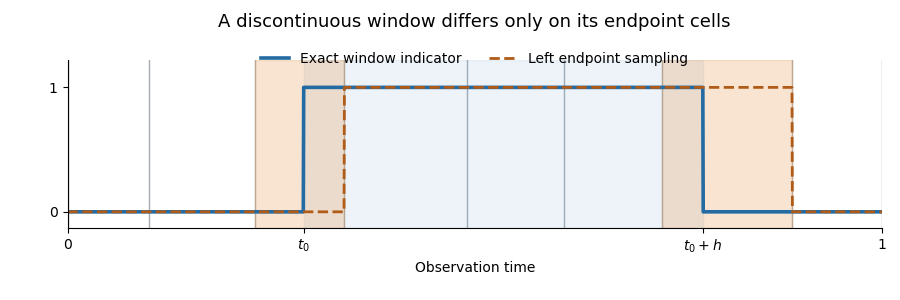

The remaining bias is the difference between an interval average and the spot variance. By the Hölder continuity of ,Retaining the centered fluctuation and bounding yieldsFor , both and equal . Therefore and satisfy both requested bounds:The constants are independent of the observation partition, , and . The exponent follows from a bias-variance tradeoff for a shrinking window.
Articles by others on the same topic
There are currently no matching articles.