The Yukawa matrices for up-type and down-type quarks are diagonalized by separate unitary changes of basis. Let and . The generation-diagonal weak charged current in the weak basis becomesThus the CKM matrix records the mismatch between the two left-handed mass bases, not an additional non-unitary interaction.
An unitary matrix has real parameters. The quark-field phases can remove phases from : the common phase changes neither current. This leaves physical real parameters, comprising mixing angles and CP-violating phases. Hence three generations give four parameters: three angles and one phase; four generations give nine: six angles and three phases. This count assumes the usual nondegenerate masses, so that extra mass degeneracies do not enlarge the allowed basis transformations.
The tree-level Feynman diagram contains one weak charged current vertex. Fermion arrows point along fermion-number flow, so the outgoing antiquark arrow points toward the vertex.
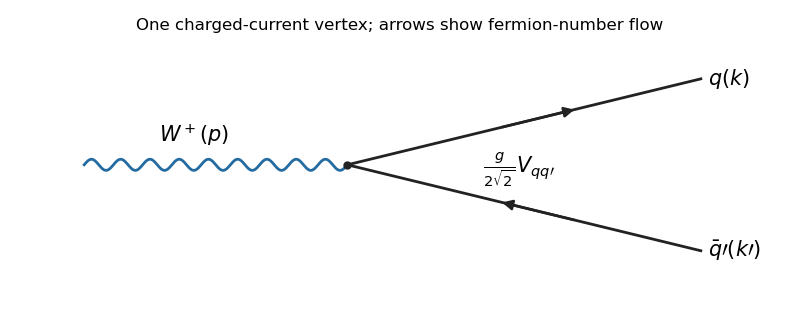

For one fixed matching color, the scattering amplitude isAn overall phase from the vertex has no effect on the width. The fermion spin sums give , in the massless approximation. For the three initial polarizations, use a spin average of . The gamma matrix trace identities giveThe sign of the last term follows the PDF's convention and does not affect this decay: the polarization sum is symmetric. Since and the daughter masses vanish, and . ThereforeIn the rest frame, the two-body Lorentz-invariant phase space integrates to : after the spatial delta function sets , its radial delta function fixes . Explicitly,The decay formula consequently givesThis is the printed expression, interpreted for one color. For a physical quark-flavor channel there are three orthogonal final color states. Their probabilities add; no initial color average is present for a colorless W boson. ThusThe PDF's formula omits this color multiplicity if read as the ordinary inclusive flavor width. It is also the familiar normalization for a colorless lepton channel.
The six physically accessible quark combinations are . A real on-shell W boson cannot produce a top quark; the massless approximation is applied to the accessible daughters and does not open a physically forbidden top channel. CKM matrix unitarity gives . Therefore the physical color-summed hadronic width at this order isIf the printed one-color convention is retained for every channel, its sum is instead . In the artificial theory where all three up-type flavors, including the top, are kinematically massless, there would be nine channels and the physical sum would be ; that is not the on-shell Standard Model channel list.
The weak charged current creates a left-handed neutrino and a right-handed outgoing positron in the massless limit. In the parent's rest frame their momenta are opposite, so these two fixed helicities give total angular-momentum projection of magnitude one along their flight axis. A spin-one W boson can supply that projection, and its leptonic width remains nonzero:A spin-zero pion cannot produce the same helicity configuration. The forbidden component is rescued only by a charged-lepton mass insertion that reverses its helicity, giving helicity suppression.
This can also be seen directly from the pion decay constant. Lorentz symmetry gives a vacuum-to-pion axial current matrix element proportional to . Contracting with the leptonic current givesusing the massless neutrino equation and . Hence and . The W boson polarization vector is not constrained to be proportional to the total momentum, so its amplitude has no analogous compulsory mass factor.
Articles by others on the same topic
There are currently no matching articles.