The operator is a fermionic annihilation operator for a particle with momentum and spin label ; is a fermionic creation operator for the corresponding antiparticle. The c-number Dirac spinors and solve the positive-energy particle and antiparticle equations respectively. They supply the spinor wavefunctions in the mode expansion of a Dirac field; they are not creation or annihilation operators.
Apply the specified parity transformation to the two operators in the mode expansion of a Dirac field:Relabel . The momentum sum is unchanged, , and the spinor identities give and . The two minus signs in the antiparticle term cancel. ThereforeTaking the Hermitian conjugate and using , in the Dirac adjoint yieldsThe unit-modulus intrinsic-parity phase cancels from all neutral fermion bilinears.
Use the printed gamma matrix conventions throughout, in particular . The transpose identity for gives , and its Hermitian conjugate gives the corresponding identity for . Thus the Dirac adjoint of the charge-conjugated field isReordering the anticommuting components of the fermion bilinear supplies a minus sign:Invariance for arbitrary fields therefore requires , so the charge-conjugation matrix is a unitary matrix. This is the required normalization constraint; it is not a bosonic reordering calculation.
For a spinor matrix , the same calculation and the given giveWith and , the supplied transpose identities implyConsequently the vector current is C-odd and the axial current is C-even: and .
For parity, put . The gamma matrix identities and giveThus is P-even and P-odd, whereas is P-odd and P-even. The axial current transforms as a pseudovector.
Keep the color matrix intact: . Under parity, invariance of its contraction with the vector current requiresUnder charge conjugation, the fermionic reordering in part (b) transposes the color matrix as well as the spinor matrix. For a fixed color matrix , becomes . Hence invariance of the interaction requiresThis is not a rule that changes the sign of every individual color component: transposition also acts on the generators of the fundamental representation.
Write the gauge field strength as . Since , the charge conjugation rule gives . Including the coordinate reflection in CP symmetry,For generators normalized by , the color contraction equals . The two charge-conjugation minus signs cancel, and transposition reverses the order inside the trace without changing it. The Levi-Civita symbol acquires under the remaining reflection. ThusThe Yang-Mills theta term is CP-odd; a generic fixed nonzero produces CP violation. Setting removes this source. Although the density is a total derivative, it can affect the quantum theory through nontrivial topological sectors; the local transformation test is not rendered irrelevant by that fact.
An experimentally observed example is , a decay of the long-lived neutral kaon into a CP-even two-pion state. Without CP violation, the long-lived state would be CP-odd and this decay would be forbidden.
For the CKM matrix mechanism of CP violation, three quark generations are the minimum. Rephasings remove every complex phase for one or two generations, while three generations leave one physical CP-violating phase. This count concerns weak quark mixing. The Yang-Mills theta term in part (c) is a separate possible source of CP violation and does not require three generations.
For , the unique minimum is . The quadratic mass term is , so there are real scalar fields, all of mass , and the global special orthogonal group remains unbroken.
For , write . The vacuum manifold is the sphere . Choose . The transformations preserving this vacuum expectation value rotate the first components, giving . At this vacuum the potential's Hessian matrix isWriting , the radial mode therefore hasThese are one massive radial scalar and physical Goldstone bosons. The Goldstone theorem applies to the broken global generators; the flat angular directions of the vacuum manifold explain their zero masses. The spontaneous symmetry breaking is a choice of vacuum, not a change in the invariant Lagrangian. For there are no continuous angular directions: only the radial scalar remains, and the potential's discrete symmetry is broken.
The three real components form the Adjoint representation of . Around a nonzero vacuum, a local gauge transformation rotates the direction of to the third axis. In this unitary gauge, the two angular fields are removed from the scalar parametrization and become longitudinal polarizations of two gauge bosons, through the Higgs mechanism. Thus describes the perturbative physical fluctuations, with .
The subgroup generated by fixes , giving . Define the physical vector fieldsThe gauge covariant derivative on the radial configuration isso the scalar kinetic term becomes .
Here is an exact form of the Lagrangian in these physical fields, up to its additive vacuum constant. DefineandThe minus sign in the printed non-Abelian gauge field strength gives precisely these signs. ThenIts quadratic terms give , , and . The two massive vectors have six real polarization degrees of freedom in total; the massless vector has two and the scalar one. Their total of nine equals the original six vector plus three scalar degrees of freedom.
Under the surviving , and have opposite charges and is neutral. The Yang-Mills theory supplies and couplings and quartic charged-vector self-interactions. The scalar term supplies and , together with the cubic and quartic scalar self-interactions. There is no direct term.
With suitable fermions, this spectrum offers a massless photon and massive charged mediators of short-range weak charged currents, so it captures part of the weak/electromagnetic pattern. It differs crucially from the electroweak interaction of the Standard Model: the latter gauges , uses a complex Higgs doublet, and breaks to . Three rather than two generators are broken, leaving a massive neutral Z boson as well as and a photon. Its charge operator and independent hypercharge coupling give a nontrivial weak mixing angle. The present theory has no massive neutral mediator, no such mixing angle, and does not reproduce the observed chiral fermion charge assignments or their usual Yukawa couplings from the standard doublet/singlet assignments.
The Yukawa matrices for up-type and down-type quarks are diagonalized by separate unitary changes of basis. Let and . The generation-diagonal weak charged current in the weak basis becomesThus the CKM matrix records the mismatch between the two left-handed mass bases, not an additional non-unitary interaction.
An unitary matrix has real parameters. The quark-field phases can remove phases from : the common phase changes neither current. This leaves physical real parameters, comprising mixing angles and CP-violating phases. Hence three generations give four parameters: three angles and one phase; four generations give nine: six angles and three phases. This count assumes the usual nondegenerate masses, so that extra mass degeneracies do not enlarge the allowed basis transformations.
The tree-level Feynman diagram contains one weak charged current vertex. Fermion arrows point along fermion-number flow, so the outgoing antiquark arrow points toward the vertex.
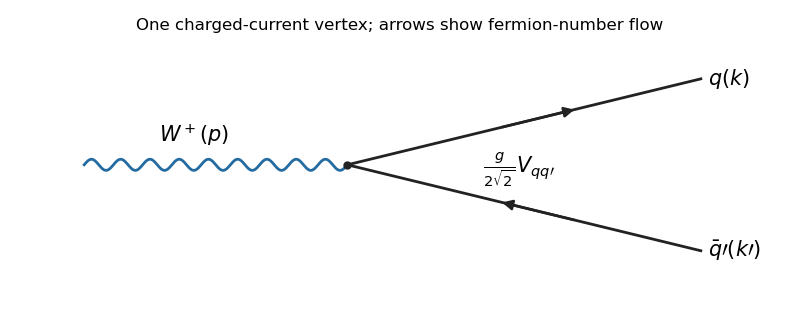
For one fixed matching color, the scattering amplitude isAn overall phase from the vertex has no effect on the width. The fermion spin sums give , in the massless approximation. For the three initial polarizations, use a spin average of . The gamma matrix trace identities giveThe sign of the last term follows the PDF's convention and does not affect this decay: the polarization sum is symmetric. Since and the daughter masses vanish, and . ThereforeIn the rest frame, the two-body Lorentz-invariant phase space integrates to : after the spatial delta function sets , its radial delta function fixes . Explicitly,The decay formula consequently givesThis is the printed expression, interpreted for one color. For a physical quark-flavor channel there are three orthogonal final color states. Their probabilities add; no initial color average is present for a colorless W boson. ThusThe PDF's formula omits this color multiplicity if read as the ordinary inclusive flavor width. It is also the familiar normalization for a colorless lepton channel.
The six physically accessible quark combinations are . A real on-shell W boson cannot produce a top quark; the massless approximation is applied to the accessible daughters and does not open a physically forbidden top channel. CKM matrix unitarity gives . Therefore the physical color-summed hadronic width at this order isIf the printed one-color convention is retained for every channel, its sum is instead . In the artificial theory where all three up-type flavors, including the top, are kinematically massless, there would be nine channels and the physical sum would be ; that is not the on-shell Standard Model channel list.
The weak charged current creates a left-handed neutrino and a right-handed outgoing positron in the massless limit. In the parent's rest frame their momenta are opposite, so these two fixed helicities give total angular-momentum projection of magnitude one along their flight axis. A spin-one W boson can supply that projection, and its leptonic width remains nonzero:A spin-zero pion cannot produce the same helicity configuration. The forbidden component is rescued only by a charged-lepton mass insertion that reverses its helicity, giving helicity suppression.
This can also be seen directly from the pion decay constant. Lorentz symmetry gives a vacuum-to-pion axial current matrix element proportional to . Contracting with the leptonic current givesusing the massless neutrino equation and . Hence and . The W boson polarization vector is not constrained to be proportional to the total momentum, so its amplitude has no analogous compulsory mass factor.
Both the left-handed electron and the electron neutrino participate in weak charged currents through , and both have weak neutral currents mediated by the Z boson. Their electromagnetic interactions differ: the electron has electric charge and couples to the photon, while the neutrino is electrically neutral and has no tree-level electromagnetic coupling.
In the minimal massless-neutrino Standard Model, the active neutrino has only a left-handed particle state and a right-handed antiparticle state. The electron has both chiralities: its right-handed component has electromagnetic interactions and a weak neutral current, but no weak charged current. Its nonzero mass comes from a Yukawa coupling to the Higgs field; the minimal massless-neutrino model contains no right-handed neutrino for an analogous Dirac mass term.
Observed neutrino oscillations establish nonzero neutrino mass-squared differences. Atmospheric muon-neutrino disappearance depends on travel distance and energy, and solar electron neutrinos convert into other active flavors; reactor and accelerator oscillations provide complementary evidence. In propagation, the relative phase of two mass eigenstates is . If all masses were zero there would be no such relative phase. Thus at least two neutrino mass eigenstates are nonzero in the three-neutrino description with two independent measured splittings. A flavor state is a superposition of mass eigenstates, so the evidence does not assign a single definite mass to a flavor label.
The two tree-level Feynman diagrams have t-channel W boson exchange. The antiquark process reverses the fermion-flow arrows on the lower line.
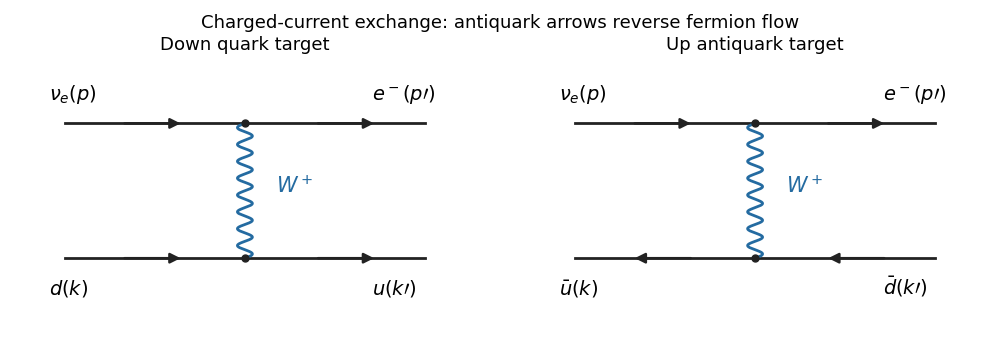


Each vertex contributes multiplying a chiral current. At momentum transfer , the gauge-boson propagator is approximated by its momentum-independent term , up to the overall phase. The longitudinal term does not contribute to these conserved massless currents. Thus the coefficient is , giving the Fermi interaction. For the quark and antiquark amplitudes, apart from irrelevant overall phases,andThe low-energy operator form is ; its external spinor matrix elements are the displayed products.
For an unpolarized initial parton, average over its two spin states. There is no factor for the incoming active neutrino, which has one allowed helicity. The initial color average cancels the final color sum, so there is no surviving color multiplicity in this parton cross section. DefineThe symmetric and antisymmetric parts have zero cross contraction. Their separate contractions are and . Thus the given Levi-Civita symbol identity yieldsIncluding the coefficient and the initial-parton spin average givesMassless kinematics and imply . From , . ThereforeTo reduce the supplied phase-space formula, use the massless center-of-mass flux and . This gives . In that frame , so . HenceThe antiquark channel's angular factor is a consequence of the chiral current and the reversed lower-line spinor order, rather than a color factor.
In the parton model, the incoming parton has and the outgoing massless parton has . Neglecting and imposing its on-shell condition givesThus the Bjorken scaling variable measures the struck parton's longitudinal momentum fraction in this approximation. The inelasticity is unchanged when the hadron momentum is replaced by its parton's collinear momentum:Let . The partonic invariant in part (b) is , and . Insert its two parton cross sections into the parton distribution function convolution:Since the event's measured fixes , the integrand is the cross-section density in . No additional Jacobian from is needed because . ThereforeEquivalently in the chosen massless-hadron frame. The explicit factor comes from the partonic energy , not from redefining the parton distribution functions. This expression uses the stated two-flavor and low-energy approximations, with masses and generation mixing omitted.
Articles by others on the same topic
There are currently no matching articles.