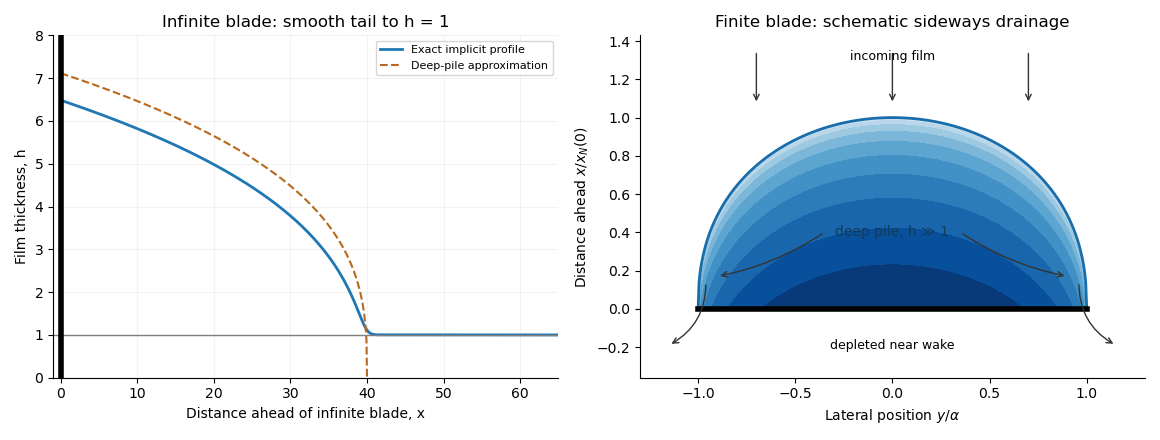
For an infinite blade, the steady moving-frame flux is constant and its upstream value is . The infinite-blade gravity pile therefore satisfies , or . Integrating givesAn additive constant in simply shifts . The head at the blade, and hence , must supply the pressure difference that makes the flux beneath the blade equal to the incoming flux. For the deep part has , followed by a smooth transition to with exponentially small, proportional to . Thus is an approximate nose coordinate, not a sharp front of the exact solution.
Near the rounded edge the parabolic lubrication gap is . In the blade frame the floor moves at and the blade is stationary. The Couette-Poiseuille flow in a thin gap has flux . Let be positive leakage towards the rear, and let . The narrow-gap integrals areIntegrating the pressure gradient gives , so the squeegee gap leakage flux isThe first term is the floor-driven contribution. For the steady infinite blade, , so . The hydrostatic pressure difference is the height difference at the two sides. A fully developed rear layer of thickness has moving-frame flux ; hence , andThe large head eventually forces all the arriving film beneath an infinite blade. Taking a perfectly closed gap instead would eliminate this steady state.

Articles by others on the same topic
There are currently no matching articles.