The fixed point zero has multiplier , so it is attracting for and repelling for . Other real fixed points satisfyTheir multiplier is , and they are attracting exactly when . At equality the linear test is inconclusive. For two branches meet at , , a generic saddle-node bifurcation. At , the nonzero branch crossing zero gives a transcritical bifurcation when .
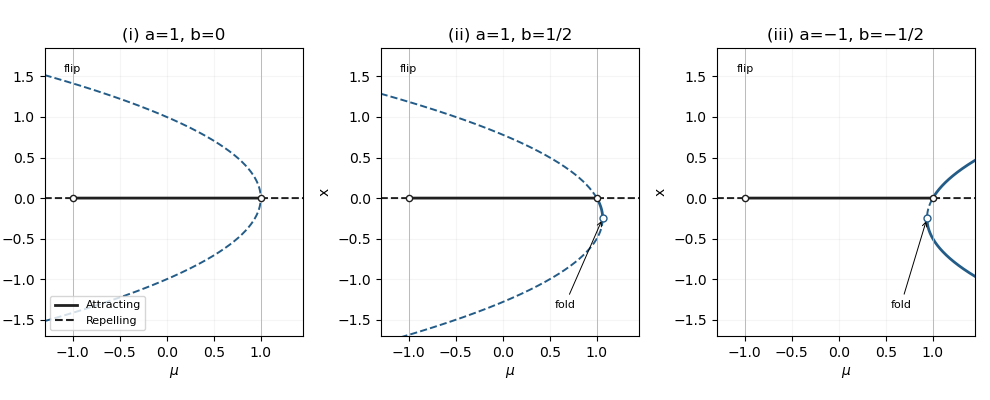
Representative fixed-point diagrams with solid attracting and dashed repelling branches
. The three sketches use respectively; case (iii) therefore illustrates the subcritical-flip choice.
For , the nonzero branches exist for and have multiplier , so both repel. Zero changes from attracting below one to repelling above one: the bifurcation at one is a subcritical pitchfork bifurcation. At minus one its multiplier crosses , producing a supercritical period-doubling bifurcation; the newly stable small two-cycle lies on the side .
For , . The negative branch segment has and is attracting wherever ; all other nonzero segments repel or undergo further flips according to the full multiplier criterion. Zero and the crossing branch exchange stability at one, and the two negative branches meet at the saddle-node. The origin's flip at minus one is supercritical.
For , . The local attracting nonzero segments have or , again subject to ; the segment between the saddle-node and zero repels. The crossings at and one are saddle-node and transcritical. The quadratic-cubic flip criticality at the origin requires additional information: writing givesIt is supercritical if and subcritical if , with a degenerate flip if . The sign assumptions in case (iii) do not determine this criticality. The original “no further bifurcations in the region sketched” qualification is local; it does not remove this possible degeneracy or the additional crossings farther along fixed branches.
Articles by others on the same topic
There are currently no matching articles.