Substitution of givesThe phase velocity is negative for all nonzero wavenumbers, so crests travel left. The group velocity is negative for , zero at , and positive for . Its minimum is at zero and maximum at ; it tends to zero from above at infinity. The odd dispersion relation has extrema at , with .
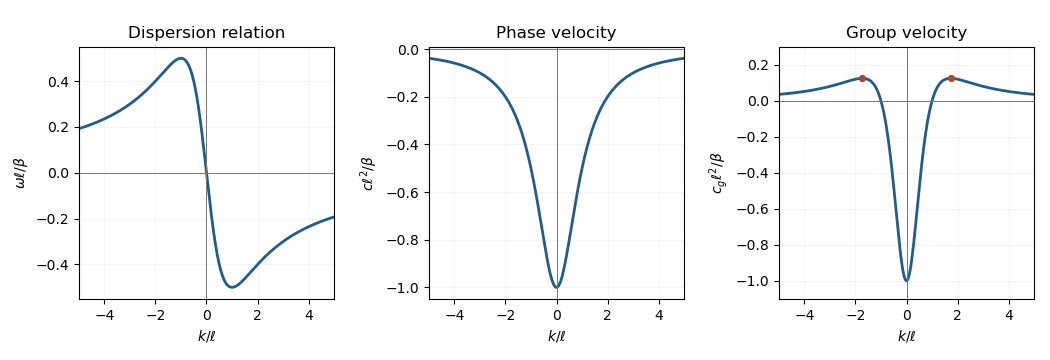
The Fourier solution is . The stationary-phase statements require enough amplitude regularity and decay, for example smooth and rapidly decreasing; realness and evenness alone do not guarantee a convergent integral or a stationary-phase expansion. For , set and solve implicitly.
For there are two positive solutions and , together with their negatives. The second derivative isEach negative stationary point has the conjugate contribution of its positive partner, because is real even and is odd. ThereforeIf a leading amplitude vanishes, this gives a zero coefficient and a higher-order term supplies that branch's first nonzero contribution.
For , there is one positive stationary wavenumber satisfying , and its negative. Since , their paired stationary-phase contribution isAt the finite stationary points are and are nondegenerate, so the same formula applies, assuming sufficient decay to control the large-wavenumber tail.
For or , there are no real stationary points: no group-velocity ray reaches those slopes. Integration by parts gives much smaller contributions; for a Schwartz amplitude they decay faster than every inverse power of at a fixed such . For less regular data the rate depends on the amplitude, and the printed even function assumption alone does not specify it. At the excluded endpoint values of the group velocity stationary points coalesce and an ordinary formula fails, typically requiring an Airy-type transition rather than the expressions above.
Articles by others on the same topic
There are currently no matching articles.