Choose photodetector along increasing main grating dispersion, and along increasing wavelength for the cross-disperser. The echellogram shows two order traces and their intersections with the axis, which passes through the optical camera optical axis.
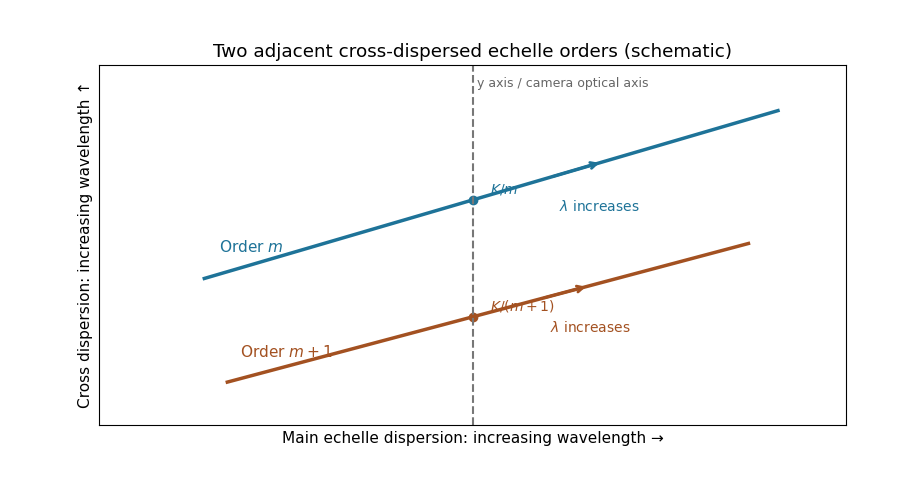

For fixed incidence, , so increasing wavelength goes to the right along each order. The cross-disperser also sends increasing wavelength upward in the chosen orientation; the traces therefore slope upward. At , , so the trace labeled lies above the trace labeled . Reflecting either plotting axis would reverse its arrow but leave the optical content unchanged. The cross-disperser separates orders that would overlap in the main dispersion direction.
Let be the direction of the optical camera optical axis. The grating equation on that axis isThe central wavelengths in adjacent diffraction orders are therefore and , with separation is the fixed order-times-wavelength product directed onto the optical camera axis, or the optical path difference between adjacent grooves in that direction. In a Littrow configuration, . This adjacent-central-wavelength spacing is a conventional free spectral range of an echelle grating; at high order it is approximately .
There is a qualification in the wording of the printed definition. The exact interval for which order lies closest to the axis is not, in general, identical to the spacing of two adjacent order centres. For a concrete counterexample take , , and a photodetector mapping . Equality of the distances from the axis for orders means , so their common boundary is . The other boundary with order is . Consequently the literal closest-order interval has widthfor and accessible non-grazing orders. This differs from the printed . For a nonzero , the exact boundary is determined by and need not even have the simple half-order form. The two definitions agree to leading order when is large. Thus the printed expression is correct as an adjacent-centre convention or a high-order coverage estimate, rather than an exact consequence of the literal nearest-axis definition. Gap-free coverage should be checked using the actual photodetector mapping and neighbouring order endpoints.
Articles by others on the same topic
There are currently no matching articles.