Take ; reflection in supplies the result for negative wavenumber. Since each region has uniform base velocity, the perturbation is an incompressible, irrotational flow with a velocity potential satisfying the Laplace equation. Its decaying outer forms areFor a varicose mode of a planar jet, reflection symmetry makes the inner potential proportional to ; for a sinuous mode of a planar jet, it is proportional to .
At the upper interface, the linearized kinematic boundary condition isThe first equation gives . The second givesThe linearized Unsteady Bernoulli equation gives . Applying pressure continuity therefore produces the equal-density top-hat planar-jet dispersion relationSolving the quadratic equation givesEquivalently,The plus sign is the unstable Kelvin-Helmholtz instability branch. In particular, the two modes have exactly the same growth rate,Its limiting forms areThus neither type grows faster in this equal-density idealization, although their phase speeds differ. The unbounded large- growth is the familiar short-wave pathology of an inviscid vortex sheet.
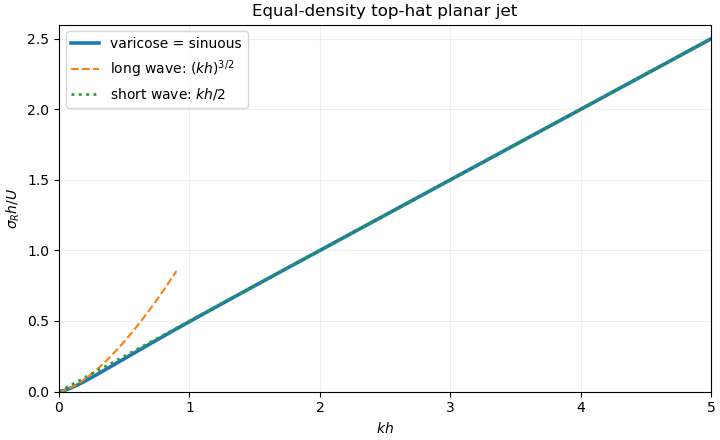
Growth rate of varicose and sinuous planar-jet disturbances
. The two modes have the same dimensionless growth curve, with the long-wave and short-wave asymptotes shown. Articles by others on the same topic
There are currently no matching articles.