For each , letA weak energy solution of a variable-coefficient wave equation is a function with zero lateral trace, equivalently , whose time trace satisfies in and for whichfor every with zero lateral trace and . Here has a continuous representative, so the displacement trace is well defined.
The velocity condition is encoded by the boundary term in time; an arbitrary space-time function need not have an trace of . The equation implies , hence has a continuous representative and in that sense. This is the weak formulation obtained by integration by parts once in time and once in space.
Take the difference of two weak solutions, so . At the stated regularity, it is not justified simply to test by , which need not belong to the spatial test space . Instead use the antiderivative test underlying uniqueness of Sobolev weak solutions of a wave equation.
Fix and defineThese are Bochner integrals in . The function is an admissible space-time test, before , and . The time term in the weak formulation isbecause . Symmetry of and integration by parts in time giveFor the lower-order part, integration by parts in space givesBounded coefficients, the Poincaré inequality for , and the Young inequality now implySince ,For in a sufficiently short fixed interval, absorb the last term into the left-hand side. The Gronwall inequality applied to proves on that interval. The equation gives continuity of in , so both initial traces at its endpoint are again zero. Repeating with the same uniform coefficient bounds covers . Therefore
For , the conormal to its zero set is . The principal symbol of isA characteristic hypersurface requires on the surface. Thus satisfies the anisotropic eikonal equationThe first-order and zeroth-order terms do not affect this condition.
Expanding the equation givesFor the hyperbolic partial differential equation discriminant, , , , soFor a curve , the characteristic hypersurface equation is , or . Therefore the two families of characteristic curves areThe values include the characteristic lines and . Every curve in the first family approaches as ; every curve in the second approaches . The two curves through are and , shown as the thick curves below. Equivalently, the characteristic coordinates are and .
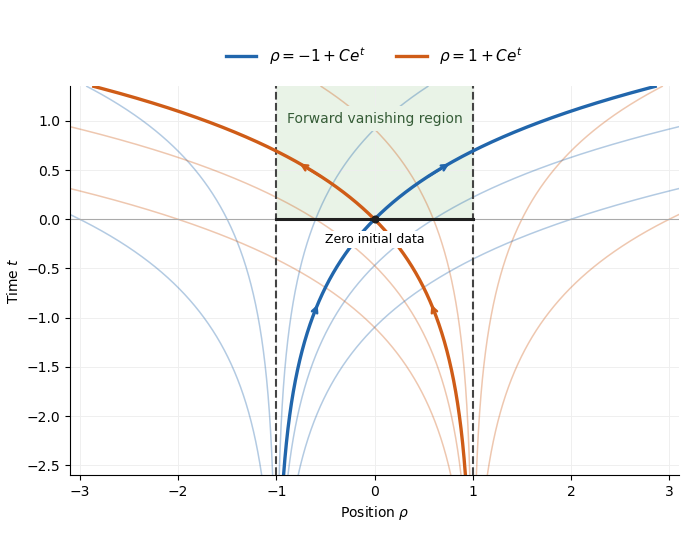
Characteristic families of the variable-coefficient wave equation
. Blue and orange curves show the two families of characteristic curves, with arrows in the direction of increasing time. Dashed lines mark the characteristic lines . The thick curves pass through the origin. The initial segment and shaded forward strip indicate the region where the zero data force vanishing, as proved in the next part. Details.
The all-time conclusion in the original PDF is false. The expanding-flow transformation of a wave equation makes both the correct forward statement and a counterexample transparent. PutFor , the expanded operator from part (i) is . In the new variables and , henceThus it is the ordinary wave equation on the half-plane . By the D'Alembert formula, any solution has the formAt , differentiating the zero displacement with respect to and using the zero velocity gives, for ,Subtracting times the first equation from the second gives , and then . Thus on and on . If and , both arguments remain in those intervals. Consequently the valid forward result isFor negative time the arguments need not stay in the initial intervals. Take and , where . Thenis a global solution, has the prescribed zero initial displacement and velocity on , but . This directly disproves the assertion for .
The connection with part (i) is directional finite propagation speed. At a future point in the strip, the two characteristics traced back to meet it at and , both in . For negative time these intersections can lie outside that interval. The lines are characteristic barriers for this forward domain of dependence, not barriers in both time directions.
Articles by others on the same topic
There are currently no matching articles.