Put and . The fundamental theorem of calculus along a line segment, followed by averaging, givesFor fixed , use the change of variables formula . Its Jacobian determinant is . The transformed domain lies in , because a cube is a convex set. Moreover, implies . Thus Tonelli theorem givesThe diagonal is a null set. The Holder inequality with now applies: implies , and integration in spherical coordinates bounds the kernel byThis proves the Morrey inequality on a cube, uniformly even when approaches its boundary:Apply this at both and the center and use the triangle inequality to obtain
Let tend to in the Sobolev space , using density of smooth functions in a Sobolev space. Write . Applying the Morrey inequality on a cube to a unit cube centered at , and bounding its average by the Holder inequality, givesfor every smooth . Hence is a Cauchy sequence in the supremum norm and has a bounded continuous limit by uniform convergence. On every finite-measure cube, this limit is also the limit, so almost everywhere.
For , choose , so that . The second estimate from part (a), followed by passage to the limit, givesThus is a Hölder continuous function andIt is the unique continuous representative: two continuous functions agreeing almost everywhere agree everywhere.
For , take a smooth cutoff function equal to one near zero and setIts weak derivative has size near zero, whose th power is integrable because . Thus , but it is essentially unbounded in every neighborhood of zero and has no continuous representative. The value assigned at zero is irrelevant.
Choose at which is finite and the -mean version of the Lebesgue differentiation theorem holds:These conditions hold almost everywhere. On a cube about , subtract the affine function and put . Its weak derivative is and . Approximate as in part (b) and subtract the same affine function from the approximants. Uniform convergence and convergence of their weak derivatives extend part (a)'s estimate to , givingFor , choose and . It follows thatThis is precisely classical Fréchet derivative differentiability, not merely existence of coordinate derivatives. Therefore the differentiability almost everywhere of supercritical Sobolev functions gives
The Lax-Milgram theorem assumes that is a real Hilbert space and is a bounded bilinear form and a coercive bilinear form: there are such thatThen for every continuous linear functional there is a unique satisfyingSymmetry of is not required.
For the proof, the Riesz representation theorem provides a bounded linear operator and with and . Coercivity and the Cauchy-Schwarz inequality implyThus is injective and its range is closed: if converges, the displayed inequality makes a Cauchy sequence; completeness gives and . If lies in the orthogonal complement of the range, then for all . Taking gives , so . A closed subspace with zero orthogonal complement is all of , hence is surjective. The unique solution is , and the same inequality gives the asserted norm bound.
The principal coefficients satisfy the positive uniformly elliptic operator condition if there is , independent of , such thatThe smooth coefficients on the compact closure also give a uniform upper bound . The first-order and zeroth-order coefficients do not enter uniform ellipticity.
Let be the trace map from the Sobolev trace theorem. The weak Robin problem for a uniformly elliptic operator uses all of as the test space, since a Robin boundary condition does not require a zero trace. DefineThe weak formulation isFor a classical solution, integration by parts produces the boundary term . Substituting the Robin boundary condition replaces it by , giving the displayed identity.
Conversely, if satisfies the identity, tests first show in the sense of distributions. Subtracting this interior equality after integration by parts givesEvery smooth boundary function is the trace of a smooth function on . The boundary residual is continuous, so this proves the boundary equation pointwise. Thus the formulations agree for solutions. If is continuous the interior equation holds pointwise; for merely , equality with that given representative of is understood almost everywhere.
The positive uniform ellipticity condition from part (i) is needed here. It is not explicitly imposed in the printed preamble. Without it the conclusion is false: on , take , , and . The Neumann boundary condition is satisfied by , and for arbitrarily large shifts.
There is also an actual error in the PDF's supplied trace inequality: a nonzero constant has nonzero trace and zero gradient. Use instead the valid multiplicative trace inequality on a bounded smooth domainFor completeness, choose a smooth vector field agreeing with the outward normal vector on the boundary. The divergence theorem gives, for smooth ,Approximation and the Sobolev trace theorem extend it to . Thus the intended existence result remains true after correcting the hint.
Set , , , , andUniform ellipticity and the Young inequality giveFor , the bilinear form is coercive on the real Hilbert space with coercivity constant .
All coefficients are bounded, and the Sobolev trace theorem gives . The Cauchy-Schwarz inequality applied to each volume and boundary term therefore proves . Also is a continuous linear functional, with . Every hypothesis of the Lax-Milgram theorem is now verified, and it gives
On the zero-boundary Sobolev space , the associated bilinear form isThe homogeneous Dirichlet boundary condition removes the boundary term, so for sufficiently regular and .
Formal self-adjointness means that equals its formal adjoint, or equivalently for compactly supported smooth functions. HereWith the symmetric real principal coefficients in the question, is equivalent to . It makes a symmetric bilinear form.
For the assertions in part (b), positivity must mean strict Dirichlet positivity:This is the positive-definite operator convention. The weaker positive semidefinite operator convention does not suffice: has zero energy on a first Dirichlet eigenfunction. Under strict positivity, the compactness argument in part (b)(i) gives a uniform lower bound as well.
Formal self-adjointness gives symmetry of , and strict positivity gives positive definiteness, so is an inner product. Bounded coefficients give . To prove the lower bound, uniform ellipticity givesIf no lower bound by the norm existed, choose with and . By weak convergence in a Hilbert space and the Rellich-Kondrachov compactness theorem, a subsequence has in and in . The principal energy has weak lower semicontinuity: it is the squared norm of the bounded multiplication operator . The potential term converges because is bounded. HenceStrict positivity forces . The preceding ellipticity estimate now gives , while , contradicting . Thus strict positivity implies coercivity for an elliptic Dirichlet form, andThe new norm is equivalent to the original norm, so the space remains complete.
The assertion about all is false as printed in the original PDF. Take , , and . This is a nonzero smooth Dirichlet function, but and . In particularAlready at , is not defined on its stipulated domain, because . Extending to for this example would give zero, not an inner product. Additional boundary conditions are essential.
The corrected spaces are the Sobolev domains of powers of an elliptic Dirichlet operator. Let be the Dirichlet realization of an elliptic operator, and setIn particular , , and also requires . The formulas in the question define inner products on these spaces.
Here is the norm-equivalence proof on the corrected domains. The base cases are the inner product at and part (i) at . Standard Dirichlet elliptic regularity, together with invertibility from the Lax-Milgram theorem, gives for every integer The first estimate applies when ; invertibility absorbs the usual lower-order term. Moreover, is an isomorphism. To see surjectivity, solve with zero Dirichlet trace for ; regularity gives , and for each further required trace. The formulas satisfyInduction therefore givesInjectivity of each iterate of gives positive definiteness. These spaces are ; the spectral characterization of elliptic Dirichlet domains in the next part makes the half-powers precise. On the paper's uncorrected spaces the claim is valid at , but fails in general beyond them.
First construct the Dirichlet eigensystem. By part (i) and the Lax-Milgram theorem, the inverse exists from into . Elliptic regularity gives , and the Rellich-Kondrachov compactness theorem makes a compact operator on . Symmetry givesso is a self-adjoint operator. It is injective, and for . The spectral theorem for compact Hermitian operators supplies an orthonormal basis with , , and . Put . ThenRepeated elliptic regularity makes each smooth up to the boundary.
As with part (ii), the stated characterization omits boundary compatibility. At , its right-hand side is finite for every by Parseval identity, whereas its left-hand side would require . At higher orders, the preceding polynomial example is also decisive for the Dirichlet eigensystem: on ,Although this function belongs to every ordinary , the weighted sum diverges at .
The correct spectral characterization of elliptic Dirichlet domains iswith defined in part (ii). For finite eigenfunction sums the squared norm is exactly the weighted sum: even orders follow from , and odd orders also use . These sums are dense in : if is -orthogonal to every , then , so . They are dense in by construction, and the isomorphisms propagate density to every . Completion in the equivalent norms from part (ii) proves both directions of the corrected equivalence. In particular, the printed characterization is correct for .
Take , the natural initial-data assumption needed for the requested convergence but not explicitly stated in this subpart. Use the genuine Dirichlet eigensystem from part (b)(iii) and put . The spectral construction of a parabolic solution isEach finite sum has zero Dirichlet boundary condition and satisfies .
To justify all derivatives, fix . For any integers , the squared norm of a tail of the th time derivative isuniformly for . Use the corrected Sobolev domains of powers of an elliptic Dirichlet operator, not the inaccurate unqualified assertion in the PDF. Their norm equivalence gives convergence in every ordinary . The Sobolev embedding theorem then gives convergence of every desired spatial derivative by choosing large enough. Thus termwise differentiation is justified, , and for every . The trace remains zero, and holds pointwise.
Finally Parseval identity givesby the dominated convergence theorem, since each factor tends to zero and is bounded by one. No boundary compatibility of the initial data is required for positive-time smoothness.
For each , letA weak energy solution of a variable-coefficient wave equation is a function with zero lateral trace, equivalently , whose time trace satisfies in and for whichfor every with zero lateral trace and . Here has a continuous representative, so the displacement trace is well defined.
The velocity condition is encoded by the boundary term in time; an arbitrary space-time function need not have an trace of . The equation implies , hence has a continuous representative and in that sense. This is the weak formulation obtained by integration by parts once in time and once in space.
Take the difference of two weak solutions, so . At the stated regularity, it is not justified simply to test by , which need not belong to the spatial test space . Instead use the antiderivative test underlying uniqueness of Sobolev weak solutions of a wave equation.
Fix and defineThese are Bochner integrals in . The function is an admissible space-time test, before , and . The time term in the weak formulation isbecause . Symmetry of and integration by parts in time giveFor the lower-order part, integration by parts in space givesBounded coefficients, the Poincaré inequality for , and the Young inequality now implySince ,For in a sufficiently short fixed interval, absorb the last term into the left-hand side. The Gronwall inequality applied to proves on that interval. The equation gives continuity of in , so both initial traces at its endpoint are again zero. Repeating with the same uniform coefficient bounds covers . Therefore
For , the conormal to its zero set is . The principal symbol of isA characteristic hypersurface requires on the surface. Thus satisfies the anisotropic eikonal equationThe first-order and zeroth-order terms do not affect this condition.
Expanding the equation givesFor the hyperbolic partial differential equation discriminant, , , , soFor a curve , the characteristic hypersurface equation is , or . Therefore the two families of characteristic curves areThe values include the characteristic lines and . Every curve in the first family approaches as ; every curve in the second approaches . The two curves through are and , shown as the thick curves below. Equivalently, the characteristic coordinates are and .
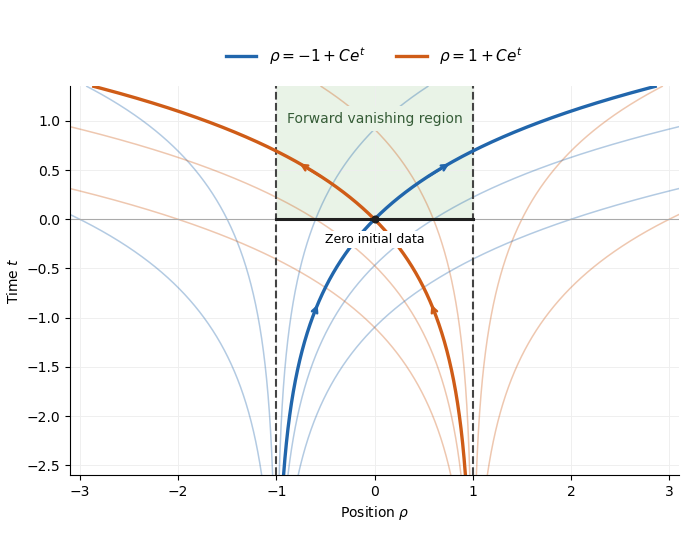
Characteristic families of the variable-coefficient wave equation
. Blue and orange curves show the two families of characteristic curves, with arrows in the direction of increasing time. Dashed lines mark the characteristic lines . The thick curves pass through the origin. The initial segment and shaded forward strip indicate the region where the zero data force vanishing, as proved in the next part. Details.
The all-time conclusion in the original PDF is false. The expanding-flow transformation of a wave equation makes both the correct forward statement and a counterexample transparent. PutFor , the expanded operator from part (i) is . In the new variables and , henceThus it is the ordinary wave equation on the half-plane . By the D'Alembert formula, any solution has the formAt , differentiating the zero displacement with respect to and using the zero velocity gives, for ,Subtracting times the first equation from the second gives , and then . Thus on and on . If and , both arguments remain in those intervals. Consequently the valid forward result isFor negative time the arguments need not stay in the initial intervals. Take and , where . Thenis a global solution, has the prescribed zero initial displacement and velocity on , but . This directly disproves the assertion for .
The connection with part (i) is directional finite propagation speed. At a future point in the strip, the two characteristics traced back to meet it at and , both in . For negative time these intersections can lie outside that interval. The lines are characteristic barriers for this forward domain of dependence, not barriers in both time directions.
Articles by others on the same topic
There are currently no matching articles.