Write . In the local-type primordial non-Gaussianity expansion, the term linear in the short field is . The long-field square contributes to the long background, the mean subtraction is spatially homogeneous, and the short-field square is excluded at the order requested. HenceThis is the long-short coupling measured by a squeezed bispectrum configuration.
Because the long potential is constant over the short-scale region, multiplication by commutes with the linear cosmological Poisson equation and any fixed linear smoothing filter. Thus the short density contrast satisfies . Taking the conditional expected value over the short Gaussian random field givesThe short-scale variance modulation by local non-Gaussianity is conditional on the long mode; averaging over that mode as well would erase the term linear in its zero mean.
Evaluate all derivatives at zero long perturbation, where , and write for the unperturbed abundance. The peak-background split changes the halo peak height toThe chain rule in the specified bias expansion therefore givesNo explicit abundance law is specified, so these derivatives are the general answer. For example, if has the Press-Schechter halo mass function dependence , then and .
For the linear long mode, the cosmological Poisson equation gives . Consequently the deterministic galaxy bias and power spectrum areHere is the linear cosmological density power spectrum; stochastic tracer noise has been omitted. This scale-dependent halo bias from local non-Gaussianity is proportional to in the specified convention.
For , plot the ratio to separate the effect from the shape of . Positive increases the ratio as decreases. Negative first suppresses it, gives a zero when , and then makes it rise again after the effective galaxy bias changes sign. The auto-power spectrum never becomes negative. A truncation is valid only when and must not be extrapolated through the zero. Within the deterministic expression, both signs give at sufficiently small . For a nearly scale-invariant primordial spectrum, in the large-scale transfer limit, so this formal asymptote is .
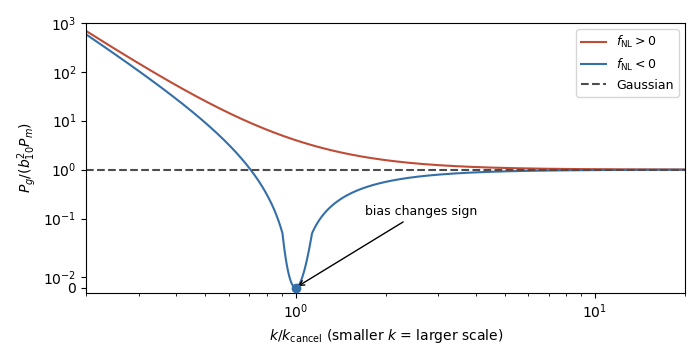
Scale-dependent galaxy bias
. Schematic deterministic power ratio for equal positive and negative coupling magnitudes, with . The negative-coupling cancellation scale defines ; the vertical axis is logarithmic away from a small linear region around zero. Details.
There is a convention issue in calling the specified abundance response an observed galaxy overdensity. The threshold response is naturally a linear Lagrangian halo bias. If instead denotes the physical linear Eulerian halo bias, the Lagrangian-to-Eulerian linear bias relation adds one to the density coefficient: , and . The boxed formulas follow the abundance expansion explicitly supplied in the paper. The Newtonian treatment also cannot be extrapolated beyond its physical large-scale domain without relativistic projection effects.
Use . For nonzero external momenta, the quadratic term in local-type primordial non-Gaussianity isInsert it in one of the three external fields. Wick theorem supplies two connected Wick contractions at each insertion, whereas the mean subtraction removes the disconnected zero-mode contribution. Thus the leading primordial bispectrum isLinear propagation by the cosmological Poisson equation gives and multiplies the primordial bispectrum by . Defining the matter three-point function by its momentum-conserving Dirac delta function times , the primordial contribution to the matter bispectrum isThe nonlinear gravitational contribution from standard perturbation theory in cosmology is excluded here.
In a squeezed bispectrum configuration, , soFor a nearly scale-invariant potential, , so the second term is subleading andRelative to the product of matter power spectra, the squeezed response is enhanced by . Its sign is the sign of . This is the three-point counterpart of the conditional short-scale variance modulation by local non-Gaussianity.
For an attractor with one adiabatic clock and a regular Bunch-Davies vacuum, a long comoving curvature perturbation acts at leading order as a spatial dilation. The single-field inflation squeezed-limit consistency relation therefore fixesFor the local convention , comparison with its squeezed primordial bispectrum givesThe matter-era negative gravitational potential is , so this is also the conventional of part (i). In single-field slow-roll inflation, the spectral tilt is small and the effective local coupling is of slow-roll size, typically of order for a tilt of a few percent. This is a statement about the normalized coupling: the squeezed primordial bispectrum still contains the large long-mode power spectrum.
Formally putting this small coupling into the local template of part (ii) predicts only a tiny correction on accessible scales, rather than an order-unity local signal. For a physical halo abundance there is a stronger qualification. The consistency-relation modulation at fixed coordinate wavelength is a dilation; the coordinate size of a fixed physical halo must be dilated too. Those responses cancel. This is the absence of primordial scale-dependent halo bias in single-clock inflation: the leading consistency-relation term produces no physical halo bias. The first physical long-mode response contains two spatial derivatives, so dividing it by does not produce the local-template enhancement. Thus the leading primordial large-scale galaxy power spectrum remains the Gaussian-bias result, apart from ordinary transfer, bias, and projection effects.
The cancellation can be seen with a top-hat filter. At fixed local time, a constant long curvature rescales physical lengths by , so the coordinate radius of a fixed physical halo is , and the coordinate short density contrast is . Changing variables givesThus the smoothed field and its variance at fixed physical mass are unchanged by the constant long mode.
The assumptions matter: a non-attractor such as ultra-slow-roll inflation, additional fluctuating fields, or an excited initial state need not obey this squeezed-limit conclusion. A sizable physical local modulation would test the stated single-clock attractor assumptions, rather than every possible one-field model.
Articles by others on the same topic
There are currently no matching articles.