Use the one-loop matter power spectrum convention in which is one ordering of . Thenwith the P22 contribution to the one-loop matter power spectrumand the P13 contribution to the one-loop matter power spectrumThe factors two and three count Wick contractions. The mixed contains an odd number of zero-mean Gaussian fields, so .
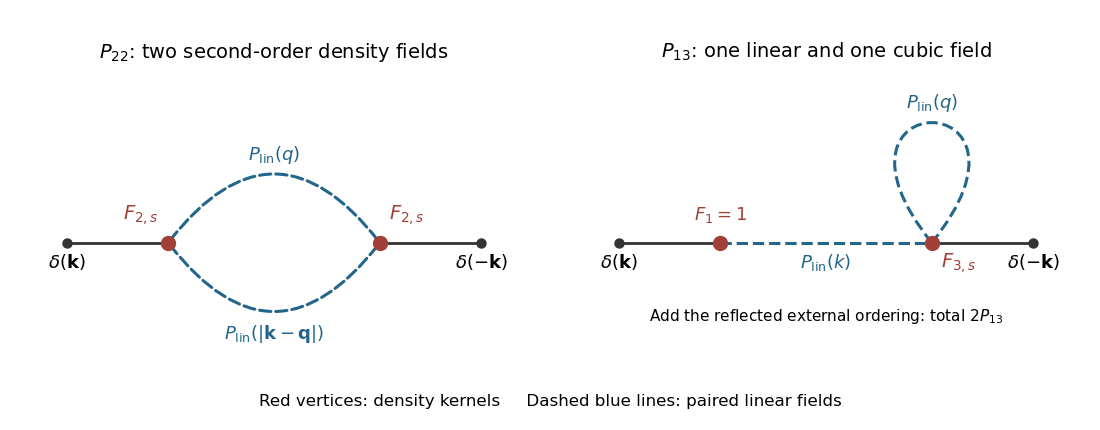
One-loop contributions to the matter power spectrum
. The two one-loop power-spectrum topologies. Solid lines attach external density fields to kernels; dashed lines pair linear fields and carry a linear power spectrum. The P13 topology has two external orderings. Details.
For , the ultraviolet softness of the second-order density kernel gives , soThe third-order kernel has , givingThese integrals expose the sensitivity to unresolved short-scale dynamics. The effective sound-speed counterterm in large-scale structure has exactly the required deterministic shape:Here absorbs the time and normalization conventions and has dimensions of length squared. A stochastic correction begins at and can absorb the corresponding short-scale sensitivity of .
The linear density contrast is Gaussian, so its cubic moment vanishes. The leading contribution isTwo connected Wick contractions giveThe third pairing vanishes because . Isotropy makes and , so the angular average of the kernel isSince to leading order, the unsmoothed matter-density reduced skewness isThis assumes finite unsmoothed variance; inserting a smoothing window generally changes .
Use the imaginary-axis contour of the inverse transform of the moment-generating function, , so the Gaussian part gives the normal distributionBecause , the first non-Gaussian term isDifferentiating the Gaussian three times givesHence the Edgeworth expansion isEquivalently its correction is , with , a Probabilists' Hermite polynomial. It integrates to zero and reproduces the third moment . The expansion is intended for weak non-Gaussianity in the bulk, rather than the far tails.
Articles by others on the same topic
There are currently no matching articles.