The early-time state is the adiabatic Bunch-Davies vacuum: modes well inside the sound horizon approach positive-frequency Minkowski modes, and the tilted early-time contour selects the interacting vacuum by damping unwanted excitations. The in-in formalism evolves this one initial state forward to the observation time and backward, computing . An in-out calculation instead computes a transition amplitude between prescribed initial and final states.
In the interaction picture, the free quadratic Hamiltonian evolves both and the free fields inside . The background Hamiltonian determines the homogeneous solution; the cubic Hamiltonian supplies the perturbative interaction insertions. In particular, the interaction-picture fields evolve under the quadratic Hamiltonian.
For the P(X, phi) scalar field theory, the background pressure is and the energy density is . Differentiating at fixed gives and , so the Sound speed of a P(X, phi) scalar perturbation isThis is the propagation speed of the scalar fluctuation; the derivative is taken at fixed field, rather than along an arbitrary background trajectory.
On the fixed expanding metric,Write the comoving curvature perturbation in the paper's convention as . Neglecting slow-roll derivatives of and yieldsWith and , the only cubic terms areThe identities and give the cubic curvature action for a P(X, phi) scalar fieldIf , the unfactored expression above supplies the regular limiting result.
For the requested primordial bispectrum, define and . The cubic Hamiltonian and combine to giveHere the positive sign comes from the two spatial derivatives and at cubic order. Wick theorem gives two contractions for each choice of which external leg meets . At the external time zero,Thus, after removing the momentum-conserving delta function, the Hamiltonian contraction isPut . Then and . The cancels the in ; moreover,Inserting these expressions into the in-in formalism and conjugating the expression inside the real part giveswhere . Conjugating the integrand also conjugates the contour: the original positive-frequency-product integral has lower limit , whereas the negative exponential displayed here requires . This supplies the convergent interpretation of the paper's integral.
Use the one-loop matter power spectrum convention in which is one ordering of . Thenwith the P22 contribution to the one-loop matter power spectrumand the P13 contribution to the one-loop matter power spectrumThe factors two and three count Wick contractions. The mixed contains an odd number of zero-mean Gaussian fields, so .
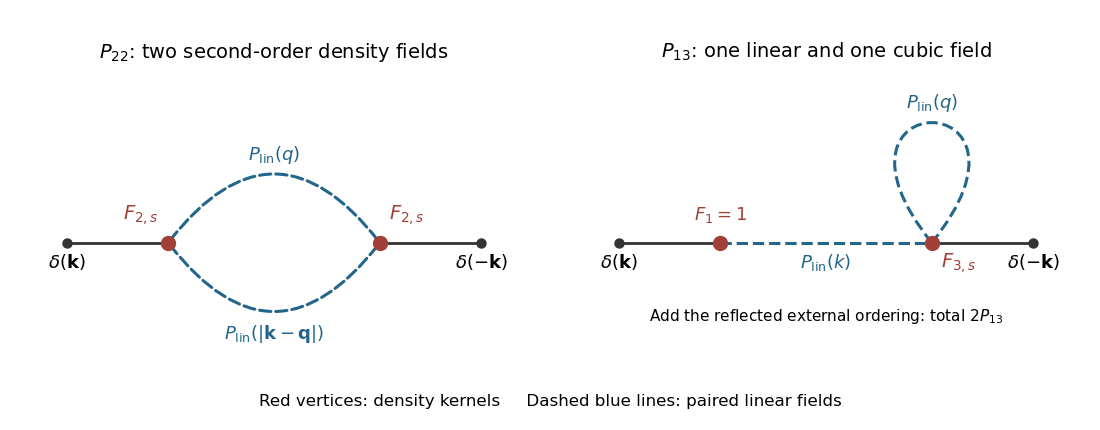
One-loop contributions to the matter power spectrum
. The two one-loop power-spectrum topologies. Solid lines attach external density fields to kernels; dashed lines pair linear fields and carry a linear power spectrum. The P13 topology has two external orderings. Details.
For , the ultraviolet softness of the second-order density kernel gives , soThe third-order kernel has , givingThese integrals expose the sensitivity to unresolved short-scale dynamics. The effective sound-speed counterterm in large-scale structure has exactly the required deterministic shape:Here absorbs the time and normalization conventions and has dimensions of length squared. A stochastic correction begins at and can absorb the corresponding short-scale sensitivity of .
The linear density contrast is Gaussian, so its cubic moment vanishes. The leading contribution isTwo connected Wick contractions giveThe third pairing vanishes because . Isotropy makes and , so the angular average of the kernel isSince to leading order, the unsmoothed matter-density reduced skewness isThis assumes finite unsmoothed variance; inserting a smoothing window generally changes .
Use the imaginary-axis contour of the inverse transform of the moment-generating function, , so the Gaussian part gives the normal distributionBecause , the first non-Gaussian term isDifferentiating the Gaussian three times givesHence the Edgeworth expansion isEquivalently its correction is , with , a Probabilists' Hermite polynomial. It integrates to zero and reproduces the third moment . The expansion is intended for weak non-Gaussianity in the bulk, rather than the far tails.
A scalar Fourier mode selects one spatial direction, , and has no transverse vector or tensor polarization. Rotations about therefore leave its temperature and polarization patterns unchanged. Only azimuthal number occurs in the corresponding spherical harmonic expansion.
Let and use the paper's conventionwhich omits the factor used in some other definitions of the photon temperature multipole. In Fourier space the transport term is . The Legendre polynomial recurrence relation makes its coefficient at multipole equal toThe gravitational time derivative is purely monopolar, and the potential gradient and baryon velocity are dipolar. Thomson scattering removes the monopole from its relaxation term and adds the quadrupole polarization correction. Thus the photon Boltzmann hierarchy isThe term containing is understood as zero.
Dropping gravity and expansion from the photon Boltzmann hierarchy givesThe first equation is photon energy continuity: the photon dipole transports the photon monopole. The second is the photon Euler equation: a pressure gradient accelerates the radiation, its quadrupole contributes shear stress, and Thomson scattering drags the velocity toward the baryon velocity.
With , the scattering contribution to is . Radiation momentum density is , whereas baryon momentum density is . Conservation of total momentum therefore requiresorSince the cosmological optical depth is measured to the observation time, ; the two drag terms reduce their relative velocity.
Write . The tight-coupling approximation requires : frequent Thomson scattering makes the photon-baryon velocity slip small and suppresses higher multipoles. Work with constant on the short scales of the question.
Set and . The dipole and baryon equations implyTo leading order, . Differentiating this and keeping the first correction in yieldsTerms involving derivatives of contribute at the next order here.
The leading polarization balance isThe temperature equation then becomesso the photon quadrupole in tight coupling with polarization isFinally substitute into the corrected dipole equation. This gives the photon-baryon diffusion damping equationThe oscillation frequency agrees with the photon-baryon sound speed. The positive damping coefficient comes from velocity slip and shear viscosity. Its growth as suppresses small-scale oscillations, producing the Silk damping tail and reducing the high-multipole Cosmic microwave background acoustic peaks.
In a local orthonormal frame, a massless neutrino has and . With degeneracy , kinetic theory gives the stress-energy tensorCoordinate components follow by inserting the orthonormal-frame vectors on the indices.
For the perturbation , integration by parts givesassuming the boundary term vanishes. Consequently the physical trace-free spatial stress isThe paper uses the opposite signed source, , consistently with its tensor equation having on the right. In that convention the neutrino tensor anisotropic stress is
The Collisionless Boltzmann equation is . At first order, directional deflections act only on the isotropic background and hence give no angular contribution. Differentiating along the unperturbed trajectory givesUsing the tensor redshift of the comoving energy,The method of characteristics follows the backward ray . With zero initial perturbation, the line-of-sight solution isTo this order the frame and coordinate direction components may be identified inside a quantity already proportional to .
Write and . Since , the line-of-sight solution isThe angular pattern is proportional to . Projecting onto this spherical harmonic multiplies its coefficient bywhere and is a Spherical Bessel function. Thus the quadrupole isUse the isotropic tensor integralBecause is symmetric and trace-free, contracting this with gives . Substitution into the paper's signed neutrino tensor anisotropic stress therefore givesThe neutrino tensor free-streaming kernel is finite at the origin, with .
Insert the result for the neutrino tensor anisotropic stress into the tensor wave equation and divide out . Since the Fourier transform replaces by , the source coefficient is . The flat Friedmann equation givesso . HenceThis memory term transfers coherent tensor motion into directional neutrino perturbations. Free-streaming neutrinos damp the tensor oscillation amplitude after horizon entry, suppressing the gravitational-wave contribution to cosmic microwave background temperature and polarization spectra. The kernel acts on , so a constant superhorizon tensor mode is unaffected at leading order.
Articles by others on the same topic
There are currently no matching articles.