For the stated axisymmetric flow, the diagonal components of the rate-of-strain tensor areTheir sum is , the incompressibility condition. In the leading thin-sheet approximation, vanishing tangential traction makes independent of . The normal stress boundary condition is , so the Newtonian fluid stress tensor givesThereforeFor the small annular sector, the inner and outer radial faces contribute in the radial direction. The two azimuthal faces contribute : their hoop tractions have inward radial components. The combined radial force of the external pressure on the sloping upper and lower surfaces is .
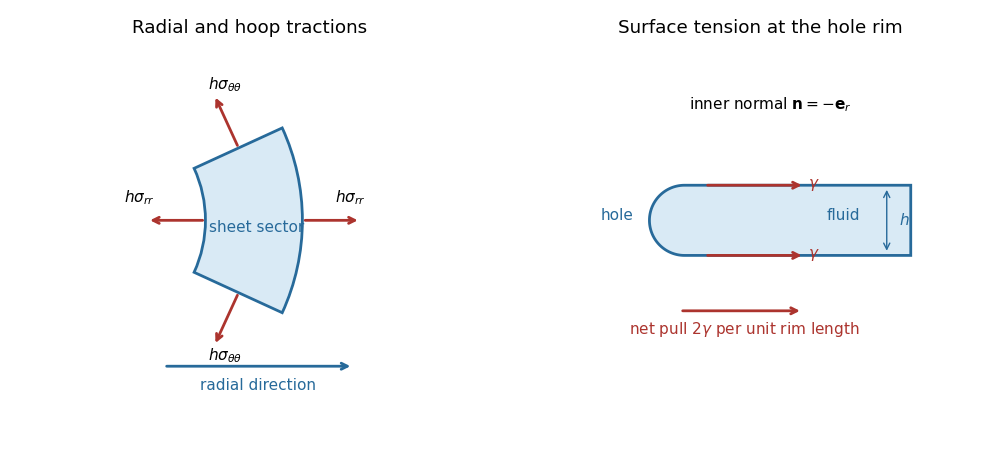

Neglecting inertia, force balance is thusSubstituting the two stresses cancels the terms involving and gives the axisymmetric viscous-sheet stretching equations:Finally, conservation of mass in the sector gives
Articles by others on the same topic
There are currently no matching articles.