For the stated axisymmetric flow, the diagonal components of the rate-of-strain tensor areTheir sum is , the incompressibility condition. In the leading thin-sheet approximation, vanishing tangential traction makes independent of . The normal stress boundary condition is , so the Newtonian fluid stress tensor givesThereforeFor the small annular sector, the inner and outer radial faces contribute in the radial direction. The two azimuthal faces contribute : their hoop tractions have inward radial components. The combined radial force of the external pressure on the sloping upper and lower surfaces is .
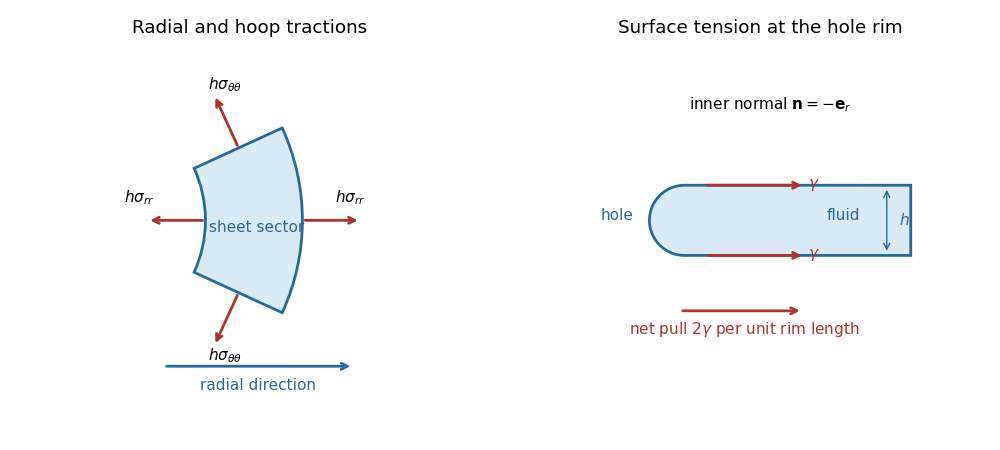

Neglecting inertia, force balance is thusSubstituting the two stresses cancels the terms involving and gives the axisymmetric viscous-sheet stretching equations:Finally, conservation of mass in the sector gives
Put , so . Balancing the viscous and pressure terms in the axisymmetric viscous-sheet stretching equations, together with fixed volume, suggests a similarity solutionThe conservation of mass equation becomesThere is no ongoing source at the origin, so the integration constant vanishes and wherever . Thus . Substitution into radial force balance givesA differentiable cannot have nonzero derivative on an interval while being fixed there at . Hence : the spreading sheet has uniform thickness.
At the material edge, . Since , the edge condition fixes . Fixed volume then fixes the radius. The self-similar spreading of a viscous oil slick isThe point-release idealization is singular at ; a finite initial uniform slick gives the same solution with a time shift.
Each broad face supplies surface tension pulling the rounded hole edge into the remaining sheet. Their resultant is per unit circumference. At the inner boundary the fluid's outward normal is , so the boundary traction is outward in the radial direction when . The right panel of the preceding diagram shows these two capillary pulls.
With uniform thickness and , the axisymmetric viscous-sheet stretching equations reduce toThis Euler-Cauchy equation gives . The fixed outer rim imposes , hence . Because , conservation of mass gives , independent of . Thus a uniform sheet remains uniform.
The radial stress is . Its value at the hole edge determinesThe edge is material, so andNeglecting the initially tiny hole's volume, conservation of mass gives , or with . Therefore the capillary growth of a hole in a viscous sheet obeysFor a finite initial hole , replace in the denominator by . A nonzero seed is needed: the exact initial condition gives the stationary solution of this differential equation. For a small positive seed, initially grows exponentially at rate .
Articles by others on the same topic
There are currently no matching articles.