The material derivative follows the interfacial surfactant. The term describes dilution by tangential expansion and concentration by compression. The term accounts for changing surface area due to normal motion of a curved interface. Finally, describes surface diffusion. Together these give conservation of insoluble surfactant on a moving interface.
The relevant surface Péclet number isWrite and . Since has zero trace and , the surface divergence isThere is no normal motion. To first order in , the steady surfactant balance becomes . The traceless quadratic is a degree-two spherical harmonic, so . The mean of is zero by total surfactant conservation; consequentlyThe discarded advective term is smaller by . This is the quadrupolar surfactant distribution on a spherical interface.
With the unit normal directed from the bubble into the exterior, the interfacial stress balance with variable surface tension isUsing the specified first-order curvature and , together with , givesThe first term is the spherical capillary pressure; the last contains the normal tension correction and the tangential Marangoni stress.
The ambient Stokes flow has the symmetry of the symmetric traceless tensor . In the Unscaled Papkovich–Neuber representation, is harmonic and yields . The decaying vector potential must have the form , and the scalar disturbance must have the degree-two form . They are harmonic outside the bubble and have precisely the required rotational covariance. Dimensionless amplitudes may therefore be writtenFor a steady bubble, the no-penetration boundary condition gives . Its tangential velocity gives . The tangential stress boundary condition then yieldsHence , and . The inviscid interior supplies only the constant pressure balancing . Matching the remaining normal stress givesEliminating givesAs , : the Marangoni stress suppresses tangential motion and effectively immobilizes the interface. This limit must retain the small surface Péclet number and small-deformation assumptions; can grow through increasing without invalidating the linear concentration approximation.
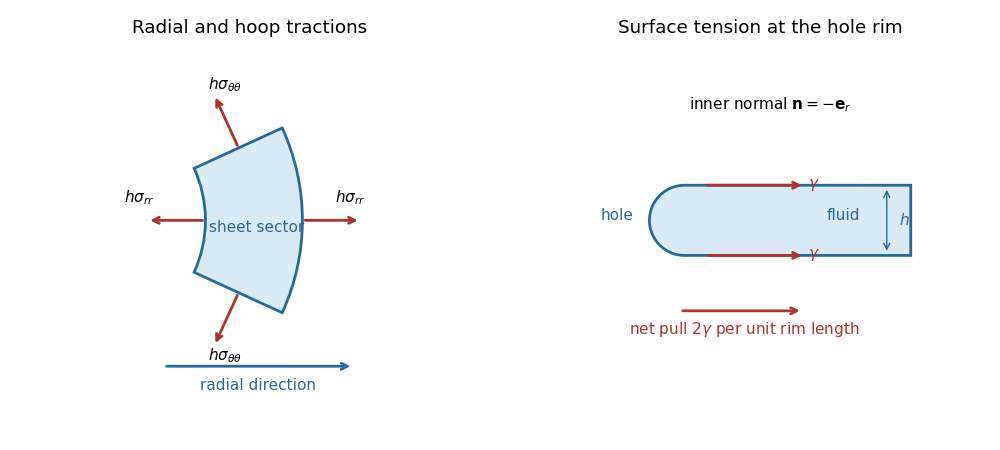
For the stated axisymmetric flow, the diagonal components of the rate-of-strain tensor areTheir sum is , the incompressibility condition. In the leading thin-sheet approximation, vanishing tangential traction makes independent of . The normal stress boundary condition is , so the Newtonian fluid stress tensor givesThereforeFor the small annular sector, the inner and outer radial faces contribute in the radial direction. The two azimuthal faces contribute : their hoop tractions have inward radial components. The combined radial force of the external pressure on the sloping upper and lower surfaces is .

Neglecting inertia, force balance is thusSubstituting the two stresses cancels the terms involving and gives the axisymmetric viscous-sheet stretching equations:Finally, conservation of mass in the sector gives
Put , so . Balancing the viscous and pressure terms in the axisymmetric viscous-sheet stretching equations, together with fixed volume, suggests a similarity solutionThe conservation of mass equation becomesThere is no ongoing source at the origin, so the integration constant vanishes and wherever . Thus . Substitution into radial force balance givesA differentiable cannot have nonzero derivative on an interval while being fixed there at . Hence : the spreading sheet has uniform thickness.
At the material edge, . Since , the edge condition fixes . Fixed volume then fixes the radius. The self-similar spreading of a viscous oil slick isThe point-release idealization is singular at ; a finite initial uniform slick gives the same solution with a time shift.
Each broad face supplies surface tension pulling the rounded hole edge into the remaining sheet. Their resultant is per unit circumference. At the inner boundary the fluid's outward normal is , so the boundary traction is outward in the radial direction when . The right panel of the preceding diagram shows these two capillary pulls.
With uniform thickness and , the axisymmetric viscous-sheet stretching equations reduce toThis Euler-Cauchy equation gives . The fixed outer rim imposes , hence . Because , conservation of mass gives , independent of . Thus a uniform sheet remains uniform.
The radial stress is . Its value at the hole edge determinesThe edge is material, so andNeglecting the initially tiny hole's volume, conservation of mass gives , or with . Therefore the capillary growth of a hole in a viscous sheet obeysFor a finite initial hole , replace in the denominator by . A nonzero seed is needed: the exact initial condition gives the stationary solution of this differential equation. For a small positive seed, initially grows exponentially at rate .
Reflection in preserves the prescribed translational velocity and axial angular velocity. A force transforms as a polar vector, whereas a torque transforms as an axial vector; consequently . Reflection in reverses both imposed motions but preserves the normal force component. The linearity of Stokes flow then gives . Thus only and can be nonzero.
There is a sign inconsistency in the printed question. In right-handed coordinates, gives a rotational velocity at the sphere's lowest point. The printed shear and force formulas instead use the opposite rotational sense. Below, let be the right-handed component along ; the paper's displayed formulas are recovered by setting .
In the translating frame, the parabolic gap and leading boundary velocities areThe no-slip boundary condition and lubrication theory giveThe gap is stationary in this frame, so . The Reynolds lubrication equation is thereforeSince and ,Differentiating the velocity profile gives the leading shear stressesThe first expression becomes the printed formula after .
For the logarithmic lubrication resistance of a sphere near a wall, write . The logarithmic region is , where . ConsequentlyThese follow from and , with a fixed small outer cutoff. The general logarithmic radial numerator is over ; the numerator in the printed integration hint appears to have a typographical error.
The force exerted on the fluid through the upper gap boundary includes pressure acting on its slope:The pressure cancels the term, givingPressure exerts no torque about the centre of a sphere because its traction is radial. To logarithmic order, the shear has lever arm , soThe other components vanish by parity: involves an integral of the term, and has an integrand odd in . The combined hydrodynamic resistance matrix isIts equal off-diagonal coefficients are required by the Lorentz reciprocal theorem for Stokes flow. It is a positive-definite matrix, as required by viscous dissipation.
In the rotational convention of the printed force formula, set and measure the scalar couple along , so . ThenFor sedimentation under the buoyancy-adjusted weight , a uniform sphere is torque-free. Thus , and the force balance givesThe rotational scalar in the paper's displayed-force convention is . The sphere rolls in the right-handed sense but still slips: its lowest point has laboratory velocity . The signs and coefficients of the right-handed resistance agree with the rigid-wall terms of Bertin et al., equations (4.4)–(4.5), after reversing the forces and torques there from fluid-on-sphere to sphere-on-fluid.
Articles by others on the same topic
There are currently no matching articles.