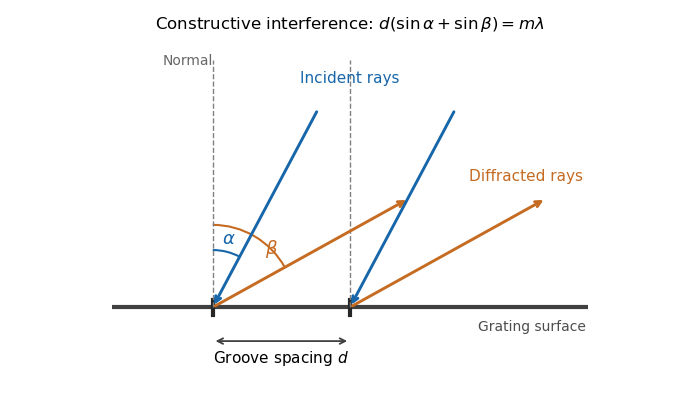
The bright peaks occur when contributions from adjacent grooves have equal phase modulo , so all illuminated grooves contribute by constructive interference. Use the reflection-grating convention shown below: and are positive angles of the incident and outgoing ray lines on the same side of the normal. The incoming and outgoing path differences between neighboring grooves are and , respectively. Hence the grating equation isThe integer labels the diffraction order. With a different signed-angle convention, the same physical condition contains a difference of sines.

Articles by others on the same topic
There are currently no matching articles.