The bright peaks occur when contributions from adjacent grooves have equal phase modulo , so all illuminated grooves contribute by constructive interference. Use the reflection-grating convention shown below: and are positive angles of the incident and outgoing ray lines on the same side of the normal. The incoming and outgoing path differences between neighboring grooves are and , respectively. Hence the grating equation isThe integer labels the diffraction order. With a different signed-angle convention, the same physical condition contains a difference of sines.
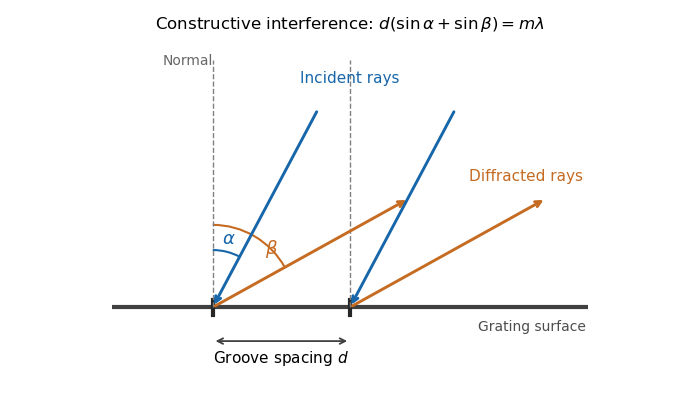
Reflection-grating angle convention
. The incident ray and selected outgoing ray are both drawn on the positive side of the surface normal. Adjacent groove spacing contributes the sum of their two projected path differences. Details.
At fixed incidence angle, differentiation of the grating equation gives . Near the camera axis, the focal-plane displacement is , so the local grating dispersion isIt has units of distance per unit wavelength. If the camera axis is at and the flat focal-plane coordinate is retained exactly as , thenThe boxed expression is the local value at the optical axis.
In the simple slit-image approximation, the projected slit width is . Equating this width to the separation of barely resolved features, using the grating dispersion, givesThis recovers the stated spectral resolving power under the assumption that the grating has unit anamorphic magnification.
For arbitrary distinct and , the anamorphic magnification of a grating must be included. At fixed wavelength, the grating equation gives , so the slit image instead has width . Thus the general slit-limited resolving power of a grating isThe two expressions agree in the Littrow configuration, . Without that condition or the unit-magnification approximation, the quoted expression is not the general slit-limited result. Finite grating size, detector sampling, and optical aberrations can lower the actual resolution further.
The echellogram contains nearly parallel traces, one for each diffraction order. Choose the main echelle grating dispersion to increase wavelength toward the right and the cross-disperser to increase wavelength upward. At a fixed horizontal coordinate, order has a shorter wavelength than order , so it lies below order in this convention.
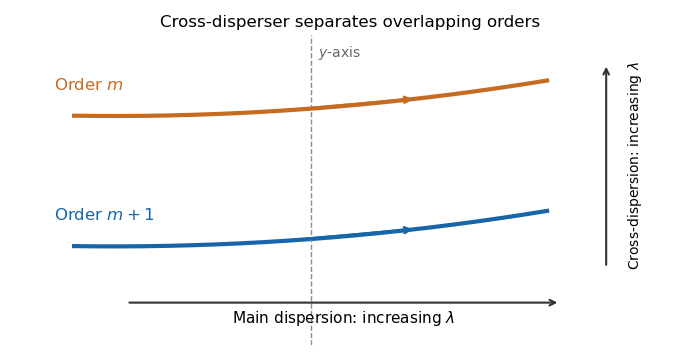
Adjacent orders in a cross-dispersed echellogram
. Order m+1 is bluer than order m at the same main-dispersion coordinate. Within either order, wavelength increases along the trace to the right; the chosen cross-dispersion orientation puts longer wavelengths higher on the detector. Details.
Let be the central camera direction. The grating equation fixesThe usual adjacent-order free spectral range of an echelle grating is thereforeThe constant has dimensions of length and is the path difference between adjacent grooves for light directed along the camera axis; it is also the fixed product . Near the Littrow configuration, . The detector width corresponding to this interval is approximately , with grating dispersion .
There is a convention issue in reading the question literally. Adjacent order-center separation is exactly the expression above. A partition assigning each wavelength to whichever order lands closest to the vertical axis has boundaries halfway in detector displacement, not at adjacent order centers. In the small-angle detector approximation its boundaries for order are and , giving width . Both conventions give for high orders, but their exact finite- widths differ. The quoted expression is the conventional adjacent-order spacing.
The magnitude zero point is defined by the reference response . With zero magnitude assigned to that reference, the apparent magnitude isThe two responses must use the same photometric passband and instrumental weighting. If the reference has assigned magnitude instead, add to the right-hand side.
The traditional infrared photometric bands extending the optical photometric system into this range are approximatelyTheir photometric passbands lie mainly in atmospheric windows between strong molecular absorption bands. This makes ground-based observations practical. The exact centers depend on the system: is near , and shortened and bands reduce unwanted background or absorption. At the longest wavelengths, atmospheric and instrumental thermal radiation make sky brightness especially important. A modern band near is an additional choice, rather than one of the traditional extensions.
For identical luminosities in a uniform Euclidean distribution, the inverse-square law gives flux , while the number of sources within distance is proportional to . Therefore ten times as many objects require and . Applying the definition of apparent magnitude givesThis is the Euclidean magnitude-limited source count relation. It assumes no extinction, spatial variation of density, or cosmological change in the flux-distance relation.
Atmospheric extinction changes the amplitude of the incoming light through absorption and scattering. Its wavelength dependence alters the measured optical spectrum and colors; clouds and aerosols introduce additional time dependence. Scattered moonlight and atmospheric emission increase sky brightness.
Atmospheric refraction changes the apparent position of the source. Its wavelength dependence, atmospheric dispersion, spreads a broadband image toward the zenith. The mean refractive index gradient therefore affects direction even in the absence of small-scale turbulence.
Atmospheric turbulence produces rapidly varying optical path lengths, distorting the phase and curvature of a nominally plane wavefront. Different pupil regions acquire different phase delays, producing astronomical seeing, image motion, and short-exposure speckle patterns. Different lines of sight sample different fluctuations, giving anisoplanatism.
Propagation through the fluctuating medium also changes the intensity through atmospheric scintillation, the familiar twinkling of stars. A phase-only adaptive optics correction can reduce atmospheric phase errors but does not remove absorption, all scintillation, or the atmospheric emission background.
Articles by others on the same topic
There are currently no matching articles.