The bright peaks occur when contributions from adjacent grooves have equal phase modulo , so all illuminated grooves contribute by constructive interference. Use the reflection-grating convention shown below: and are positive angles of the incident and outgoing ray lines on the same side of the normal. The incoming and outgoing path differences between neighboring grooves are and , respectively. Hence the grating equation isThe integer labels the diffraction order. With a different signed-angle convention, the same physical condition contains a difference of sines.
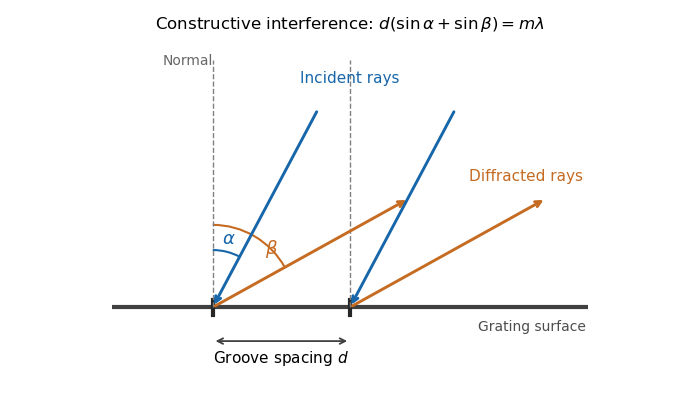
Reflection-grating angle convention
. The incident ray and selected outgoing ray are both drawn on the positive side of the surface normal. Adjacent groove spacing contributes the sum of their two projected path differences. Details.
At fixed incidence angle, differentiation of the grating equation gives . Near the camera axis, the focal-plane displacement is , so the local grating dispersion isIt has units of distance per unit wavelength. If the camera axis is at and the flat focal-plane coordinate is retained exactly as , thenThe boxed expression is the local value at the optical axis.
In the simple slit-image approximation, the projected slit width is . Equating this width to the separation of barely resolved features, using the grating dispersion, givesThis recovers the stated spectral resolving power under the assumption that the grating has unit anamorphic magnification.
For arbitrary distinct and , the anamorphic magnification of a grating must be included. At fixed wavelength, the grating equation gives , so the slit image instead has width . Thus the general slit-limited resolving power of a grating isThe two expressions agree in the Littrow configuration, . Without that condition or the unit-magnification approximation, the quoted expression is not the general slit-limited result. Finite grating size, detector sampling, and optical aberrations can lower the actual resolution further.
Articles by others on the same topic
There are currently no matching articles.