The echellogram contains nearly parallel traces, one for each diffraction order. Choose the main echelle grating dispersion to increase wavelength toward the right and the cross-disperser to increase wavelength upward. At a fixed horizontal coordinate, order has a shorter wavelength than order , so it lies below order in this convention.
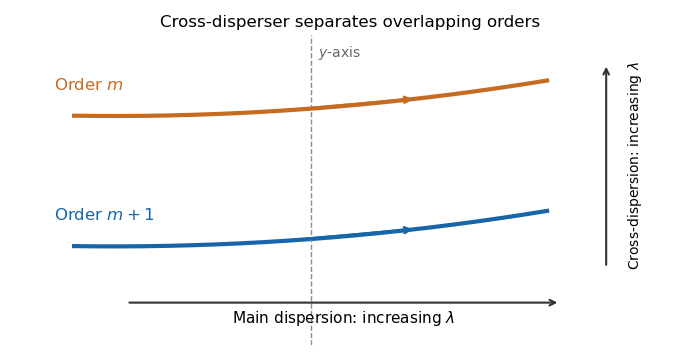
Adjacent orders in a cross-dispersed echellogram
. Order m+1 is bluer than order m at the same main-dispersion coordinate. Within either order, wavelength increases along the trace to the right; the chosen cross-dispersion orientation puts longer wavelengths higher on the detector. Details.
Let be the central camera direction. The grating equation fixesThe usual adjacent-order free spectral range of an echelle grating is thereforeThe constant has dimensions of length and is the path difference between adjacent grooves for light directed along the camera axis; it is also the fixed product . Near the Littrow configuration, . The detector width corresponding to this interval is approximately , with grating dispersion .
There is a convention issue in reading the question literally. Adjacent order-center separation is exactly the expression above. A partition assigning each wavelength to whichever order lands closest to the vertical axis has boundaries halfway in detector displacement, not at adjacent order centers. In the small-angle detector approximation its boundaries for order are and , giving width . Both conventions give for high orders, but their exact finite- widths differ. The quoted expression is the conventional adjacent-order spacing.
Articles by others on the same topic
There are currently no matching articles.