Substitute the harmonic plane waveinto the elastic wave equation. The vector identitygivesIf is parallel to , this becomesand gives a longitudinal P-wave. If , it becomesand gives either polarization of an S-wave.
For , convenient polarization vectors areThe SV-wave lies in the propagation plane, whereas the SH-wave is perpendicular to that plane.
Fix . For a P-wave,SetEqual-amplitude P-waves with vertical wavenumbers then give, after an irrelevant common normalization,Thus is even and both scalar functions multiplying and are real.
Similarly, putUsing the in-plane transverse polarizations and for the two vertical directions givesThis has the same required parity and reality properties.
Take a linear combination of the P- and SV-fields from part (b). The rigid boundary condition at givesThe conditions at are the same because the horizontal displacement is even and the vertical displacement is odd. A nonzero pair exists exactly when the determinant vanishes:Therefore the rigid elastic waveguide mode dispersion relation is
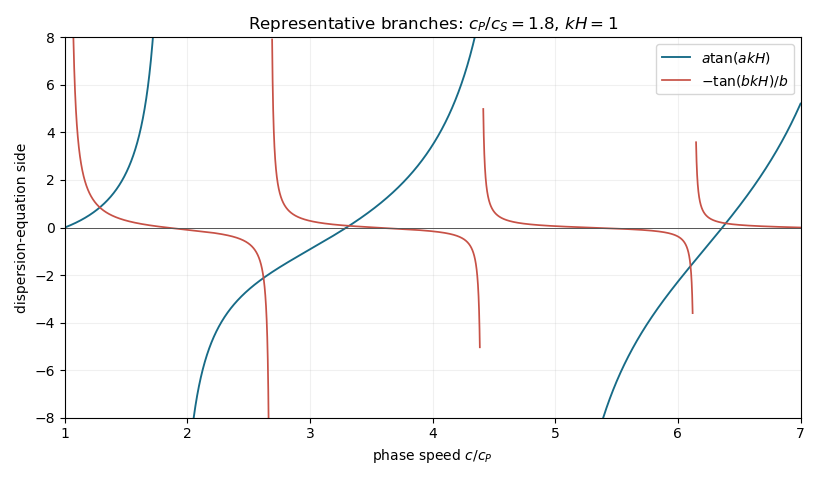
Dispersion relation branches in an elastic waveguide
. As increases, both and increase without bound. The two sides consequently have infinitely many alternating tangent branches and poles. On successive continuity intervals their relative ordering reverses, so the intermediate value theorem gives infinitely many intersections, corresponding to infinitely many propagating waveguide modes.
Articles by others on the same topic
There are currently no matching articles.