Interpret every logarithm in the empirical profile as base ten with the dimensionless argument . PutThe upper atmosphere has for , while integration of below it givesAssume that the stated planetary equilibrium temperature is a reasonable brightness temperature at the photosphere. ThenAt , , and thereforeThis estimate neglects day-night variation, wavelength-dependent photospheric pressure, and a possible radiative-convective boundary; it treats the retrieved profile as representative of the dayside disk.
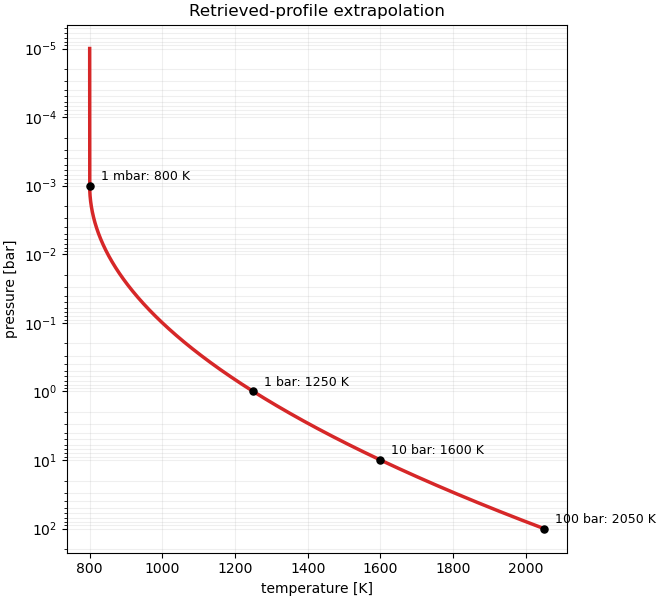
In a thin atmosphere in hydrostatic equilibrium, take gravity and mean molecular mass as constant. The ideal gas equation of state and hydrostatic balance giveFor ,so the atmospheric lapse rate follows from the chain rule:It vanishes in the assumed isothermal region above . If natural logarithms are used instead, the factor is absent and the fitted numerical value of changes accordingly.
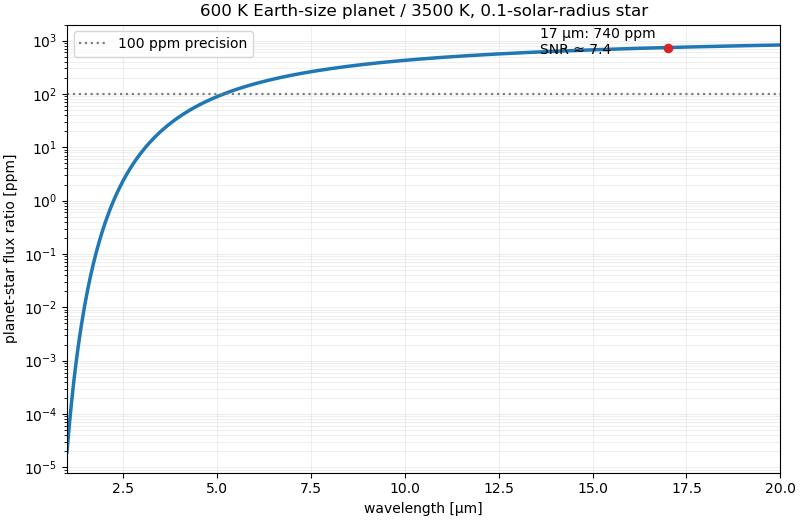
Assume that both objects emit as blackbodies, take and , and use because the line-free window sees the -bar continuum photosphere. Across a narrow bin, the thermal eclipse depth isAt this givesIntegrating the Planck law over the full bin changes this narrow-bin estimate only slightly.
For , , , and , the same thermal eclipse depth at isThus a uncertainty givesThis assumes one independent eclipse measurement with that precision, negligible reflected light in the infrared, no atmosphere, and blackbody emission from the bare surface.


Articles by others on the same topic
There are currently no matching articles.