Planck's law gives the spectral radiance of an ideal blackbody in thermal equilibrium at absolute temperature . It predicts how much power is carried in each small frequency or wavelength interval, per projected area and per solid angle. The whole curve is determined by : no material-specific parameter enters this ideal Planck function.
Writing for frequency in hertz and for wavelength in metres, the two forms of the Planck function areHere is the Planck constant, the Boltzmann constant, and the speed of light in vacuum. Their exact values in the International System of Units are , , and . [ref]
https://www.nist.gov/si-redefinition/meet-constants. NIST, Meet the Constants
The units matter: is measured in , whereas is measured in . Both are spectral radiance, rather than radiant exitance or energy density. To report per micrometre, multiply its per-metre value by ; a micrometre-wide interval is metres wide.
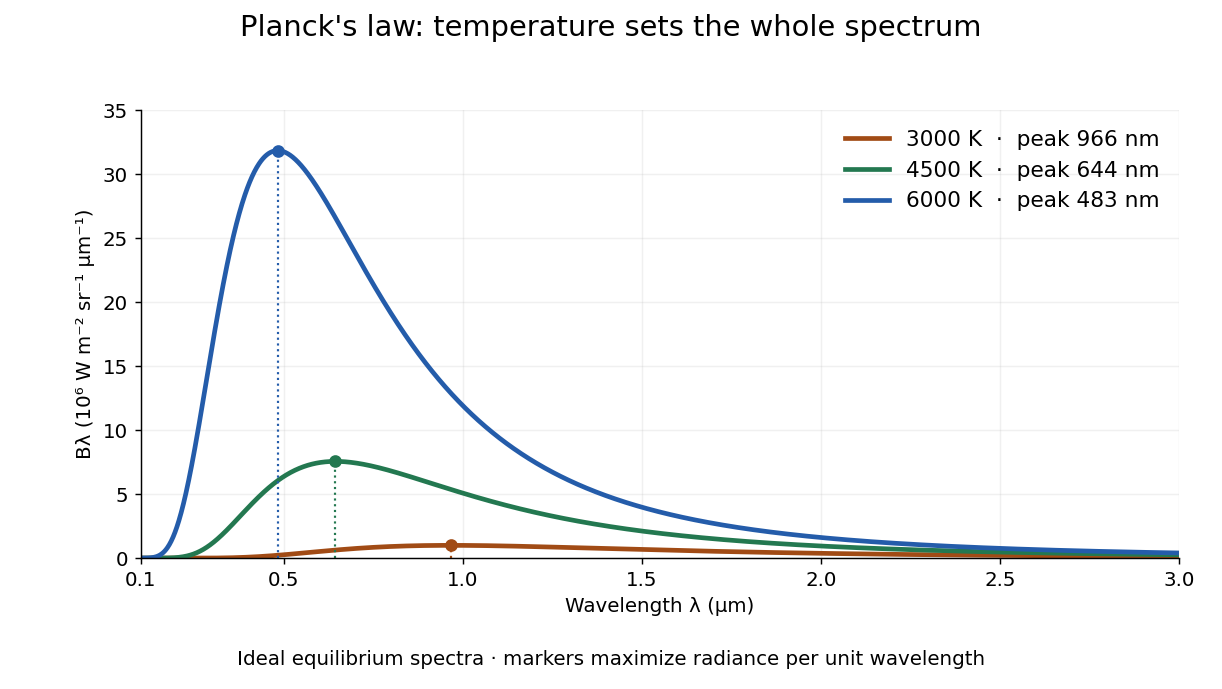
For a computed example, at and , the exponent is . Substitution into Planck's law gives , or per micrometre. At the same wavelength, the illustrative temperatures and give and in the latter units. These are ideal predictions for stipulated temperatures.
The key change of variables is . Corresponding positive intervals carry the same power, so andEqual-width wavelength intervals have unequal widths in frequency; the factor compensates for this. Merely replacing the horizontal-axis labels of by does not produce . This explains the frequency and wavelength peaks of Planck's law.
A short derivation uses the Boltzmann distribution for a single electromagnetic mode with thermal energies , . Put . The geometric series gives and mean thermal energy . The electromagnetic mode density in a box, including both independent polarization of an electromagnetic wave states of a photon, is per volume per unit frequency. Multiplication gives spectral energy density ; isotropy gives . This counts thermal excitation energy, excluding zero-point energy. [ref]
https://www.feynmanlectures.caltech.edu/I_41.html#Ch41-S3. Feynman Lectures, I.41.3, quantum oscillator and radiation
Planck's law connects quantum mechanics to a measurable radiation curve. Its small- limit is the Rayleigh-Jeans law, ; its large- limit is the Wien approximation, . The suppression at high frequency makes the total energy density finite. Integrating the curve gives the Stefan–Boltzmann law, while locating its peak gives Wien's displacement law. Thus one formula predicts both the spectral shape and the total emission.
At a fixed temperature, the frequency maximizing and the wavelength maximizing in Planck's law are different ways of describing the same black-body radiation. They are maxima of different densities. The inverse relation between frequency and wavelength does not preserve those maxima because its interval-conversion factor varies with wavelength.
For a short extremum calculation, substitute into , leaving a positive constant times . Substitute into , leaving a positive constant times . Setting each derivative to zero givesSelect the positive roots: and . Although solves the rearranged equations, it is an endpoint, not either peak. For or , the function initially increases, its derivative crosses zero once, and it eventually becomes negative. Hence it has exactly one positive root. Each density tends to zero at both ends, so this root gives its unique maximum. The bisection method brackets these roots in and .
Consequently Wien's displacement law givesThese constants agree with NIST's tabulation. [ref] The wavelength peaks at , , and are , , and . Doubling temperature halves this peak wavelength.
At , the frequency peak is , whose converted wavelength is . The peak is instead , corresponding to about . These numbers are compatible: equal-width frequency bins and equal-width wavelength bins partition the same radiation differently. Specifying which density was maximized is essential when using a peak to infer temperature.
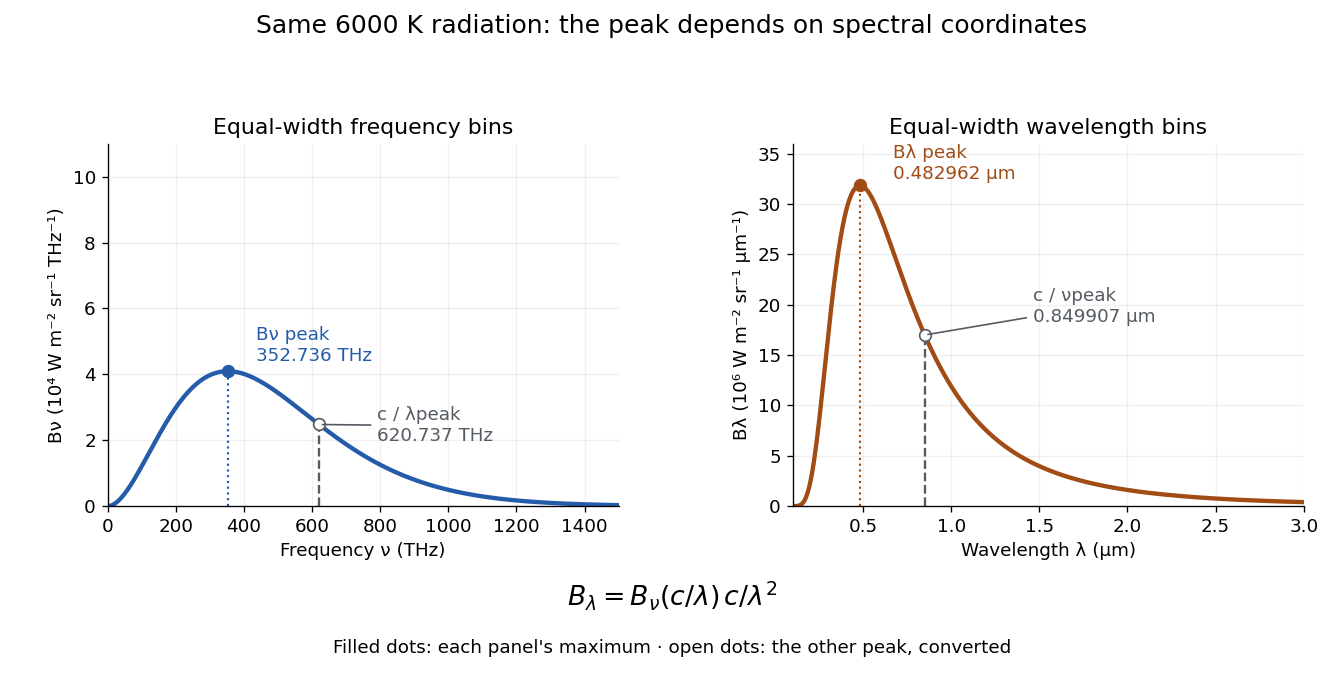
One spectrum, two spectral-coordinate peaks
. The left panel plots the Planck function per terahertz and marks its frequency peak. The right panel plots the same black-body radiation per micrometre and marks its wavelength peak. Dashed lines locate the counterpart of the other panel's peak. The converted frequency peak at is not the peak at : the change of variables changes density heights through . Details.For photons in thermal equilibrium at temperature , Planck's law gives the photon number density per frequency interval. In terms of the Planck function, it is , hence
Changing variables to in the Planck distribution giveswhere and are temperature-independent constants.
In an orthonormal tetrad, is the photon number density and is its number flux. Integrating the Boltzmann equation gives when momentum-boundary terms vanish. Collisionless propagation and photon-number-conserving scattering give zero divergence. Photon emission, photon absorption, electron-positron annihilation in cosmology, bremsstrahlung and double Compton scattering generally do not. This is a number current, not an electric charge current: photons are neutral.
Black-body radiation is the electromagnetic radiation in thermal equilibrium with an ideal blackbody. It can be described as a photon gas: a cavity whose walls are all at the same temperature contains radiation with the universal Planck's law spectrum. A small opening in such a cavity approximates a blackbody emitter because incoming radiation undergoes repeated absorption inside. The radiation's equilibrium spectrum depends on temperature, rather than the wall material. [ref]
https://openstax.org/books/university-physics-volume-3/pages/6-1-blackbody-radiation. OpenStax, University Physics 3, §6.1, blackbody cavity and emission laws
There are three useful quantities to keep distinct: directional spectral radiance or , total energy density in the cavity, and outward radiant exitance from its opening. Planck's law supplies the first; integrals over frequency and directions supply the others. For isotropy, every direction has the same , so the full solid angle givesHere is the reduced Planck constant, and the radiation constant is . The explicit Boltzmann constant makes this an SI formula; adopting natural units with recovers .
For a short integral outline, substitute and useThe expansion is a geometric series with nonnegative terms; repeated integration by parts evaluates each integral, and is a value of the Riemann zeta function. This gives the coefficient above.
The photon gas also exerts radiation pressure, . The factor comes from the angular average of the squared directional component of photon momentum, . The thermodynamic derivation of blackbody radiation pressure gives the same result. In contrast, outgoing power involves one projected-direction factor over an outward hemisphere, yielding radiant exitanceThis is the Stefan–Boltzmann law with unit emissivity; is the Stefan-Boltzmann constant. The factor follows from Lambert's cosine law, rather than the full-sphere factor used for energy density.
For example, an ideal cavity has , radiation pressure , and outward radiant exitance . A stipulated cavity has one-sixteenth each value because all three scale as . These describe stored energy, mechanical pressure, and outgoing power per area, respectively. In a closed equilibrium cavity, equal opposing radiation balances the directional power flow even though and are nonzero.
The usefulness of black-body radiation is this common reference: Planck's law, Wien's displacement law, and the Stefan–Boltzmann law consistently connect spectral measurements, temperature, and total emission. The three illustrative curves in Planck's law are ideal equilibrium spectra; applying them to a material requires considering its emissivity and whether thermal equilibrium is a suitable approximation.
In a large periodic box of volume , one polarization has wavevector modes per unit . The two transverse photon polarizations therefore giveafter integration over directions.
For an equilibrium system with energy and no conserved particle number, exactness of the entropy differential obtained from givesIf and as , integration gives .
Articles by others on the same topic

Planck's law describes the spectral density of electromagnetic radiation emitted by a black body in thermal equilibrium at a given temperature. Formulated by Max Planck in 1900, it provides a theoretical foundation for understanding black body radiation. The law states that the intensity of radiation emitted at a specific wavelength is proportional to the wavelength and depends on the temperature of the black body.



Used to explain the black-body radiation experiment.
Published as: On the Theory of the Energy Distribution Law of the Normal Spectrum by Max Planck (1900).
The Quantum Story by Jim Baggott (2011) page 9 mentions that Planck apparently immediately recognized that Planck constant was a new fundamental physical constant, and could have potential applications in the definition of the system of units (TODO where was that published):This was a visionary insight, and was finally realized in the 2019 redefinition of the SI base units.
Planck wrote that the constants offered: 'the possibility of establishing units of length, mass, time and temperature which are independent of specific bodies or materials and which necessarily maintain their meaning for all time and for all civilizations, even those which are extraterrestrial and nonhuman, constants which therefore can be called "fundamental physical units of measurement".'
TODO how can it be derived from theoretical principles alone? There is one derivation at; en.wikipedia.org/wiki/Planck%27s_law#Derivation but it does not seem to mention the Schrödinger equation at all.