Interpret every logarithm in the empirical profile as base ten with the dimensionless argument . PutThe upper atmosphere has for , while integration of below it givesAssume that the stated planetary equilibrium temperature is a reasonable brightness temperature at the photosphere. ThenAt , , and thereforeThis estimate neglects day-night variation, wavelength-dependent photospheric pressure, and a possible radiative-convective boundary; it treats the retrieved profile as representative of the dayside disk.
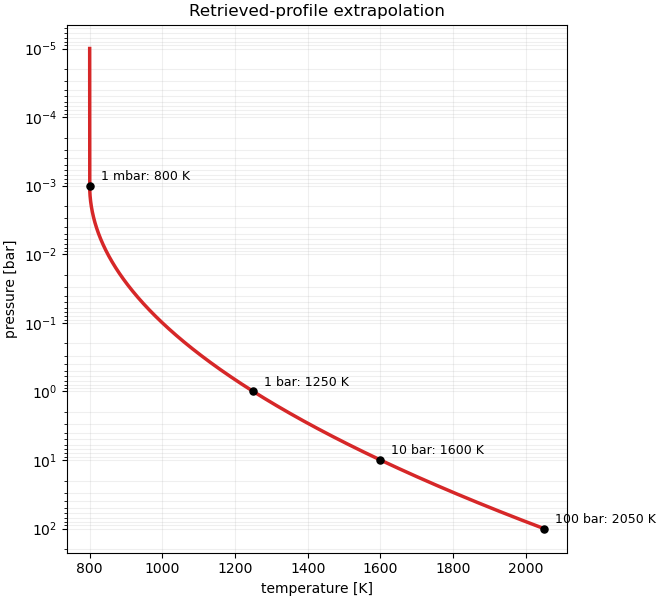

In a thin atmosphere in hydrostatic equilibrium, take gravity and mean molecular mass as constant. The ideal gas equation of state and hydrostatic balance giveFor ,so the atmospheric lapse rate follows from the chain rule:It vanishes in the assumed isothermal region above . If natural logarithms are used instead, the factor is absent and the fitted numerical value of changes accordingly.
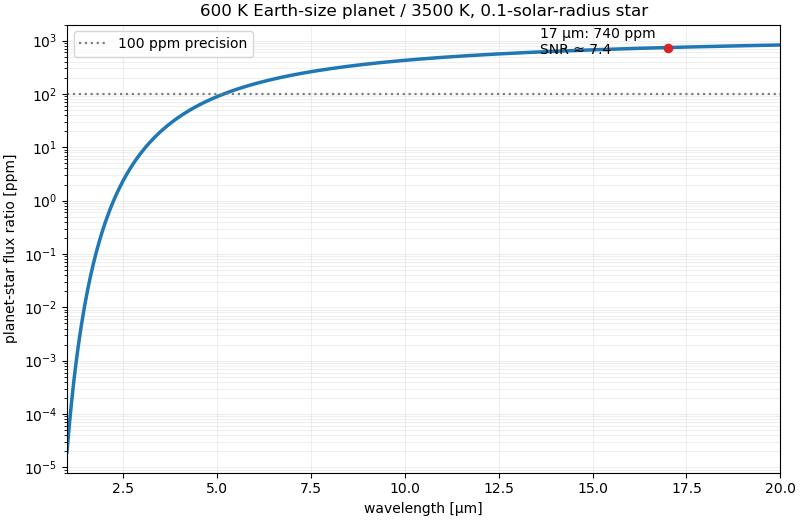
Assume that both objects emit as blackbodies, take and , and use because the line-free window sees the -bar continuum photosphere. Across a narrow bin, the thermal eclipse depth isAt this givesIntegrating the Planck law over the full bin changes this narrow-bin estimate only slightly.
For , , , and , the same thermal eclipse depth at isThus a uncertainty givesThis assumes one independent eclipse measurement with that precision, negligible reflected light in the infrared, no atmosphere, and blackbody emission from the bare surface.

Let be the core radius and the planetary radius. For the two-layer constant-density planet,and the mantle volume givesThe enclosed mass profile is
Assume Newtonian spherical hydrostatic equilibrium, neglect rotation and thermal density changes, and require continuous pressure at the layer boundary. Writeso the mantle mass profile is . Integrating inward from gives the boundary pressure
At a mantle radius , the same integration givesInside the core, , so matching to givesThe central pressure is therefore
For a geometrically thin isothermal ideal-gas atmosphere, set andHydrostatic balance gives . The observed transit photosphere at is consequently at the isothermal pressure-level transit radiusThis assumes , constant , composition, and gravity, and an opacity that selects the stated pressure.
Hydrostatic balance makes the atmospheric column mass . Multiplying by the surface area gives the mass of a thin hydrostatic atmospherewhere the second expression neglects the top pressure and atmospheric self-gravity.
For a plane-parallel atmosphere with optical depth increasing downward, the radiative transfer equation isIntegrating over solid angle gives the first radiation-field momentIn radiative equilibrium, matter has no net local radiative heating, so the opacity-weighted frequency integral of vanishes. After converting each optical-depth derivative to physical depth and integrating over frequency,Thus the bolometric internal flux is constant with depth, as stated by constant flux in a plane-parallel radiative-equilibrium atmosphere.
In local thermal equilibrium . Define the planet's internal effective temperature of a planet by the constant outward flux. The standard Planck law integral givesThe corresponding intrinsic luminosity is .
Let the atmosphere occupy a thin annulus from to . With mass extinction coefficient , constant density , and the assumed common chord length , its optical depth isThe opaque solid planet removes area , while the annulus removes the fraction of the incident specific intensity. Neglecting limb darkening, the exoplanet transmission spectrum is thereforeFor a thin annulus,If the geometrical thickness is estimated as , then the atmospheric scale height is . A wavelength-independent makes this idealized spectrum flat; real molecular opacities create its features.
Let the stellar radius and temperature be and . Assume Bond albedo , isotropic stellar emission, blackbody planetary emission, and complete redistribution over the tidally locked planet. The absorbed stellar power isAdding the isolated internal luminosity and balancing the total against gives the planetary equilibrium temperatureIf heat is reradiated uniformly only over the dayside, replace the denominator by . The latter is often more plausible for inefficient redistribution on a tidally locked bare planet.
Use a single-layer greenhouse model whose atmosphere is transparent to incident stellar light and has infrared emissivity . Let and be the surface and atmospheric temperatures. Atmospheric balance givesAt the top of the atmosphere, the escaping flux is the directly transmitted surface radiation plus upward atmospheric emission:ThereforeFor a perfectly infrared-opaque one-layer atmosphere, ; for , .
In vacuum, a narrow ray bundle conserves both power and geometrical etendue . Their ratio, the specific intensity, is therefore independent of source-receiver distance. Equivalently, geometric dilution reduces received power and apparent solid angle by the same inverse-square factor.
For an isotropically emitting isothermal blackbody atmosphere, the outward surface flux iswhere the last equality is bolometric. Multiplication by the emitting area gives the luminosity of a spherical blackbody
At a molecular line, the large opacity moves the optical-depth-one surface to lower pressure and higher altitude than the neighboring continuum. The Eddington-Barbier relation makes the emergent intensity approximately the Planck function at that layer. In an ordinary outward-cooling atmosphere, the line-forming layer is cooler and the feature is in absorption. In an atmospheric thermal inversion, it is hotter, so the spectral-line emission from an atmospheric thermal inversion exceeds the continuum brightness and the feature appears in emission.
Factors that can create or suppress inversions include the abundance of high-altitude optical absorbers such as TiO, VO, or atomic metals; the host star's irradiation level and spectral energy distribution; and clouds, hazes, composition, and day-night circulation, all of which alter where stellar and thermal radiation are absorbed.
At fixed temperature and pressure, a closed reacting system is in thermochemical equilibrium when its Gibbs free energy is minimal subject to elemental-abundance constraints. For every independent reaction,with a positive second variation in every allowed direction.
An atmosphere can be driven into disequilibrium chemistry in an exoplanet atmosphere by vertical mixing faster than chemical conversion, which causes chemical quenching; ultraviolet atmospheric photochemistry; and atmospheric escape. Lightning, energetic particles, horizontal transport, condensation, and rainout provide further mechanisms.
Articles by others on the same topic
There are currently no matching articles.