Subtract the star's acceleration from that of in an inertial frame. With measured from the star,This has the requested form withand disturbing functionThe first term is the direct disturbing function, the attraction of on . The second is the indirect disturbing function, which subtracts the acceleration of the star-centered origin by .
Expanding the disturbing function in orbital elements gives a Fourier series of the formwhereThe radial coefficients are combinations of Laplace coefficients. Rotational and reflection symmetry impose the D'Alembert characteristic: the integer coefficients sum to zero, nodal coefficients obey a parity rule, and each harmonic begins at the corresponding order in eccentricities and inclinations.
The expansion separates naturally into three timescales:
- A short-period orbital perturbation contains rapidly varying mean longitudes. It describes individual conjunction kicks and usually averages to zero away from a commensurability.
- A resonant orbital perturbation has a nearly stationary integer combination of mean longitudes near a mean-motion resonance. Successive conjunctions then occur at correlated phases, so their effects accumulate and the resonant argument may librate.
- A secular perturbation survives averaging over both mean longitudes. It drives slow apsidal precession, nodal precession, and exchange of orbital eccentricity or orbital inclination over many orbital periods.
Short-period terms matter for instantaneous osculating elements and encounters, resonant terms near period commensurabilities, and secular terms for long-term evolution away from strong resonance.
The angleobeys the D'Alembert characteristic. Because reflection in the reference plane makes the disturbing function even in inclination, the nodal coefficient must be even, and thereforeAt astronomical conjunction, , soThus is the angular distance from the ascending node of to the conjunction. When is at that node, , andUp to the chosen sign convention, is the angular separation between the inner body and the node when the outer body crosses the reference plane. These two views explain geometrically why libration confines both conjunction and node-crossing phases.
Just after crosses its ascending node, it lies above the nearly fixed orbital plane of . At a nearby conjunction, is inward of , because . The perturbing acceleration toward therefore has an inward component and a downward normal component. In the view along the node toward the star, the downward component opposes 's upward vertical velocity and reduces its orbital inclination; in the face-on view, the inward component perturbs its orbital energy and shifts the conjunction phase. A conjunction before the ascending node reverses the relation between the normal force and vertical velocity. Repeated phase-correlated impulses therefore provide the restoring dynamics of an inclination-type mean-motion resonance.
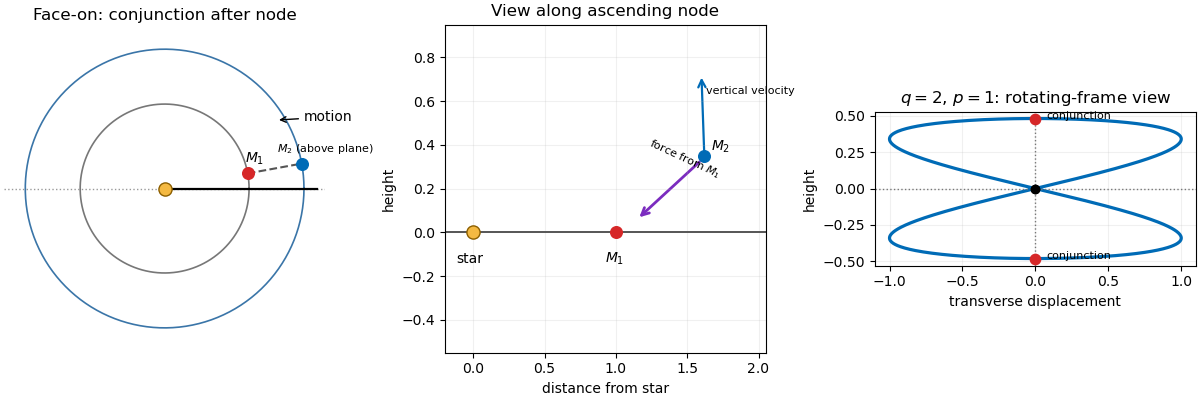

For , at conjunctionThe stable geometry puts conjunctions a quarter orbit from either node, where has maximum vertical separation from the inner body's plane and close approaches are avoided. Therefore or , and both possibilities giveThis is resonance protection: the resonant phase moves conjunctions away from the two node crossings, where the physical separation would be smallest.
Let be the outer body's argument of latitude in the nearly circular limit and let be its azimuth in the frame rotating with . At the libration centre,Viewed along the star-- line, the projected coordinates therefore have the schematic formThis relation is the general sketch prescription. For the simplest resonance it is a figure-eight-like curve, with conjunctions on the vertical axis at maximum positive or negative height and node crossings in the reference plane. More generally the curve repeats with the vertical oscillations and two relative azimuthal circuits required by the commensurability.
Articles by others on the same topic
There are currently no matching articles.