For the relative position , Newton's law of universal gravitation gives the two-body problem in its reduced one-body form,Taking the dot product with the relative velocity givesIntegration therefore yields conservation of specific orbital energy:
Let be the specific angular momentum. The radial Kepler orbit equation has semi-latus rectum , so comparison withgives for an elliptic orbit and for a hyperbolic Kepler orbit. At either apsis, and . Substituting the apsidal radius and angular momentum into part (i), or equivalently using the vis-viva equation, givesThus the signs are in the convention of the question.
At the encounter radius , the planet's circular Kepler orbit has speedThe comet's speed follows from the vis-viva equation:Its component parallel to the planet's prograde tangential velocity is fixed by its specific angular momentum,The relative velocity therefore satisfiesand hence
In the planetocentric hyperbolic Kepler orbit, the speed at infinity is and the impact parameter is . Conservation of specific angular momentum givesConservation of specific orbital energy at the moon's radius giveswhere . ThusThe moon moves tangentially at , soTherefore the correctly dimensioned reading of the displayed result is
For some orbital phase of the moon to permit an impact, the comet's planetocentric hyperbolic Kepler orbit must at least cross the moon's circular orbit. At the limiting case is the comet's periapsis, so the radial velocity in part (iv) vanishes. ConsequentlyThis is gravitational focusing by the planet; an actual collision additionally requires the moon to occupy the crossing point at the right time.
The limiting trajectory grazes the planet at periapsis . Equating the asymptotic and periapsis values of specific angular momentum and using the vis-viva equation givesHence the comet avoids the planet when
An encounter can occur only near an orbital node of the comet's inclined orbit. Its tangential velocity projected into the planet's plane is reduced by , so the relative-speed calculation becomesThe missing projected component is a vertical relative velocity, so the moon encounter is three-dimensional: becomes a vector in the impact plane, and a collision also requires the trajectory to pass close to the moon's orbital plane. Once the total asymptotic speed is used, the two-body gravitational focusing formulae in parts (v) and (vi) retain their form, but the geometrical collision probability is lower.
The unit binary separation and unit mean motion imply through Kepler third law thatThe centre of mass conditions put at and at . Therefore
In a frame with unit angular velocity, transforming the acceleration introduces the Coriolis acceleration and centrifugal acceleration. Radiation reduces the attraction of by the factor , soWith the effective potentialits Cartesian components are exactlyThis is the photogravitational restricted three-body problem.
Multiply the three equations by and add. The Coriolis acceleration does no work because its two terms cancel, leavingEquivalently, the radiation-modified Jacobi constant is
DefineAt an equilibrium point, the velocity and acceleration vanish. Direct differentiation givesandThus the equilibrium conditions are
At a Triangular Lagrange point, , so . The equation then givesSubstitution into and yieldsIntersecting these two circles givesAs rises from zero to one, falls from one to zero. The two points move along the unit circle about , from the classical equilateral positions toward , where they coalesce when the attraction of is fully cancelled.
Put . Repeating part (v) with radiation from both bodies givesThe two triangular points are intersections of circles with these radii and centre separation one. Iftheir coordinates areFor ordinary outward radiation pressure, , the non-collinear points exist precisely when the strict triangle inequalityholds. Equality merges the two points on the line of centres.
The same absorption and re-emission that produce radial radiation pressure also produce Poynting–Robertson drag. This velocity-dependent force removes specific orbital energy and angular momentum, destroys the exact Jacobi constant, and turns the formal equilibrium points into slowly drifting configurations. Stellar-wind drag can provide a similar correction.
For a spherical grain of diameter , density , and radiation-pressure efficiency , comparison of the stellar momentum flux with Newton's law of universal gravitation gives the radiation-pressure coefficientFor much larger than the characteristic stellar wavelength, , so . When becomes comparable to the optical wavelength, diffraction and the grain's composition make size dependent and reaches a broad maximum. Deep in the Rayleigh scattering regime, absorption can give and hence nearly constant , while scattering alone gives and hence . A realistic curve therefore rises roughly as toward micron sizes, turns over near the stellar spectral peak, and falls or flattens for still smaller grains.
Immediately after release, the grain has the comet's position and velocity, but its effective stellar gravitational parameter is . Using the comet's specific orbital energy,the grain energy isThereforeRelease with zero relative velocity preserves the specific angular momentum . Applying then givesThe paper instead prints in the first three terms. That expression is incompatible with both its printed and conservation of , except at . The next part is the result obtained from the printed eccentricity, so both consequences are recorded below.
First follow the expression printed in the paper. Put and compare its numerator with . To first order in ,Thus the grain is unbound, , whenSince the cometary apoapsis is ,For completeness, the energy and angular-momentum-consistent formula derived in part (ii) instead gives . The distinction is not a matter of approximation: it exposes the typographical inconsistency in the question.
At periapsis, . The grain's energy from part (ii) is nonnegative whensoThe strict inequality gives a hyperbolic Kepler orbit, while equality gives a parabolic Kepler orbit. The printed eccentricity formula yields , which has the same requested lowest-order limit .
At periapsis the release velocity is tangential. A grain with feels no net stellar inverse-square force and therefore moves on the tangent line. A grain with retains an inward acceleration and bends toward the star; a grain with feels a net outward acceleration and bends away from it. At the common observation time, joining these positions in increasing gives the synchrone shown below. It starts near the low- orbital trajectory, passes through the force-free position, and extends outward through the repelled high- grains.
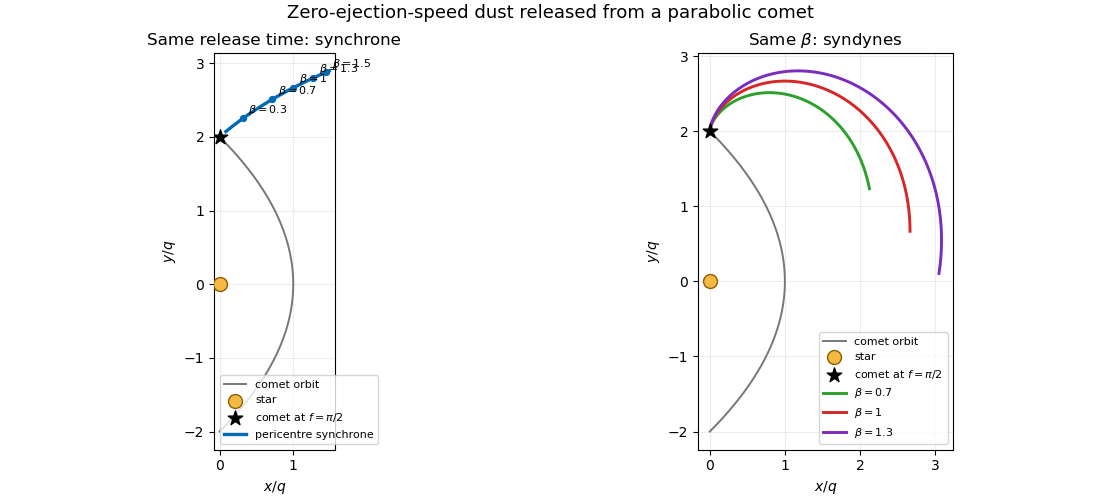

For a fixed , release points from through the current generate a syndyne. The newest grain is still at the comet, whereas earlier grains have had longer to separate. The right panel of the figure shows the resulting family. The curve consists of particles following the tangent lines inherited at their respective release points. Residual gravity bends the syndyne starward and shortens its displacement; net repulsion bends the syndyne anti-stellar and lengthens it.
A cometary dust tail is a superposition of synchrones and syndynes, rather than a material line emitted in one fixed direction. For grains larger than the stellar wavelength, : small grains have large , are displaced rapidly in the anti-stellar direction, and make a relatively straight broad tail. Large grains have small , remain closer to the comet's Kepler orbit, and make a more strongly curved dust trail. The observed position angle consequently depends on grain size, release time, orbital phase, and projection onto the plane of the sky.
Subtract the star's acceleration from that of in an inertial frame. With measured from the star,This has the requested form withand disturbing functionThe first term is the direct disturbing function, the attraction of on . The second is the indirect disturbing function, which subtracts the acceleration of the star-centered origin by .
Expanding the disturbing function in orbital elements gives a Fourier series of the formwhereThe radial coefficients are combinations of Laplace coefficients. Rotational and reflection symmetry impose the D'Alembert characteristic: the integer coefficients sum to zero, nodal coefficients obey a parity rule, and each harmonic begins at the corresponding order in eccentricities and inclinations.
The expansion separates naturally into three timescales:
- A short-period orbital perturbation contains rapidly varying mean longitudes. It describes individual conjunction kicks and usually averages to zero away from a commensurability.
- A resonant orbital perturbation has a nearly stationary integer combination of mean longitudes near a mean-motion resonance. Successive conjunctions then occur at correlated phases, so their effects accumulate and the resonant argument may librate.
- A secular perturbation survives averaging over both mean longitudes. It drives slow apsidal precession, nodal precession, and exchange of orbital eccentricity or orbital inclination over many orbital periods.
Short-period terms matter for instantaneous osculating elements and encounters, resonant terms near period commensurabilities, and secular terms for long-term evolution away from strong resonance.
The angleobeys the D'Alembert characteristic. Because reflection in the reference plane makes the disturbing function even in inclination, the nodal coefficient must be even, and thereforeAt astronomical conjunction, , soThus is the angular distance from the ascending node of to the conjunction. When is at that node, , andUp to the chosen sign convention, is the angular separation between the inner body and the node when the outer body crosses the reference plane. These two views explain geometrically why libration confines both conjunction and node-crossing phases.
Just after crosses its ascending node, it lies above the nearly fixed orbital plane of . At a nearby conjunction, is inward of , because . The perturbing acceleration toward therefore has an inward component and a downward normal component. In the view along the node toward the star, the downward component opposes 's upward vertical velocity and reduces its orbital inclination; in the face-on view, the inward component perturbs its orbital energy and shifts the conjunction phase. A conjunction before the ascending node reverses the relation between the normal force and vertical velocity. Repeated phase-correlated impulses therefore provide the restoring dynamics of an inclination-type mean-motion resonance.
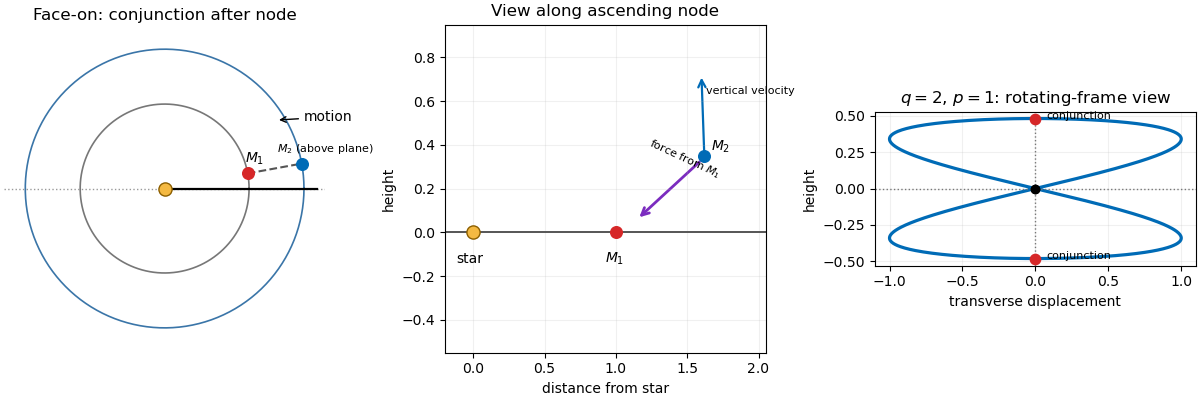

For , at conjunctionThe stable geometry puts conjunctions a quarter orbit from either node, where has maximum vertical separation from the inner body's plane and close approaches are avoided. Therefore or , and both possibilities giveThis is resonance protection: the resonant phase moves conjunctions away from the two node crossings, where the physical separation would be smallest.
Let be the outer body's argument of latitude in the nearly circular limit and let be its azimuth in the frame rotating with . At the libration centre,Viewed along the star-- line, the projected coordinates therefore have the schematic formThis relation is the general sketch prescription. For the simplest resonance it is a figure-eight-like curve, with conjunctions on the vertical axis at maximum positive or negative height and node crossings in the reference plane. More generally the curve repeats with the vertical oscillations and two relative azimuthal circuits required by the commensurability.
Articles by others on the same topic
There are currently no matching articles.