The Fourier cosine series on isIt is the Fourier series of the even extension to , repeated with period . The Fourier sine series isIt comes from the odd extension and its -periodic extension. These Fourier coefficient formulas follow by Fourier orthogonality, since every nonconstant sine or cosine has squared integral on , while the constant function has squared integral .
Under the stated piecewise smooth hypotheses, the Dirichlet convergence theorem for Fourier series gives the average of the two one-sided limits of the corresponding periodic extension. The even extension is continuous at both endpoints, so the Fourier cosine series converges toThe odd extension agrees with on , but its left and right limits are at zero and at the join . Therefore the Fourier sine series converges toIndeed every partial sum of the Fourier sine series is already zero at both endpoints. The endpoint values agree with only when the corresponding boundary values vanish.
Set and . The required integrals follow fromConsequently the Fourier coefficients areThus the Fourier cosine series isand its sum is everywhere on . The Fourier sine series isand its sum is on and zero at the two endpoints. The open and filled circles in the sketches distinguish these endpoint limits from the actual values of the sum.
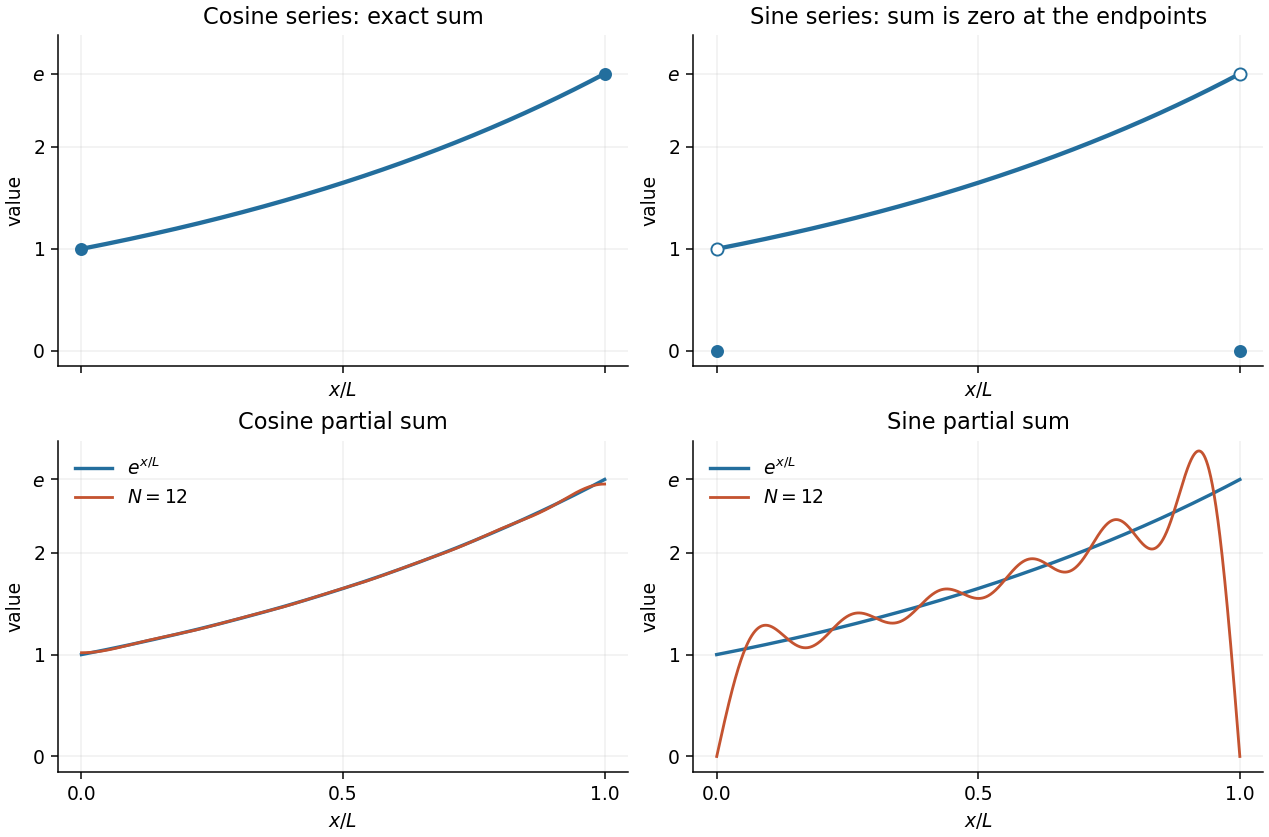

First, the Fourier coefficients of the Fourier cosine series decay as , whereas those of the Fourier sine series are of order . In particular, the absolute convergence bound for the Fourier cosine series gives a uniform tail estimateThus its tail is absolutely controlled using fewer Fourier harmonics. The Fourier sine series does not have an absolutely summable sequence of Fourier coefficients.
Second, the even extension is continuous, so its Fourier cosine series converges uniformly on the closed interval and approximates the nonzero endpoint limits correctly. The odd periodic extension has jumps, producing the Gibbs phenomenon in its Fourier sine series near zero and . Every Fourier sine series partial sum is zero at both endpoints, so by approaching from inside one obtainsHence the Fourier sine series approximation cannot converge uniformly even on the whole open interval, despite pointwise convergence at each interior point. The Fourier cosine series approximation has faster coefficient decay and avoids the persistent errors near the endpoints.
Take . It vanishes at both endpoints. Its odd periodic extension is continuously differentiable across the joins, whereas its even extension has corners because and are nonzero.
Two integrations by parts, with , giveThe Fourier coefficients are thereforeThe Fourier sine series has a uniform absolute tail , and each of its partial sums satisfies both zero boundary values exactly. The Fourier cosine series has an absolute tail bound ; at its omitted even-index Fourier coefficients have the same sign and yield an error of order . This verifies a strictly faster uniform error bound for the sine approximation in this example.
Articles by others on the same topic
There are currently no matching articles.