Choose a common origin at vertex , set and , and orient the remaining edge as . ThenThis convention makes the interior angle between and equal to , and their lengths equal to the opposite side lengths and .
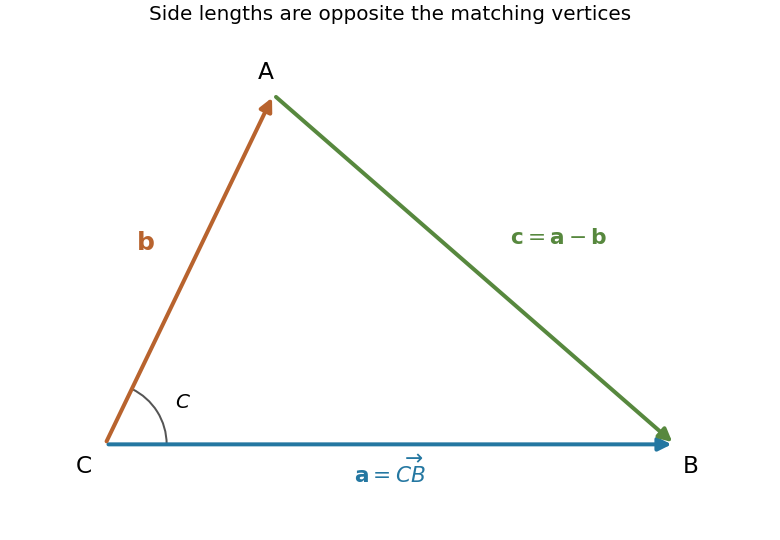

Take the dot product of the difference with itself. Since , the law of cosines follows:The magnitude of the cross product of two edge vectors is twice the triangle's area . Applying this at each vertex gives . Divide by the nonzero product to obtain the law of sines:
Let be the interior of the tetrahedron, and take any constant vector field . Its divergence is zero, so the divergence theorem givesChoosing to be each Cartesian basis vector proves . This is the general fact that vector areas of a closed polyhedron sum to zero, specialized to four faces. The outward orientations are essential: the scalar face areas are all positive and do not sum to zero.
Articles by others on the same topic
There are currently no matching articles.