Using the principal complex logarithm, and . Thus the values and their real parts and imaginary parts areFor the final row, first calculate and only then raise this positive real number to the power . Treating nested powers as ordinary real powers would ignore the branching of complex exponentiation.
If all branches are requested, also has the negative of its principal value, and the complex logarithm of is . Allowing nonprincipal logarithms of the positive base gives . Finally, all values of are , for integers as appropriate. These alternatives do not alter the principal-value table.
Euler's formula givesCubing the expression for the sine, and grouping the and terms, givesThe required equation therefore becomes . The complete real solution set is
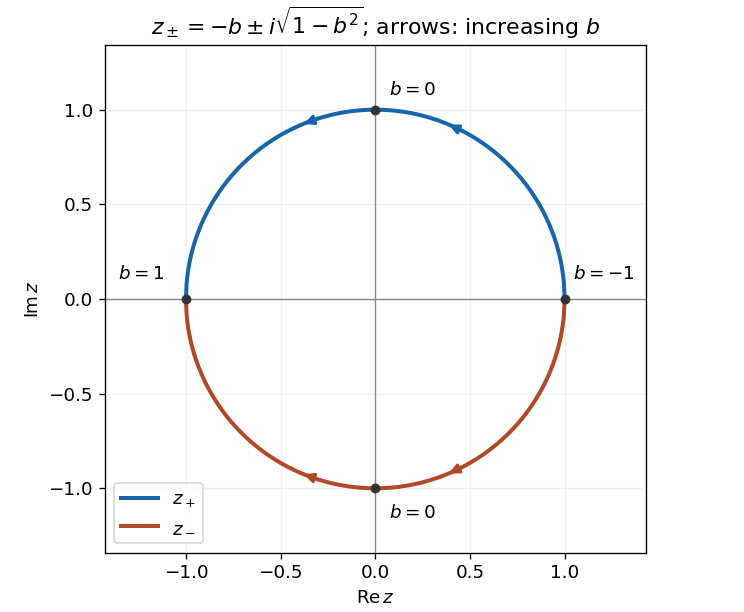
The quadratic formula gives . For , write this asEach root of a polynomial has modulus , since . As increases from to , the upper root traverses the upper unit semicircle from to , and the lower root traverses the lower semicircle in the opposite angular direction. At the roots coincide at ; at they coincide at . For intermediate they are complex conjugates.

Articles by others on the same topic
There are currently no matching articles.