The factor theorem gives a factor . Polynomial division and then factorization giveConsequently all three roots of a polynomial are
Completing the square puts the equation of the circle in the formHence its centre is and its radius is .
The geometric series has first term and common ratio , whose absolute value is less than one. Therefore
On this parametric curve, permits or , but only also gives . The chain rule gives the slopeAt the required point, , so
The double-angle identity for the sine factors the equation as . The first factor gives in the specified interval; the second gives and hence . ThusKeeping the first factor avoids losing the solution where division by would be invalid.
Call the centre of the circle , the left endpoint on the diameter , the point of tangency , and the external intersection . Since are radii, the isosceles triangle has equal base angles: . Therefore , and, because and point in opposite directions, . The tangent to a circle is perpendicular to the radius , so in the right triangle ,
Rationalizing a denominator by multiplying by gives . Consequently the sum inside the parentheses is , and the entire expression is
The function is nonnegative and satisfies . Its derivative is , so it decreases from to its minimum and then increases to . These three points all have horizontal tangent lines.
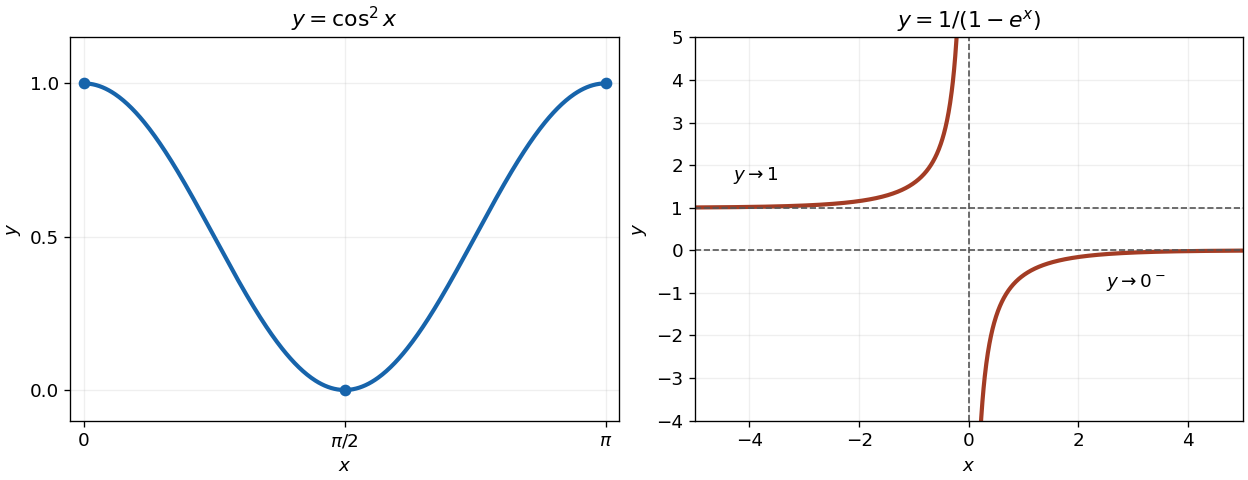

The denominator vanishes only at , giving a vertical asymptote. Since , the function tends to from the left and from the right. Its derivative isso each branch is increasing. The horizontal asymptotes are as and as . The left branch lies above ; the right branch lies below , as in the preceding figure.
If tangency occurs at , the slope must satisfy both and . Eliminating gives , so the tangent through the origin to an exponential curve has
Because is a scalar, applying the linear operator again givesThis is the first nontrivial case of the powers of a rank-one operator; its matrix is the outer product .
The vector triple product identity and giveApply once more. The term parallel to vanishes under its cross product with , leaving . The result includes .
The displayed power series is the matrix exponential . From , its odd powers and nonconstant even powers sum separately:The scalar power series are and , with continuous values and at zero. Substituting and the preceding formula for yieldsThis is the Rodrigues rotation formula: the component parallel to is fixed, while the perpendicular component undergoes a rotation through . For the linear operator is the identity operator.
Using the principal complex logarithm, and . Thus the values and their real parts and imaginary parts areFor the final row, first calculate and only then raise this positive real number to the power . Treating nested powers as ordinary real powers would ignore the branching of complex exponentiation.
If all branches are requested, also has the negative of its principal value, and the complex logarithm of is . Allowing nonprincipal logarithms of the positive base gives . Finally, all values of are , for integers as appropriate. These alternatives do not alter the principal-value table.
Euler's formula givesCubing the expression for the sine, and grouping the and terms, givesThe required equation therefore becomes . The complete real solution set is
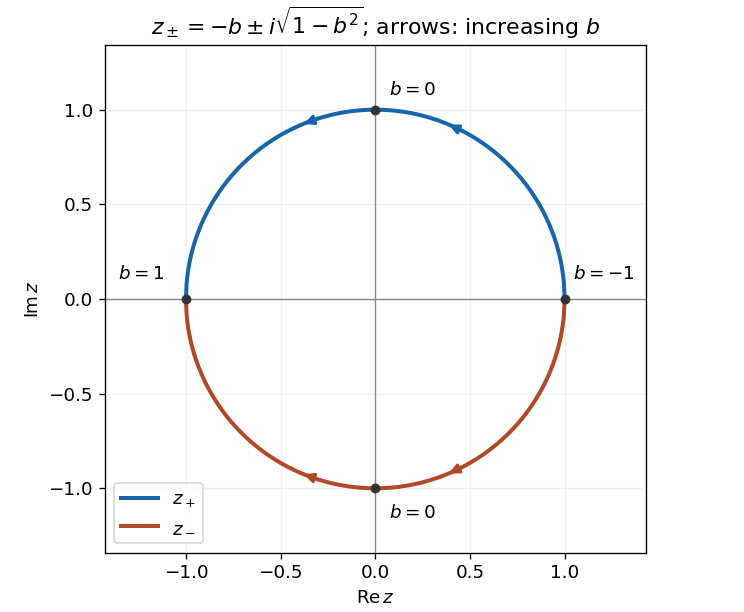
The quadratic formula gives . For , write this asEach root of a polynomial has modulus , since . As increases from to , the upper root traverses the upper unit semicircle from to , and the lower root traverses the lower semicircle in the opposite angular direction. At the roots coincide at ; at they coincide at . For intermediate they are complex conjugates.

Since the derivative of the arctangent is near zero, termwise integration givesThe integration constant is zero because .
The expression in the PDF is , with the subtraction outside the fraction. Using the exponential series with givesFor , , these are the first two nonzero terms. If , the function is identically zero, so there are no nonvanishing terms.
Since , only the first three positive powers of contribute through degree three. The composition coefficients of power series follow by using and in . HenceHere and are coefficients of the power series, rather than raw derivatives; their definitions already contain any factorial factors.
The exponential series proves normalization of a probability distribution:Let and count the two labels. Conditional on , independent labeling gives a binomial distribution, so the joint probability mass function isEach bracket is a normalized Poisson distribution. Summing over therefore givesThe factorization also proves that and are independent random variables. This is Poisson thinning; the phrase about ignoring the other count refers to taking a marginal distribution, rather than fixing that count.
Let , , and denote the three disjoint categories, and or the test result. The law of total probability givesTo calculate the requested conditional probability, first combine the two categories with the virus. Their joint negative-test probability is , whereas . Bayes' theorem therefore givesThese numbers use the specified population proportions and test probabilities; the negative result reduces the initial combined proportion to about within this model.
Writing the differential one-form as , its coefficients satisfy . It is an exact differential form, with potential , becauseThe implicit solution is therefore
On the real domain , and have and , so this differential one-form is not exact. An integrating factor for a differential one-form is , which is nonzero on this domain. Multiplication givesHence the implicit solution is
On the interval containing the initial condition, division by gives a linear ordinary differential equation with integrating factor . ConsequentlyThe initial value gives . ThusThis polynomial also satisfies the original equation at and gives an extension to all real . The initial value problem is uniquely determined on ; the vanishing leading coefficient at does not ensure unique continuation to its left.
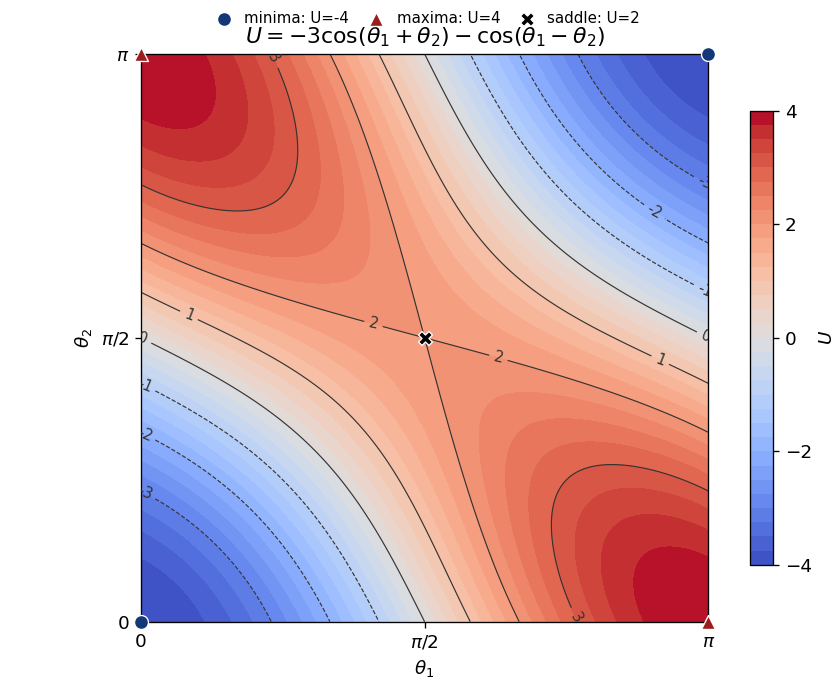
Put and . The gradient has components and , so a stationary point requires . In the closed square, and , and the compatible possibilities are precisely the four corners and .
The Hessian matrix isIts eigenvectors and have eigenvalues and . The second-derivative test gives the following classification:
| Point || || Hessian eigenvalues || Classification | | | | Minima | | | | Maxima | | | | Saddle point of a scalar function |
|---|
The corner classifications also hold for the smooth extension beyond the square, and hence for the restricted region. The global bounds show that the stated minima and maxima are global within it. The central point has opposite curvature along the two diagonal directions.

The region is , . Reversing the order describes the same triangle as , . Since the integrand is continuous on this compact region, Fubini's theorem permitsThe new inner integral introduces the factor needed for the change of variables .
In cylindrical coordinates the spherical cap has , and . Its mass density is and the volume element is . ThereforeThis is the mass of a spherical cap with height-proportional density with and .
For its curved surface area, write with . The surface integral of one becomesIt agrees with the curved area of a spherical cap, , for . The planar closing disk is not part of the requested curved surface.
False. Take the diagonal matrix and its eigenvectors , . Their sum is mapped to , which is not a scalar multiple of that sum. More generally, need not have the form when .
True. Applying the matrices in order gives . The eigenvalue isThis conclusion only uses the shared eigenvector; it does not require and to commute on other vectors.
If for a nonzero eigenvector, then . Thus , soBoth values need not occur: the zero matrix has only , and the identity matrix only . More precisely, an idempotent linear map whose rank of a linear map is has copies of and copies of . Indeed, its image of a linear map and kernel of a linear map form a direct sum, giving an eigenbasis without assuming an orthogonal projection.
On an eigenvector of with eigenvalue , the linear operator has eigenvalue . ThereforeThe multiplicities are exchanged: if the matrix rank of is , then has copies of and copies of . Again, a value with zero multiplicity is absent.
Computing the characteristic polynomial with the convention givesThus the three eigenvalues areThey can also be checked directly on the respective eigenvectors , , and .
Articles were limited to the first 100 out of 209 total.
Articles by others on the same topic
There are currently no matching articles.