For an integrable discrete random variable, its expectation and variance are and , respectively. The first formula requires for a finite ordinary mean; the variance may be infinite. A probability density function gives .
Conditioning on and using independence givesThe interchange is justified by Tonelli's theorem, since all integrands are nonnegative. Consequently has an absolutely continuous distribution, withIts integral is . This is the convolution of independent random variables, specifically a Gaussian smoothing of an integer-valued distribution for the given normal density. The specified weights are normalized because .
The density is the symmetric sumFor small , the normal distributions are narrow and well separated, giving peaks near each nonzero integer. The largest two peaks lie near and ; those near have approximately one quarter of their height, and the envelope falls as . There is no component centered at zero, and the density there is exponentially small. The left panel shows the resulting smooth comb.
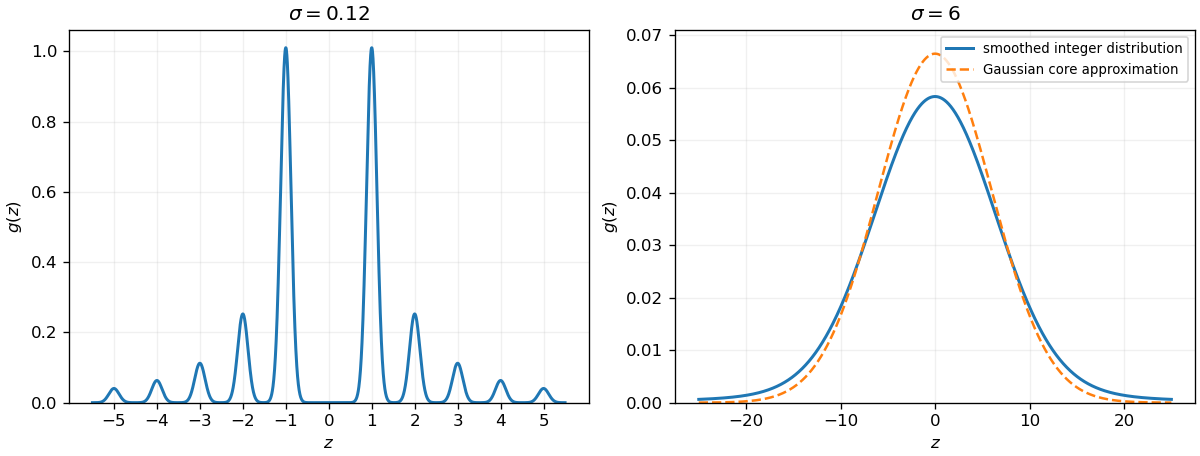

For large , neighboring peaks overlap and the density has a broad, smooth, symmetric central hump, approximately on the scale . A precise central-profile statement follows fromfor each fixed , almost surely and the integrand is bounded, so dominated convergence applies. The right panel of the preceding figure shows this Gaussian-looking core.
This approximation does not remove the heavy-tailed distribution. Here , so the symmetric distribution has no ordinary mean and no finite variance. Adding the independent Gaussian, which has finite absolute moments, leaves these conclusions unchanged. In particular a central Gaussian sketch cannot justify assigning variance to .
Articles by others on the same topic
There are currently no matching articles.