If with continuous second partial derivatives of , then , . The symmetry of second derivatives requiresThis is a necessary condition for an exact differential. With continuously differentiable coefficients it is also locally sufficient, and is globally sufficient on a simply connected open domain; a domain with holes can require additional global information.
The partial derivatives are and . At they have values and . The first-order Multivariate Taylor polynomial therefore gives the changeThus the requested linear approximation is ; it is the change from , not the new function value itself.
Seek a separated nonzero solution . Division by on intervals where the factors are nonzero gives . Write and , with both factors zero at their endpoints .
For , a nonpositive gives only the zero solution under the two endpoint conditions: linear functions vanish identically when , and the hyperbolic solutions do likewise for . For , the endpoints force with positive integer and . Applying the same argument to gives and , with positive integer .
The only positive integer pairs satisfying are and . By superposition,To establish that this is the most general sufficiently regular solution, expand in the complete product Fourier sine series on the square. Substitution, or integration by parts against each sine mode, gives for every coefficient. Hence only the two displayed modes remain; all boundary terms vanish because of the given zero values. This is the eigenvalue- case of the Dirichlet eigensystem of a rectangle. The zero solution is included when .
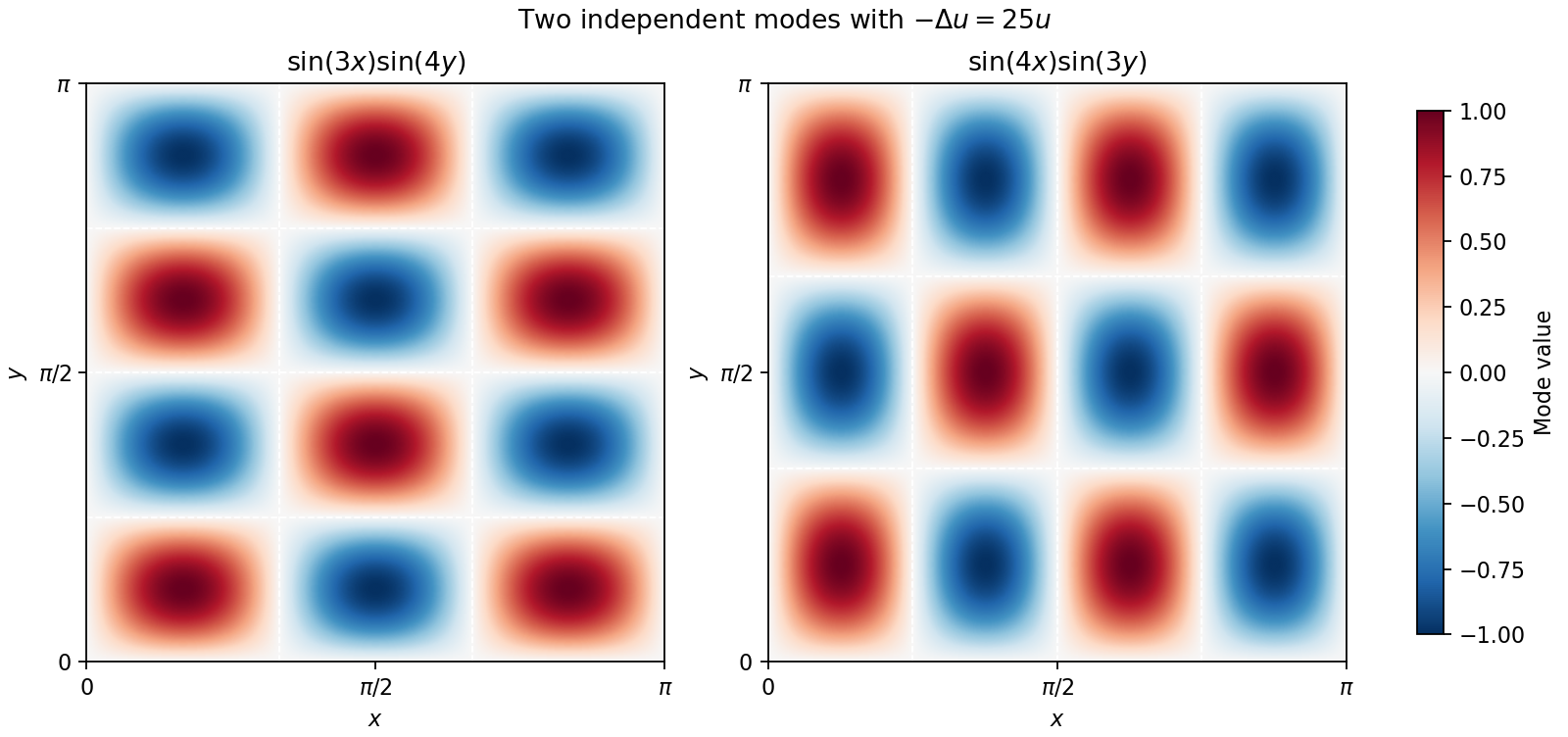
The two independent zero-boundary modes sharing Laplacian eigenvalue 25 on the square
. Details. 
Articles by others on the same topic
There are currently no matching articles.