The known root gives a factor by the factor theorem. Polynomial division leaves , soConsequently all the roots areThe three linear factors account for the full degree of the polynomial, so there are no further complex roots.
For , use integration by parts with and . ThenDifferentiating the answer checks cancellation of the extra constant term from .
The Gaussian function is even and is odd, so their product is an odd function. Moreover , whose integral on the real line is finite. Thus the improper integral is absolutely convergent, not merely a symmetric principal value, and the contributions of its two half-lines cancel:
Let the contact point have positive horizontal coordinate . Equality of slopes between the tangent line and the logarithmic curve requires . The point must also satisfy both equations, giving . HenceThe contact point is , and the resulting line has exactly the required derivative there.
This geometric series has first term and ratio , which lies strictly inside the unit interval. ThereforeThe decimal is treated as the exact value .
There are terms, namely . The arithmetic series formula givesPairing the first and last terms gives pair sum , explaining both factors.
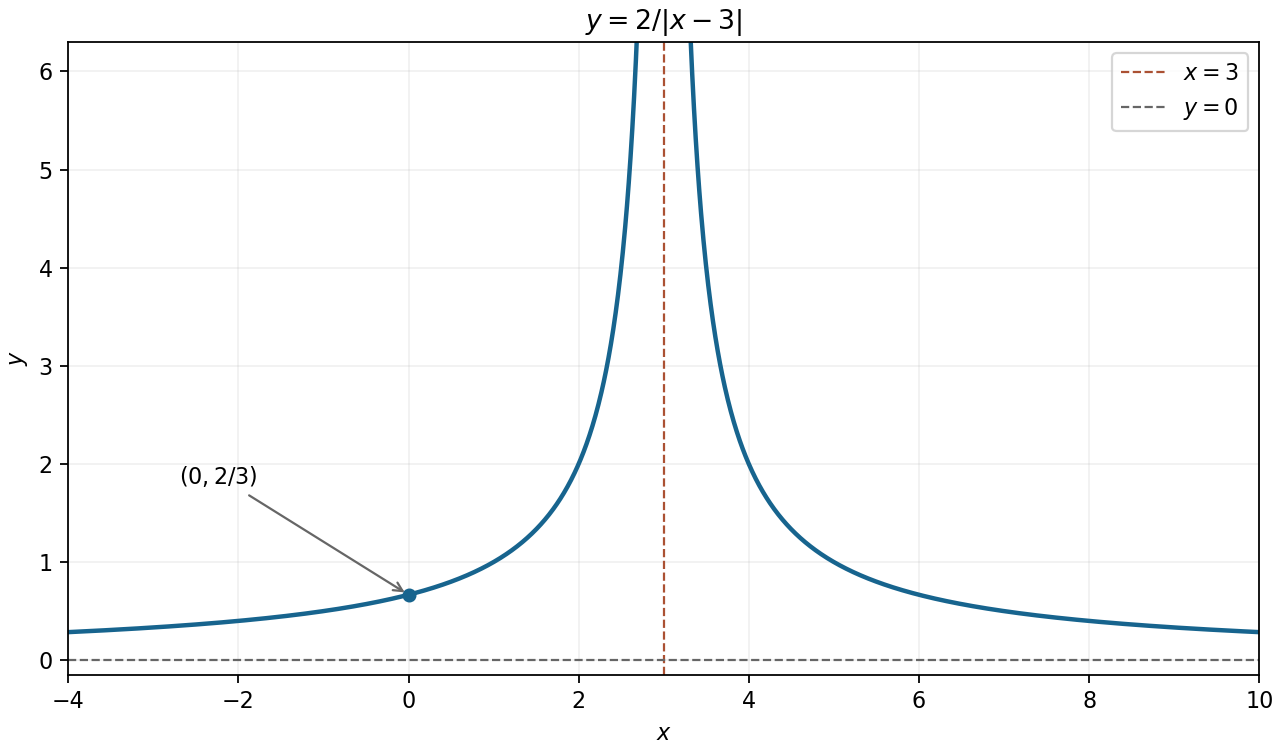
The domain of a function excludes . Both branches are positive, with a vertical asymptote at approached from both sides with value , and horizontal asymptote at either infinity. The graph is symmetric about because it depends only on .
For , the formula is and the derivative is positive; for , it is and the derivative is negative. It passes through and has no zeros.
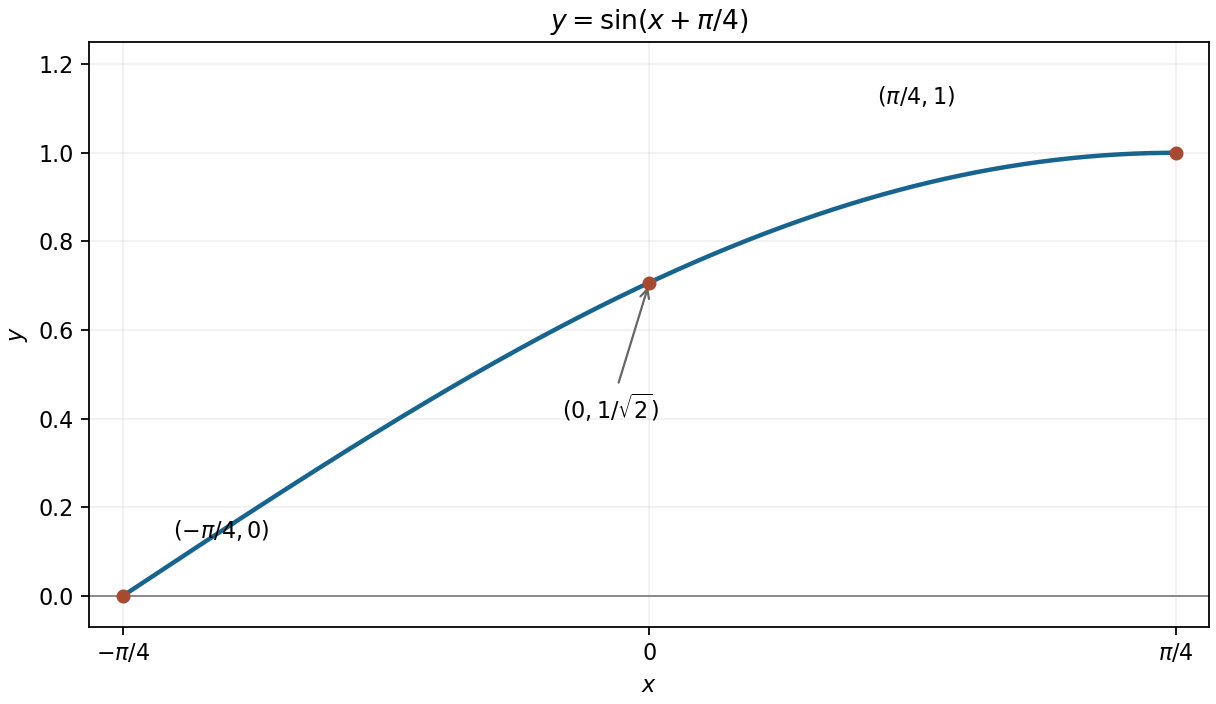
The sine addition formula gives . On the requested interval the shifted angle runs from to , so the graph rises from through to .
Its derivative is nonnegative and reaches zero only at the right endpoint. Its second derivative is , so the rising arc is concave downward and ends with a horizontal tangent.
Isolate the square root: . Its right side must be nonnegative, so retain the condition before squaring. Squaring then givesBoth candidates pass the original equation: and . ThusThe substitution check excludes the possibility of extraneous roots introduced by squaring.
The first four terms form the cubic Taylor polynomial about :With a continuous fourth derivative nearby, Taylor's theorem gives a remainder . Continuous derivatives through third order suffice for the weaker remainder . These are local approximations; equality with an infinite Taylor series requires additional convergence information.
For , the first two derivatives are and . At they giveUse the first three Taylor expansion terms with increment :The positive third derivative shows that this quadratic approximation underestimates the true value. The Taylor remainder is at most , since decreases on and the cubic remainder is .
Multiply the Maclaurin series for the exponential and the sine, keeping terms through degree three:Only , , and contribute at these orders, so
Use independent choices with constant probabilities and . Completing the entire reverse circuit while the forward-moving object never moves requires the first choices all to be reverse moves. ThusHere and below, a zero-length product is interpreted as one, including at or .
After choices, let be the number of forward moves. The two unwrapped positions are and , whose gap is . It follows that the first subsequent meeting occurs exactly at step , regardless of the order of the choices. Its position is the number of forward moves in that block.
That count has a binomial distribution with parameters . ThereforeThe two endpoint labels and represent the same physical seat reached by different complete circuits; the unwrapped convention distinguishes their probabilities.
The meeting position is the sum of independent Bernoulli random variables, each of mean and variance . Linearity of expectation and variance additivity for independent random variables giveThese are the mean and variance of the unwrapped integer label specified in the question, rather than circular angular statistics.
For the forward-moving object to have been waiting at the meeting position, the last move must be a reverse move. The preceding choices must then contain exactly forward moves and reverse moves. Choosing their order givesAt the probability is zero, since the reverse-moving object was already at that unwrapped position initially. At the displayed formula is , consistent with the forward object waiting at its initial position throughout. Equivalently, use the binomial convention to include this endpoint in the same formula without a negative power of .
Let be the meeting label. If , the forward-moving object has already crossed while the reverse-moving object has not yet reached it, so the forward object wins the race to . If , the reverse object passed first. If , the required event is exactly the special meeting from part (d).
These disjoint possibilities giveThis includes the endpoints: for the probability is , and for it is , with the initial positions understood in the unwrapped convention.
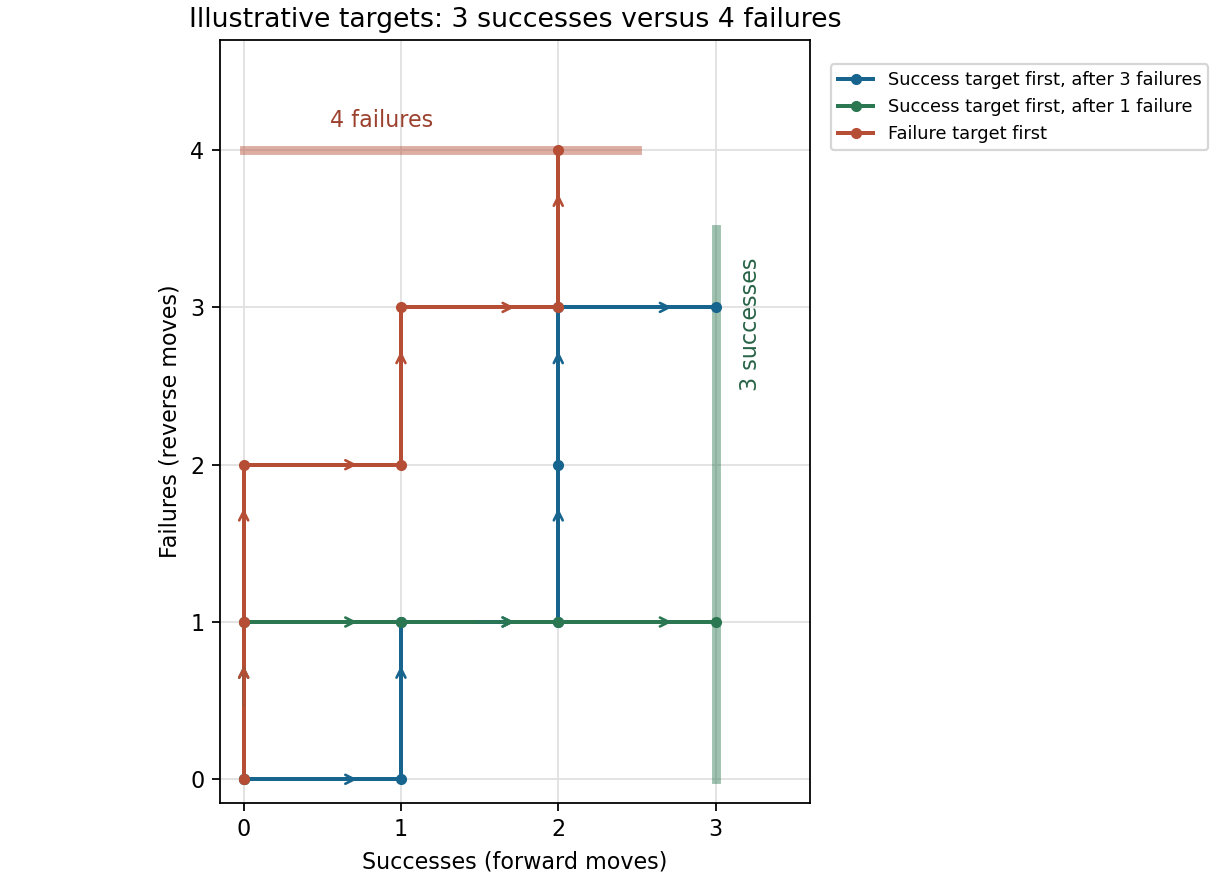


First take . The forward object reaches at its th move, while the reverse object reaches that label at its th move. If the forward object wins after reverse moves, then . The final choice is forward; among the preceding choices, exactly are reverse. By the negative binomial stopping argument, this case has probability .
Sum these mutually exclusive cases and equate the result to part (e), using parts (b) and (d). This proves the success-failure stopping identity here:The right side splits the same race into a special meeting at and all meetings beyond ; the left side splits it according to the number of reverse moves at the winning time.
At , both sides are zero with an empty sum and . At , the event has probability one; the right side equals . The printed left side includes and is outside the usual nonnegative-upper-index combinatorial definition. With the explicit generalized convention , its term is one and all terms vanish, so the identity also holds at that endpoint. Without this convention the displayed sum is undefined there; the zero-target race must instead be stated separately. All identities extend to by their polynomial forms.
Compute the characteristic polynomial using :Its three distinct real roots are and . For , the first row of gives and the second then gives , so take .
For either root of , take and solve the row equations to get . Substitution makes the first two row residuals opposite multiples of the quadratic equation and the third zero. Thus a complete choice isEvery nonzero scalar multiple is another valid eigenvector in the corresponding one-dimensional eigenspace.
For either sign, the dot product with isThe remaining pair also satisfiesHence the three eigenvectors are mutually orthogonal. This also follows from the spectral theorem for real symmetric matrices, since and its eigenvalues are distinct, but the displayed products verify the actual chosen vectors directly.
Write the linear system as withExpansion along the first row gives . Since , is an invertible matrix, and is the unique solution for this right side.
The adjugate matrix formula givesMultiplication by the right-side column yieldsMultiplying the inverse by checks the identity matrix, and substitution of this solution into the three original rows gives respectively.
The logarithm's argument is , with complex modulus one. The principal complex logarithm is therefore , givingIf denotes all logarithm values rather than the principal branch, they are for : the real part remains zero and the imaginary part changes by integer multiples of . The principal value is the conventional single-valued answer.
Integer powers of repeat with period four. Thus , andThis negative integer power is single-valued and does not require a logarithm branch.
The number being squared has polar form of a complex number . Squaring doubles its argument, giving . Hence
Rearrange to . A fourth root has modulus and an argument one quarter of . Therefore all four solutions areTheir arguments differ by , so they are distinct. Raising any of them to the fourth power returns .
Put and . Taking the dot product of the original equation with eliminates and gives . ThusNext take its cross product with . The term disappears, and the vector triple product identity givesInsert this expression back into . The two longitudinal terms cancel, leaving . ConsequentlyThe denominator is strictly positive for every real , including . Substitution using the same triple-product identity verifies the solution and establishes uniqueness. This is the cross-product operator with a longitudinal rank-one term.
Let . Taking a dot product with reduces the vector equation to . If , this determines a unique scalar and hence a unique vector:Direct substitution verifies it, so necessity has also produced sufficiency. The formula includes , when .
If , the reduced scalar equation becomes . When , there is no solution. When , all solutions are with arbitrary : their dot product with is indeed . Since forces , this is an entire affine line, not a single point. These alternatives are the solvability of an affine rank-one vector equation.
In the integral for , put , so and the endpoints are interchanged. ThenThus exchanging the positive parameters leaves the Euler beta function unchanged. Positivity ensures convergence at both endpoints of this improper integral.
The increasing substitution maps onto , with . Since sine and cosine are nonnegative there, powers combine without a sign ambiguity:This is the trigonometric form of the beta function. The powers at the endpoints are integrable because .
Write and set . Since and ,In the last integral put , giving . This yields , and part (a) interchanges the arguments. HenceThe equal-argument beta integral identity holds for every positive real , not only positive integers.
Multiply the two defining Gamma integrals. For the nonnegative product integrand allows Tonelli's theorem:Use , , so , and the positive quadrant becomes , . The Jacobian determinant has absolute valueAfter including this factor, the transformed integral separates:This proves the beta-gamma identity,All changes of variables are made inside the open positive domains; their boundaries do not contribute to the integrals.
Use the product substitution for a first-order equation . The product rule gives , turning the equation into . Consequently , so .
At the initial value gives , hence . Recovering givesThis is the maximal real graph interval containing the initial point: the logarithm requires , and the numerator has a nonzero limit at zero, so this particular solution cannot extend through zero. Differentiating verifies .
Away from the separable differential equation givesOn the interval containing , one has , so the positive initial value selects . Substitution of gives . ThusThe zero solution omitted by division by cannot satisfy the initial value. Although the selected solution tends to zero as , its derivative diverges there; it does not extend through that point as a classical differentiable solution.
Homogeneous equation. Its characteristic equation is . The two independent solutions are and , soForced equation. A particular solution is , since its second derivative minus its first derivative equals . Thus and . The derivative condition at one gives , so . The value condition then gives , so . HenceBoth initial conditions and the forced equation follow directly on substitution.
Articles were limited to the first 100 out of 218 total.
Articles by others on the same topic
There are currently no matching articles.