Convert the cardioid from polar coordinates to Cartesian coordinates:The curve is symmetric about the horizontal axis. It has a cusp at the origin at , passes through , and reaches on the right. Its leftmost horizontal coordinate is , since .
For the largest , differentiate the parametrization:The candidates have or . The positive maximum occurs at , where . Comparing with the negative extremum and the zero cusp value proves
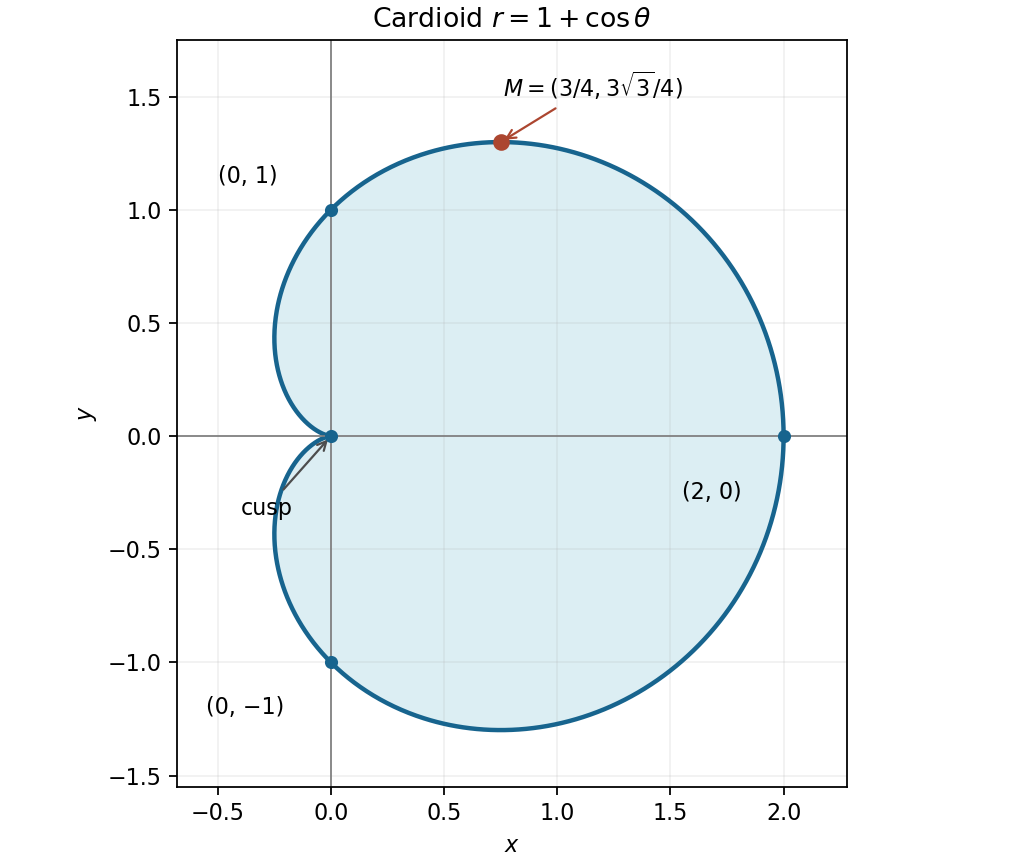

Each radial segment from to lies inside the cardioid. Integrating the polar area element givesThe three integrals are respectively , and . Thusin square coordinate units, agreeing with the scale-one case of the area and perimeter of a cardioid.
Differentiate , :Squaring and adding cancels the mixed terms and uses , givingFor this cardioid, the polar arc length integrand isThe cosine inside the absolute value changes sign at . Therefore the perimeter isin coordinate length units. The isolated cusp does not obstruct this piecewise smooth arc length integral.
Articles by others on the same topic
There are currently no matching articles.