Use completing the square after taking out the leading coefficient:Thus , and . Since a real square is nonnegative, the global minimum is , attained at .
The derivative of the parabola is , giving tangent line slope at . A normal line to a plane curve has the negative reciprocal slope, since its direction is orthogonal to a tangent vector. HenceThe point satisfies the equation, and the product of the two slopes is .
For the separate polynomial long division, successively cancel the leading powers of the dividend. Subtracting leaves ; subtracting leaves ; subtracting leaves . ThusThe polynomial remainder also equals the dividend evaluated at .
Use integration by parts twice. First,The bracket containing vanishes, while the last definite integral is . Therefore
A repeated linear factor requires both reciprocal powers. Write the partial fraction decomposition asMultiplication by the common denominator gives . Setting gives , and setting gives . Comparing the coefficients of then gives . Thus
For a nonzero solution, the separable differential equation gives . Integrating yields , hence . The initial condition fixes , soThe zero solution omitted by division by cannot satisfy the given initial condition. Differentiating the displayed solution verifies .
This geometric series has first term and common ratio , whose absolute value is less than one. Consequently
The domain of a function is , because the denominator vanishes at zero. Near zero, , so is a vertical asymptote, approached with value from the left and from the right. The horizontal asymptotes are as and as .
Moreover,Both branches define a strictly decreasing monotone function: the left branch lies below , and the right branch is positive. There are no zeros or vertical-axis intercept.
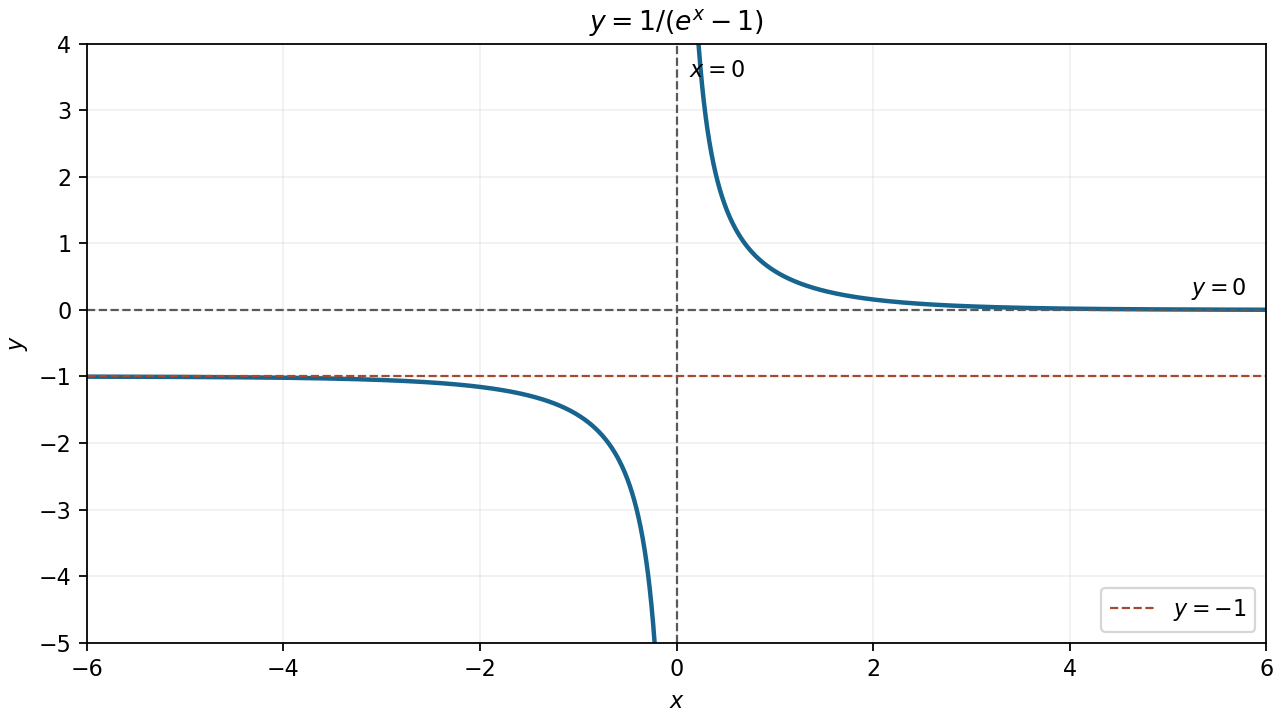
The decreasing reciprocal-exponential branches with their three asymptotes
. Details. The absolute value in the original PDF reflects every negative sine arch upward. The graph is nonnegative, with zeros at for , and it lies below the decaying envelope . On the th arch, differentiation gives a factor proportional to . Thus its unique local maximum isSuccessive maximum heights have ratio . At each interior zero the one-sided slopes have opposite signs, producing a corner. The smaller panels below magnify the later arches so that all four remain visible.
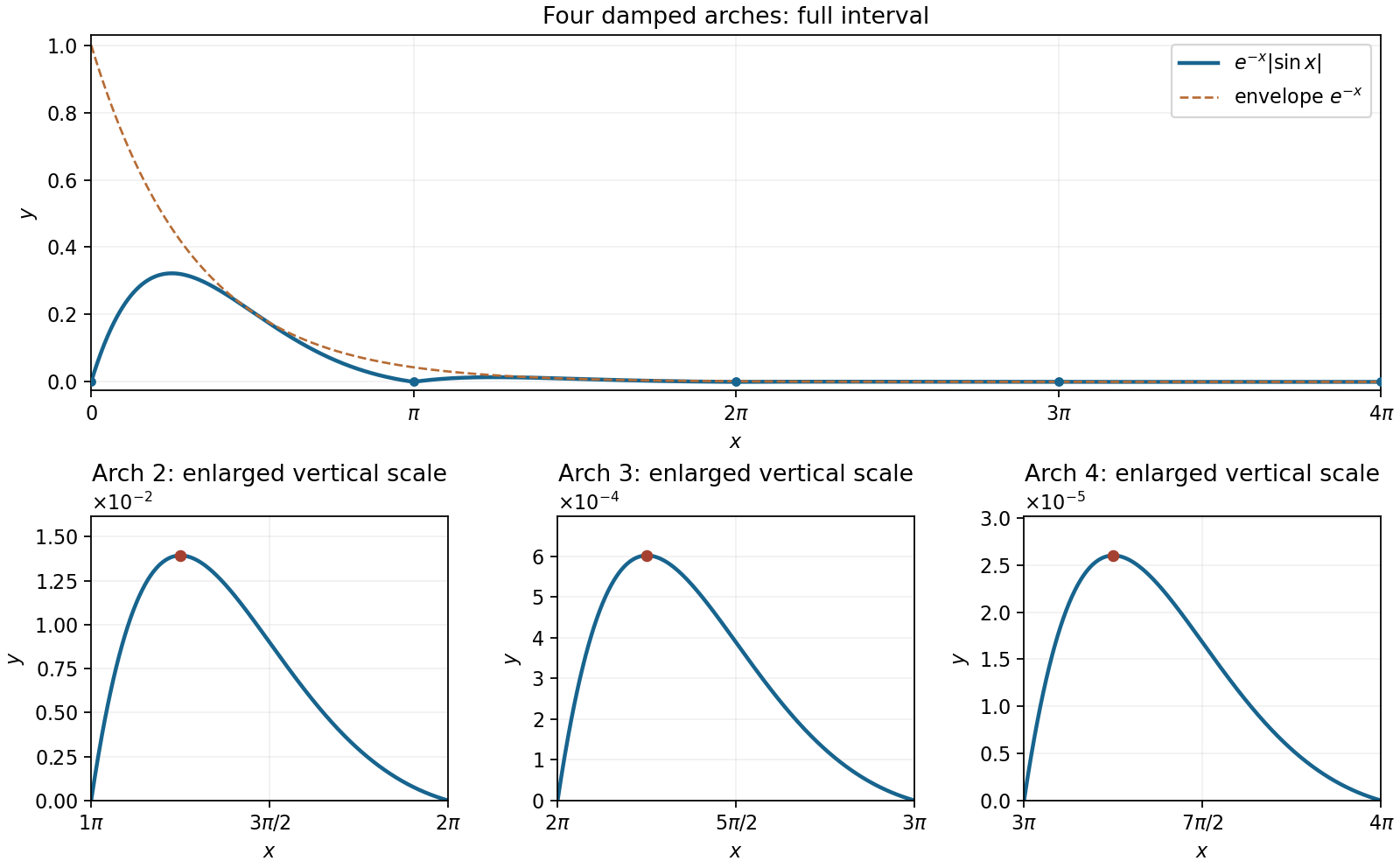
Four positive exponentially damped sine arches, with separate linear-scale enlargements of the later arches
. Details. A cross-section perpendicular to the rotation axis is a disk of radius . Disc integration therefore givesThe result is in cubic coordinate units; the full rotation is already accounted for by the disk area.
Collecting the coefficients gives the coefficient matrixA square homogeneous linear system has a nonzero solution precisely when its matrix is a singular matrix. Expanding the determinant down the first column,Hence the necessary and sufficient condition is or or . A zero determinant gives a nontrivial kernel of a linear map; otherwise multiplication by the matrix inverse would force the zero solution.
With , , , substitute into the matrix equations. The equations reduce to and , with the latter repeated. Taking gives the complete null spaceThe two independent rows impose two constraints on three unknowns, leaving exactly one free parameter. This also includes the zero solution at .
Use orthogonality to the image of a matrix. For , the condition is , since must vanish for every nonzero input. Direct multiplication givesEach coefficient must vanish; choosing the three coordinate basis vectors as inputs already proves necessity. Solve , to obtainThese values make every output have zero dot product with , including any zero output. Here orthogonality is understood in this algebraic sense; no direction is assigned to the zero vector.
For , orthogonality to the image of a matrix would requireThe second component forces , but then the third component is . Equivalently, the last two required zero components always sum to . Therefore there are no such values of .
Multiply numerator and denominator by the complex conjugate of the denominator:Squaring gives . Thus the real part and imaginary part are
The complex sine function identity follows from the exponential definition of sine. With , its imaginary term vanishes, whileConsequently the real part is and the imaginary part is .
Write a square root as , with real. Equating the real part and imaginary part of its square gives and . Taking complex modulus also gives . ThereforeSince , the signs agree. The two roots areThe changes both signs together, rather than independently.
Set , so . The binomial theorem givesUse and to obtainThis is a finite Fourier sine series, with only odd harmonics.
Using the exponential definition of hyperbolic cosine, multiply by the nonzero quantity . This yields , hence .
If , its complex modulus requires , so ; its phase then requires . Thus all complex solutions areThere are no real solutions, since real .
Work on an interval with . The homogeneous first-order differential equation becomes a separable differential equation under : substituting gives , hence .
For , integration gives . Renaming the arbitrary constant producesFor the nonzero family the denominator must remain nonzero, so take any connected interval avoiding both and . The zero solution must be restored after division by ; by the Picard-Lindelöf theorem away from , a solution cannot switch between zero and a nonzero branch there.
Let and . Their cross partial derivatives agree: . More directly, construct the scalar functionThis exhibits the expression as an exact differential. Along a solution of the differential equation,Thus the general solution isFor , the graph also extends smoothly through and satisfies the original, undivided equation there. Nonzero cannot extend through zero as a finite-valued differentiable solution. The extra vertical component of the implicit zero-level equation is not a graph on an interval and is not an additional solution of this ordinary differential equation.
The integrating factor is , giving . The required antiderivative isAfter dividing by , the general solution is the oscillatory term plus . The initial condition fixes , soThe real, nonzero parameters ensure ; direct substitution verifies both the equation and .
The vector triple product identity isThus the expression lies in the linear span of and , with respective scalar coefficients and . The order and the minus sign matter because the cross product is not an associative operation.
The nonzero vectors are normal vectors to the two planes. If , then for some nonzero real . Their equations are therefore and .
When , the planes coincide and their intersection is an entire plane. Otherwise they are distinct parallel planes and have no intersection. Neither case has exactly a line as its intersection. Hence is necessary for intersection in a line. It means that the two normal vectors are not parallel; in that case it is also sufficient.
Apply the vector triple product identity and the two plane constraints:Put . If is one intersection point, subtraction gives , so is parallel to . Conversely, adding any multiple of preserves both plane constraints because is orthogonal to both normal vectors. The whole intersection is thereforeSuch an exists: choose and solve the two-by-two linear system with determinant . This also proves sufficiency rather than assuming a nonempty intersection.
The squared Euclidean distance along the line isIts minimum occurs at exactly when its derivative there vanishes, so . Since are independent, their linear span is the two-dimensional orthogonal complement of . Consequentlyfor unique real . This is the closest point on the intersection of two planes; the positive quadratic coefficient proves that the stationary distance is a strict global minimum.
With , substitute into the plane constraints. They become and , givingThe Pythagorean theorem for the two orthogonal terms in then gives the closest distanceZero values of either scalar are allowed, including zero distance if both planes contain the origin.
Convert the cardioid from polar coordinates to Cartesian coordinates:The curve is symmetric about the horizontal axis. It has a cusp at the origin at , passes through , and reaches on the right. Its leftmost horizontal coordinate is , since .
For the largest , differentiate the parametrization:The candidates have or . The positive maximum occurs at , where . Comparing with the negative extremum and the zero cusp value proves
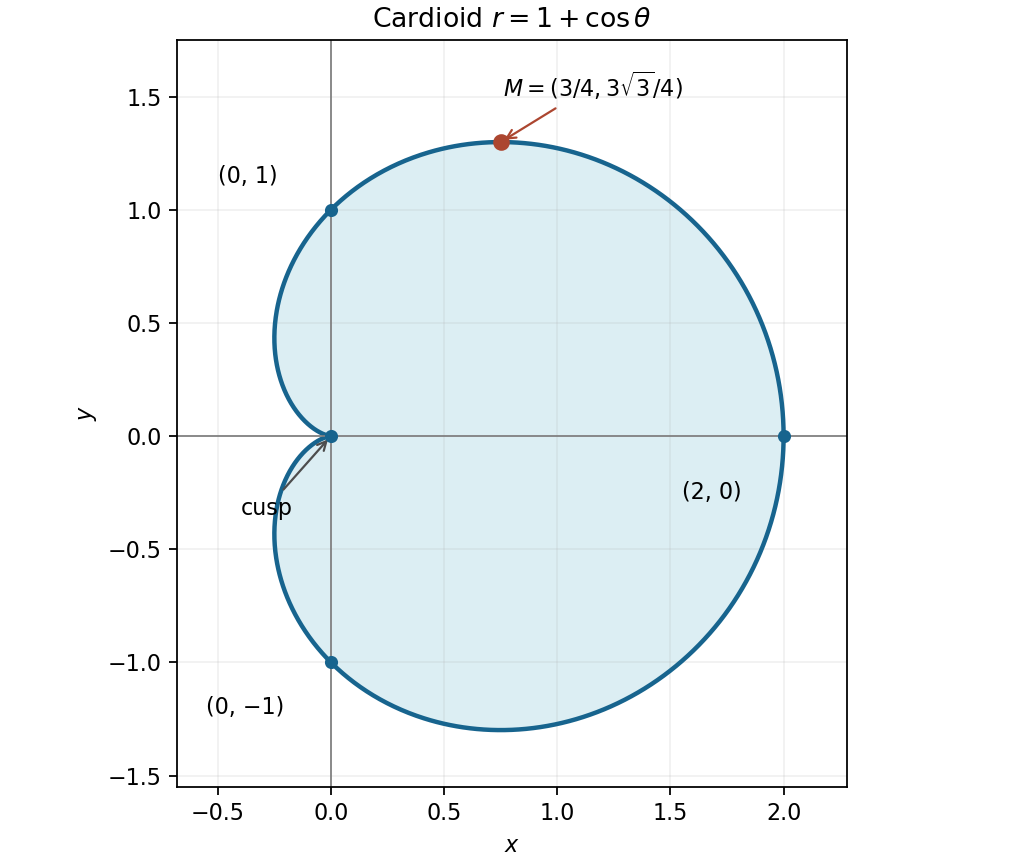


Each radial segment from to lies inside the cardioid. Integrating the polar area element givesThe three integrals are respectively , and . Thusin square coordinate units, agreeing with the scale-one case of the area and perimeter of a cardioid.
Differentiate , :Squaring and adding cancels the mixed terms and uses , givingFor this cardioid, the polar arc length integrand isThe cosine inside the absolute value changes sign at . Therefore the perimeter isin coordinate length units. The isolated cusp does not obstruct this piecewise smooth arc length integral.
A directional derivative measures change per unit distance, so first normalize the direction: . The gradient isTaking the dot product with the unit vector,Using the unnormalized vector would instead give , the change per unit parameter along ; it is not the rate per unit distance requested here.
The product rule gives the two partial derivativesThey both vanish at the origin. The exponential function is never zero, so any further stationary point must satisfy or , and or . Having both coordinates nonzero would require both opposite differences to be , which is impossible. If , the nonzero choices are ; if , they are . Hence the full list is
At the origin the Hessian matrix isThus the second-derivative test gives a saddle point. Its opposite signs can also be checked without a test formula: for , whereas for . Both types of values occur arbitrarily close to the zero value at the origin, excluding either a local maximum or a local minimum.
Assume . For any nonzero integer ,For , the product-to-sum identity expresses the integrand as one half the sum of cosines with nonzero frequencies and , so the integral is zero. For , use to get . Finally, for the integrand is one. The complete Fourier orthogonality formula isThe constant mode has twice the squared norm of a positive-frequency cosine mode.
For period , use the Fourier series conventionThe Fourier coefficients have prefactor on . First, . For the useful antiderivatives areAt the endpoints and , soConsequently, on ,The Dirichlet-Jordan convergence theorem justifies equality at every point of continuity of the periodic extension. At odd integers the extension has a jump discontinuity between and , so the series converges to their average , regardless of any assigned endpoint value. This is the case of the Fourier series of a periodically extended exponential.
Under independent daily tosses, attending every lecture is the intersection of independent events of probability . Hence
Write the count as a sum of Bernoulli random variables, one for each attendance indicator. Each indicator random variable has expected value , so linearity of expectation givesEquivalently, has a binomial distribution with parameters and .
Independence makes the variances of the attendance indicators additive. The binomial distribution therefore gives . Its positive square root is the standard deviation:
Articles were limited to the first 100 out of 241 total.
Articles by others on the same topic
There are currently no matching articles.