The curve has and can be written . It is a hyperbola with vertical asymptote and oblique asymptote , crossing the horizontal axis at . It is symmetric under .
On each branch . For , the branch descends from as , passes through , and approaches from above as . The negative branch follows by the central symmetry.
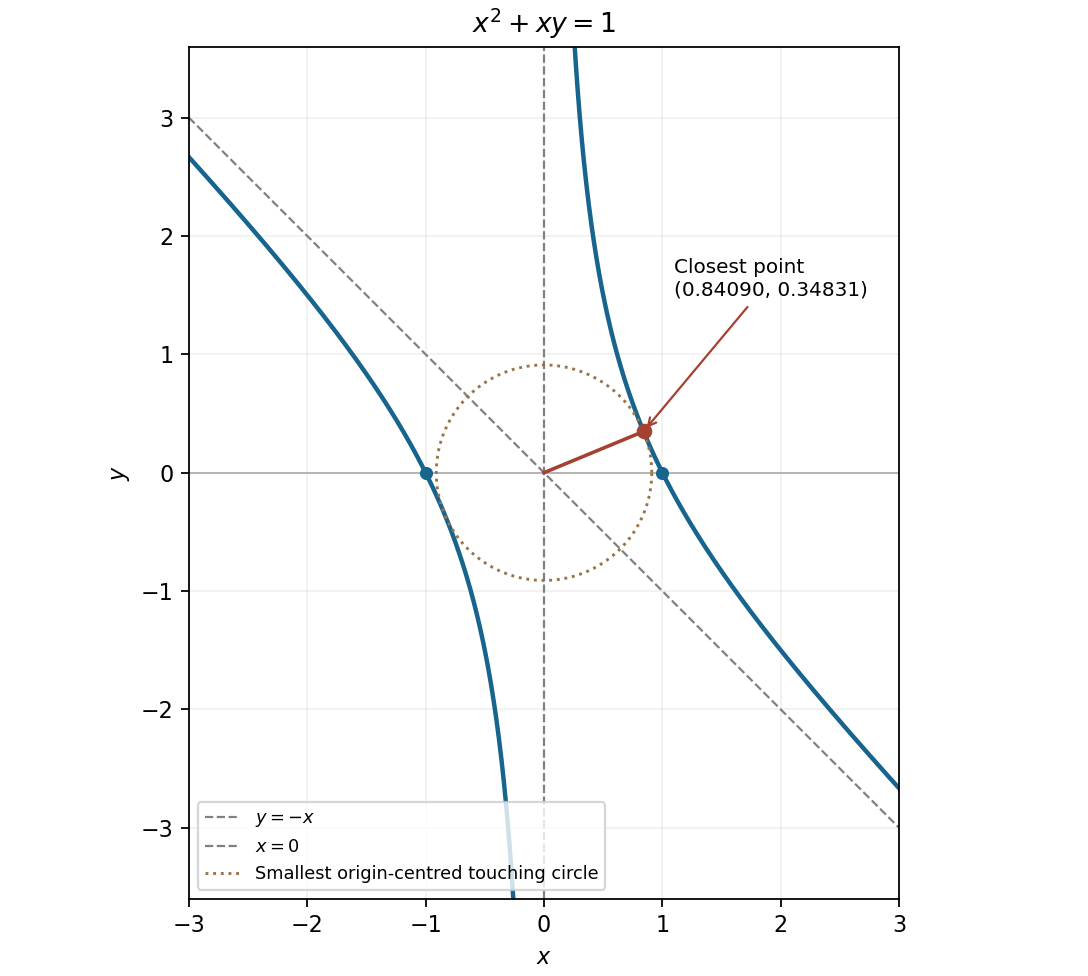
The two hyperbola branches and their asymptotes, with the nearest point on the positive-horizontal branch marked
. Details. 
Minimize the squared distance , which has the same minimizers as the distance. The Lagrange multiplier equations for the constraint areThe constraint gradient cannot vanish on this branch, since its second component is . Eliminate to obtain . Put ; then , so . But the constraint says , requiring and selecting . It follows thatTo prove a global minimum on the whole branch, substitute into :The arithmetic-geometric mean inequality proves this bound, with equality only when , namely . Thus the stationary point is the unique closest point on the required branch. Numerically it is approximately and its distance is in coordinate units.
Articles by others on the same topic
There are currently no matching articles.