With the usual real normalization, the Fourier series iswith Fourier coefficientsThese formulas follow from Fourier orthogonality. Integrability is needed to define the coefficients, and periodicity alone does not guarantee pointwise equality with the series. For a piecewise smooth periodic function, the Dirichlet-Jordan convergence theorem gives the average of the one-sided limits at a jump and the function value at a continuity point.
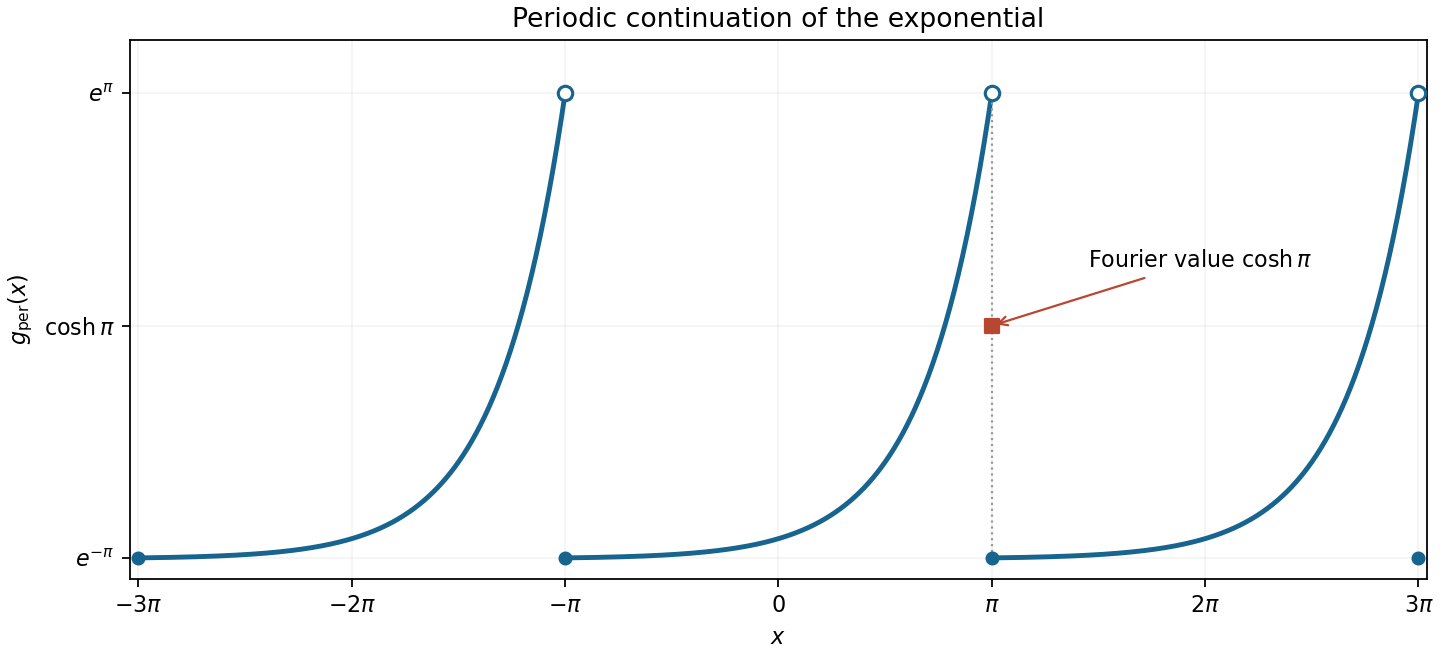
The periodic continuation is on each interval . Thus the plot repeats an increasing exponential segment on each of the three requested periods, jumping down from to at odd multiples of .
At , the left and right limits are and . The Dirichlet-Jordan convergence theorem therefore makes the Fourier series converge toThe actual half-open periodic definition has ; the Fourier value at the jump need not equal that assigned endpoint value.

Take the odd extension on and then extend with period . It agrees with the required arch for and is continuous at its joins. Its Fourier sine series hasFor clarity, let , so and . Two integrations by parts, with the first endpoint term zero, giveConsequently : the even coefficients vanish and the odd ones are . This provesThe Fourier sine series of an odd quadratic arch converges to this continuous extension; its coefficients are also absolutely summable. Finally evaluate at . The left side is and the sine factors are , soThe evaluation is at a continuity point, so it does not invoke a jump midpoint.
Articles by others on the same topic
There are currently no matching articles.