Write the rational expression as and apply the chain rule:The denominator is positive for every real , so the derivative is defined throughout the real line.
The outer exponential function differentiates to itself, and the inner sine has derivative cosine. The chain rule gives
For positive , write . Differentiating by the chain rule givesThe natural logarithm of the constant base supplies the factor; it must not be omitted when .
Set , so . The real domain is , ensuring . The integration by substitution followed by integration by parts givesThus
Use the real antiderivative , valid on either half-line away from zero:The negative answer is consistent with a negative integrand and increasing integration limits.
The specified range ensures , so the separable differential equation can be written . Integrating gives . The range selects the principal inverse tangent, henceEvery finite produces a solution within the required range. Constant solutions at the excluded values are not part of this family or of the question's domain.
The general solution of this first-order linear ordinary differential equation is . Its initial condition gives , soDifferentiation verifies and substitution at zero gives the required value.
Substituting the line into the hyperbola givesThe two polynomial roots give all intersections:Both satisfy the original line as well as the curve.
Put the equation into standard ellipse form:The centre is , with horizontal semiaxis and vertical semiaxis . Its four axis vertices are and ; the ellipse meets the vertical coordinate axis at .
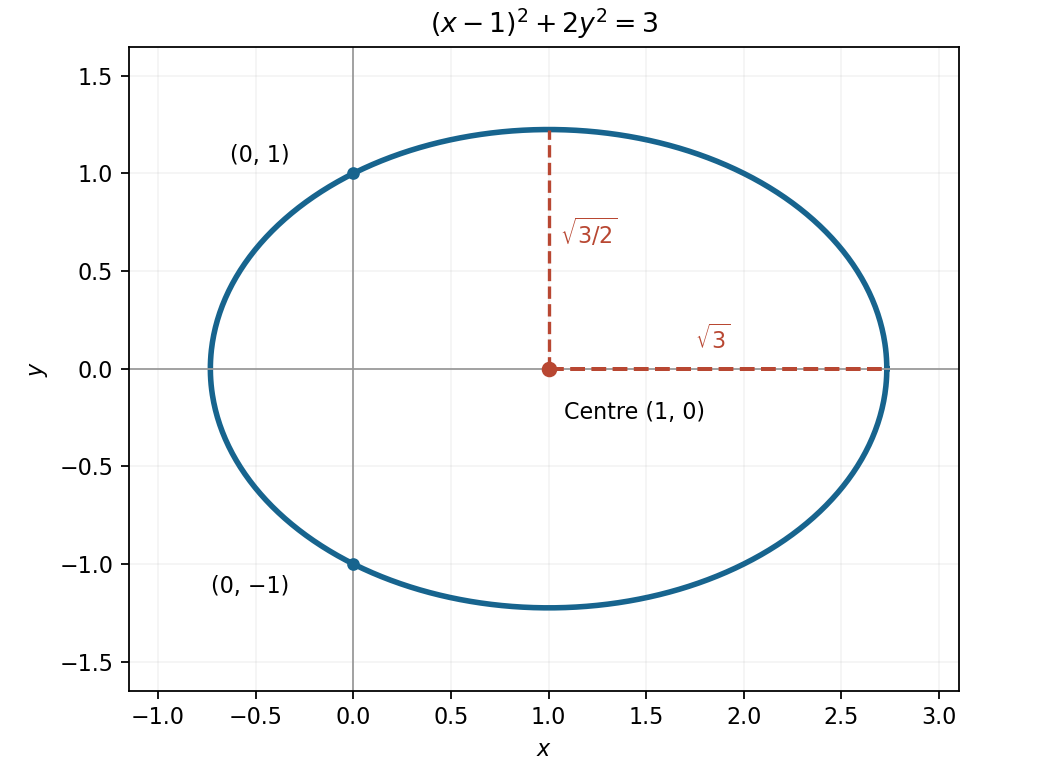
The displaced ellipse with its centre, semiaxes and coordinate-axis intersections
. Details. The sphere has surface area . Dividing the given surface-patch area by that total gives the dimensionless fractionor about of the surface. The patch area is already measured on the surface, so no planar projection or spherical-cap conversion is needed.
Interpret the stated side lengths as all eight edges of the square pyramid. The equal lateral edges put its apex above the base centre. The base-centre-to-vertex distance is half the diagonal, . The Pythagorean theorem therefore givesUsing the pyramid volume formula with a base,
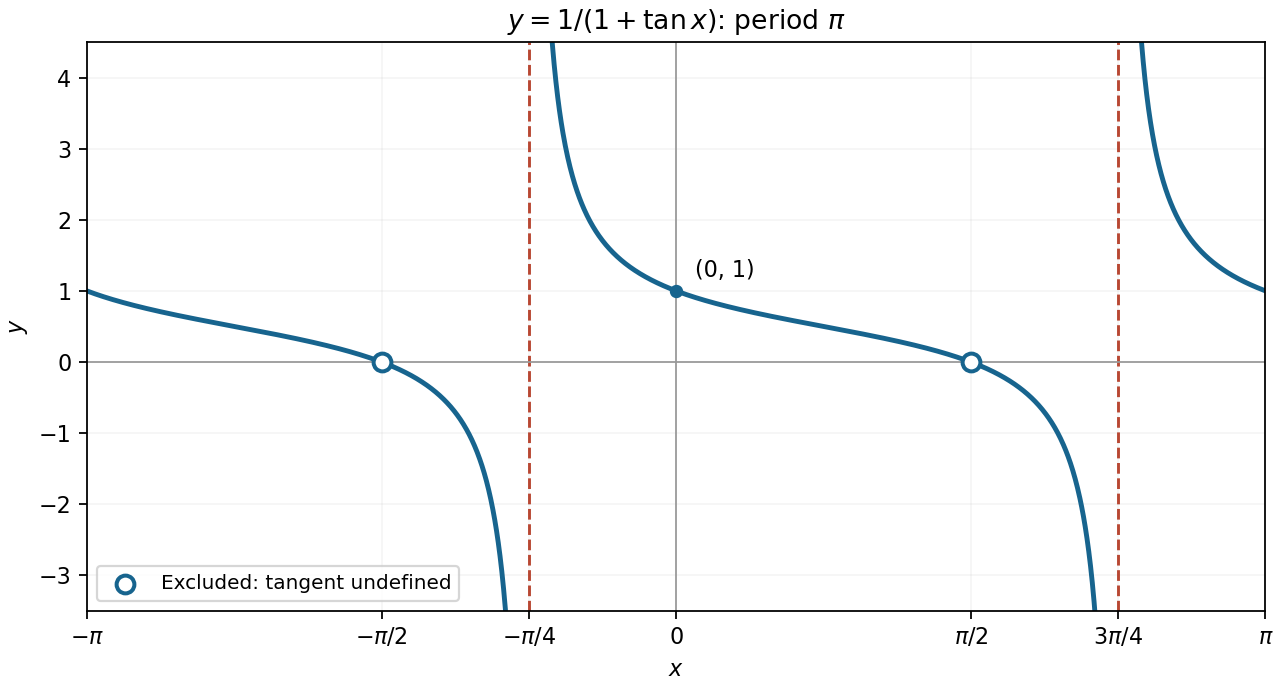
Where the original expression is defined, multiplication by givesThus the graph repeats with period and has vertical asymptotesBetween consecutive asymptotes the extended cotangent branch decreases from to , since . It passes through and .
It is essential to preserve the domain when simplifying a function. At , the original tangent is undefined. The finite limiting value is zero, so the graph has holes at , rather than actual zeros. The simplified expression extends across those points, but the original one does not.
This exponential function is positive everywhere, with , as and as . Its derivatives areIt is strictly decreasing overall, with a horizontal stationary inflection point at . A second, nonstationary inflection point occurs at , where . The only horizontal asymptote is toward positive infinity; the graph is not symmetric about the vertical axis.
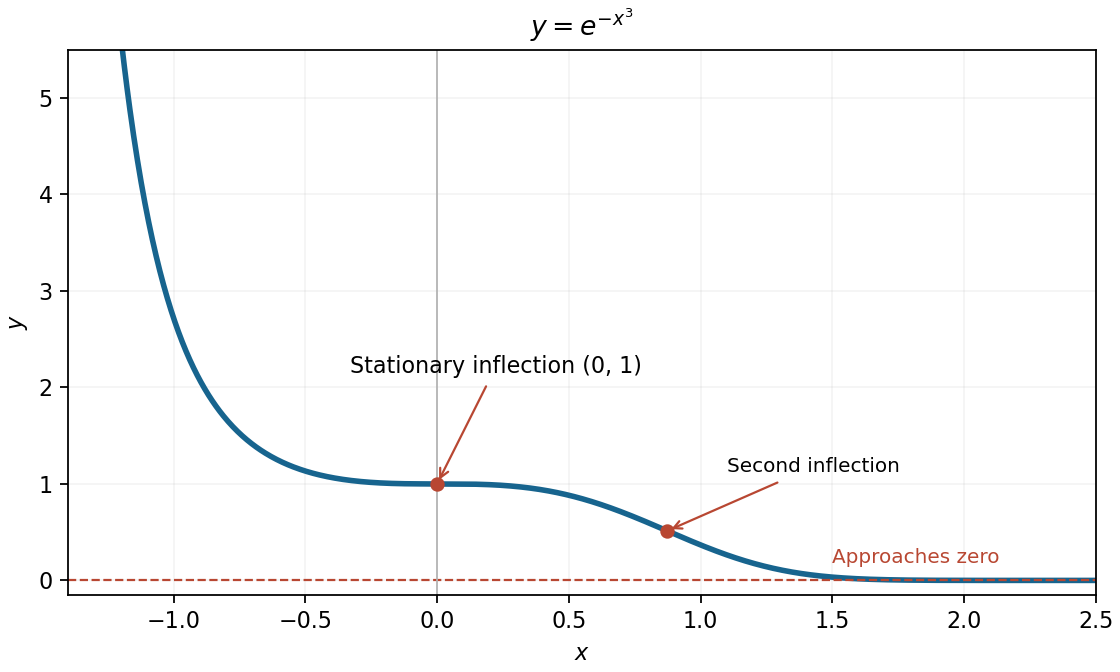
The decreasing cubic exponential, its stationary inflection, and its positive horizontal asymptote
. Details. Differentiate the polynomial and factor:The stationary points therefore have horizontal coordinatesFor a check, is negative at the first and positive at the second, giving a local maximum and a local minimum respectively.
The second derivative is , so . By the second-derivative test, the stationary point is a strict local minimum, at . It is not a global minimum, since this cubic is unbounded below toward negative infinity.
On , the quadratic polynomial is positive. The required area is therefore its definite integral above the horizontal axis:The units are square coordinate units.
Real points require , and the two branches areThis is a semicubical parabola, symmetric about the horizontal axis and with a cusp at the origin. The parametrization , traces both branches. Their limiting slopes at the origin are zero, so the common tangent direction is the positive horizontal axis, even though the curve has a cusp there.
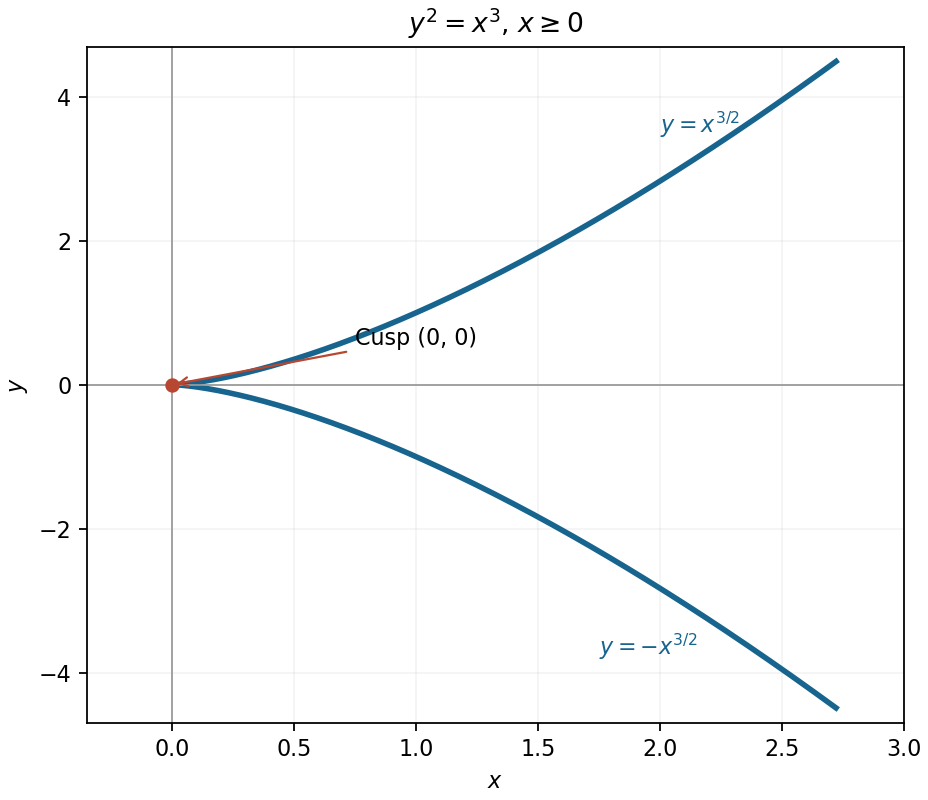
The two real branches of the semicubical parabola and their cusp at the origin
. Details. The original line meets the horizontal axis at . A perpendicular line has slope , the negative reciprocal of , soSubstituting verifies the required common point.
For the partial fraction decomposition, write . Clearing denominators gives . Substitution at and yields and , hence
Expanding the determinant along the first row givesThe matrix trace is the sum of the diagonal entries, . Since the determinant is the product of the eigenvalues, at least one eigenvalue is zero. Thus is singular; the determinant alone does not specify the two other eigenvalues.
The symmetry between the first and third coordinates makes an eigenvector, with eigenvalue . In the remaining invariant plane, write a vector as . Its image is , so the reduced eigenvalue equation has determinantThe corresponding directions have for and for . Normalizing givesTheir squared unnormalized norms are . The pairwise unnormalized dot products are , , and , so these unit eigenvectors are mutually orthogonal. The eigenvalues sum to and have product zero, agreeing with part (a).
Expand an arbitrary vector in the orthonormal eigenbasis:Its image has no component along , soAlternatively, symmetry gives . This is image-kernel orthogonality for an adjoint, with .
Resolve the input along the three perpendicular eigendirections. The linear map removes the component along , stretches the component along by , and reverses and stretches the component along by . Every output lies in the plane perpendicular to . A nonzero input in the kernel of a linear map is sent to zero; other nonzero inputs remain in that output plane. Equivalently, take the orthogonal projection onto this plane, then scale by the two signed eigenvalues along its perpendicular eigendirections.
The complex number has complex modulus and argument . A cube root has modulus , and its argument is one third of . Hence the three distinct roots areTheir displayed arguments are , , and ; the last is equivalently in the principal range.
Use the exponential definition of the hyperbolic tangent:The complex exponential has modulus one here, so . Its arguments satisfy . Thus all solutions areThe denominator is then , so no pole was admitted by cross-multiplication. Substitution also follows from and the period .
Divide the complex polynomial by its known factor :The quadratic factors further as , because its two proposed roots sum to and multiply to . Therefore the remaining solutions areAll three roots are distinct. Complex coefficients do not require nonreal roots to occur in conjugate pairs.
By De Moivre's theorem, . Take real parts of the binomial expansion:Eliminate using and collect powers:
First write the forcing as . An integrating factor for the linear ordinary differential equation is , givingSet inside the antiderivative. ThenThe initial value forces , henceThe resulting expression is explicit and valid for all real ; the substitution does not impose a global monotonicity condition on when verifying an antiderivative.
The characteristic polynomial of the homogeneous equation is . Thus the complementary function is . The forcing resonates with the first term, so a resonant exponential particular solution is . Substitution gives , hence .
The nonparallel direction unit vectors have nonzero cross product. LetFor any joining vector , its normal component is fixed:Thus its length is at least the absolute value of that component. Since the two line directions span , suitable cancel the entire component in that plane, attaining the bound. Therefore the distance between skew lines, including the zero-distance intersecting case, isThe numerator is a scalar triple product. The nonparallel hypothesis is essential to the denominator and to the spanning argument.
Choose any nonzero auxiliary vector not collinear with . Then form a basis, so writeTaking the dot product with gives . This separates the two cases requested in the hint.
If , choose freely and solve for :If , the coefficient of is fixed and the other two are free:These formulas describe the whole plane with normal , including . Completeness follows from the basis expansion, not only from checking that the displayed vectors satisfy the equation. The parametrization of a plane with an auxiliary vector also gives a single formula valid in both cases.
Use the convention , , , with measured from the positive vertical axis. The squared radius isSince the horizontal radial distance is for finite ,The horizontal angle advances with . Thus the spherical coordinates areAn unwrapped continuous azimuth is simply ; a principal-angle convention introduces harmless jumps by . The polar angle stays in and approaches the two poles only as .
The radial interval is nonempty exactly when , or . Choose the representative angular range . The region of integration is thereforeIt is the right-hand cap inside the cardioid and outside the circle of radius , symmetric about the horizontal axis. Its boundary intersections have coordinates , and the cap reaches . The radial segment on the horizontal axis runs from to .
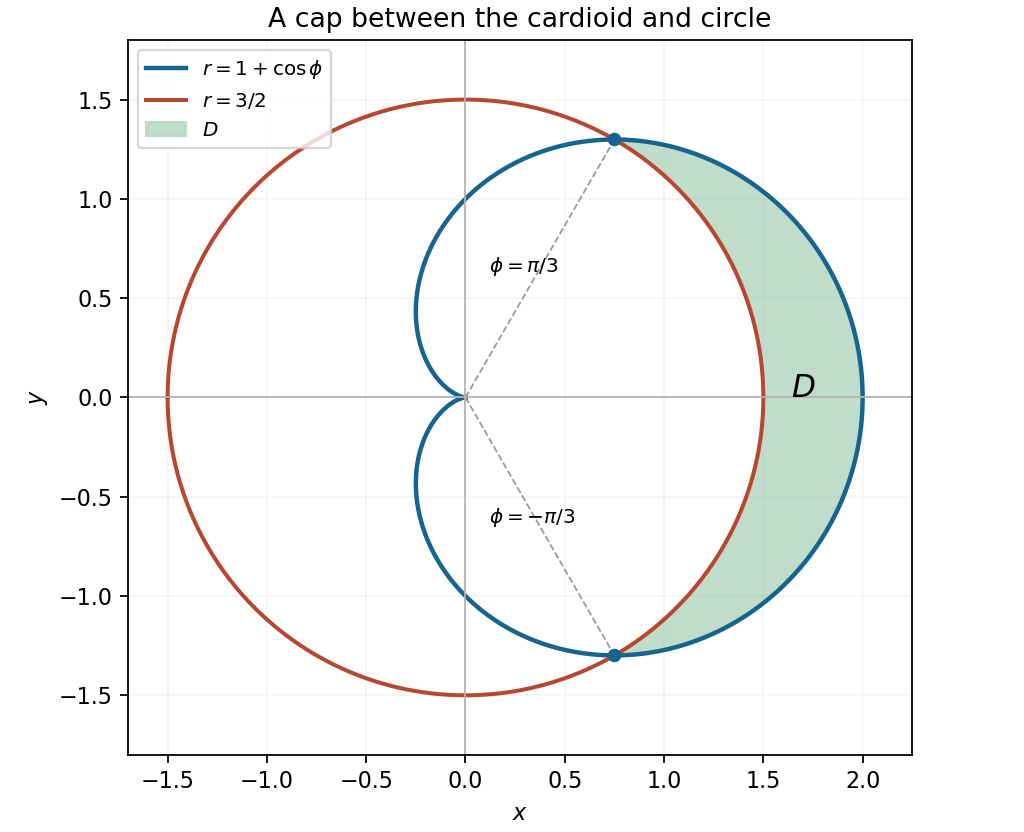


The polar area element is . Integrating first in radius and using symmetry givesThis is the specialization , of the polar cap between a cardioid and a circle area formula.
Substitute , and include the Jacobian determinant factor . The integrand times the area element becomesBoth terms containing one factor are odd in , while the radial bounds and angular interval are even. They therefore integrate to zero. The remaining double integral isThe domain stays away from , so the denominator of the original integrand causes no singularity in this region.
Translate the variables by , , . The numerator becomes . The part odd in integrates to zero, while the constant part factors into three Gaussian integrals. ThusThe absolute integrability of a polynomial times a Gaussian justifies this separation by Fubini's theorem. Neither nor affects the result; when , odd symmetry makes the integral zero.
The gradient equations factor asFor they give . Otherwise , which gives and the matching . Thus there are exactly four stationary points.
The Hessian matrix isAt it is , and at it is . At and its determinant is . The second-derivative test therefore yieldsThe extrema are local: along the cubic is unbounded both above and below.
The partial derivatives give and . If either coordinate is zero, both vanish. Otherwise substitution gives , so the real stationary points are , and .
The Hessian matrix isAt the origin its eigenvalues are and , so it is a saddle at level zero. At either of the other points its eigenvalues are and , so both are strict minima at level . In fact,with equality only at those two points. HenceFor levels , two separate closed contours surround the two minima. At the contours form two lobes, in the first and third quadrants, meeting at the origin. Their limiting tangent directions there are the coordinate axes because the leading term is . On the diagonal the outer zero-level points are . Positive levels form one closed outer contour enclosing both wells; there are no contours below . The graph is symmetric under exchanging and under reversing both signs, but not under a quarter-turn. These features are the case of the quartic double well with bilinear coupling.
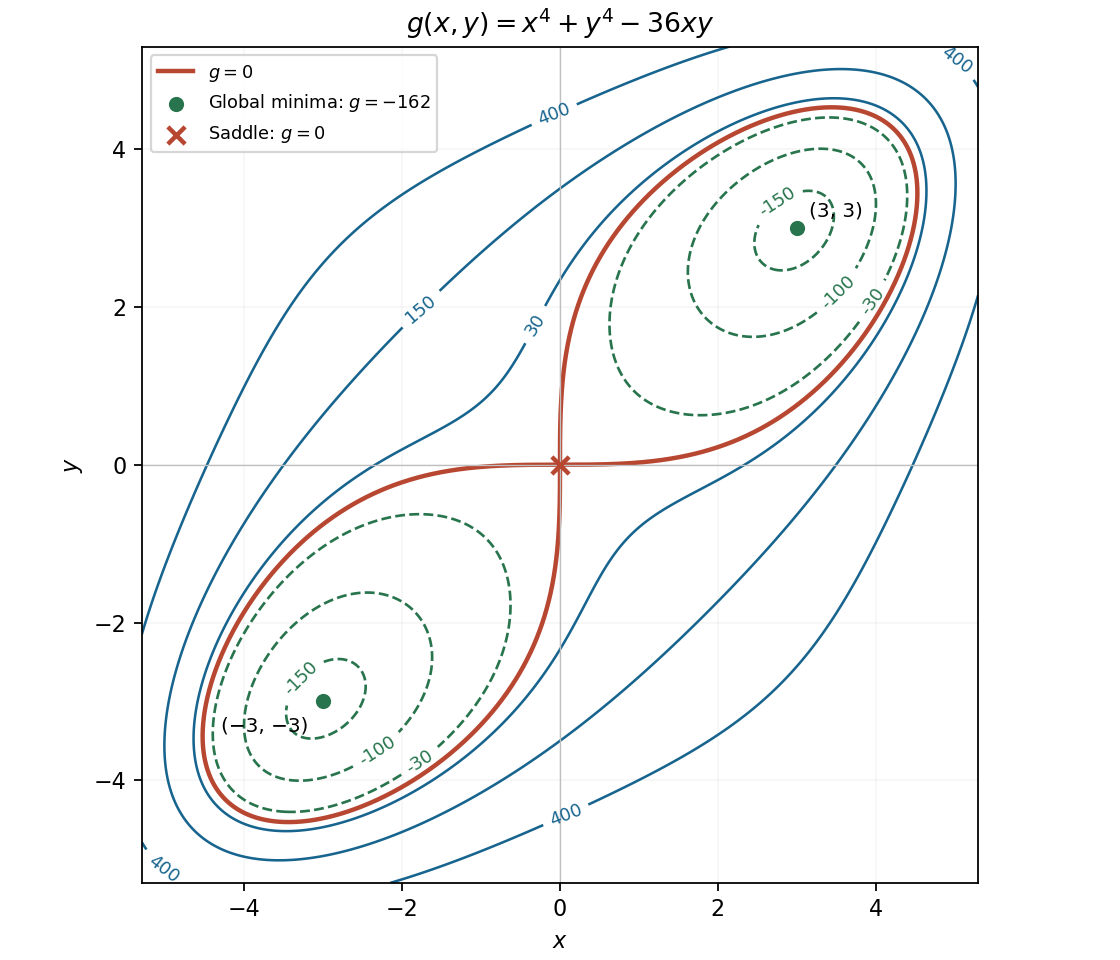
The quartic function's two minima, saddle, and transition from two contour loops to one
. Details. 
Articles were limited to the first 100 out of 138 total.
Articles by others on the same topic
There are currently no matching articles.