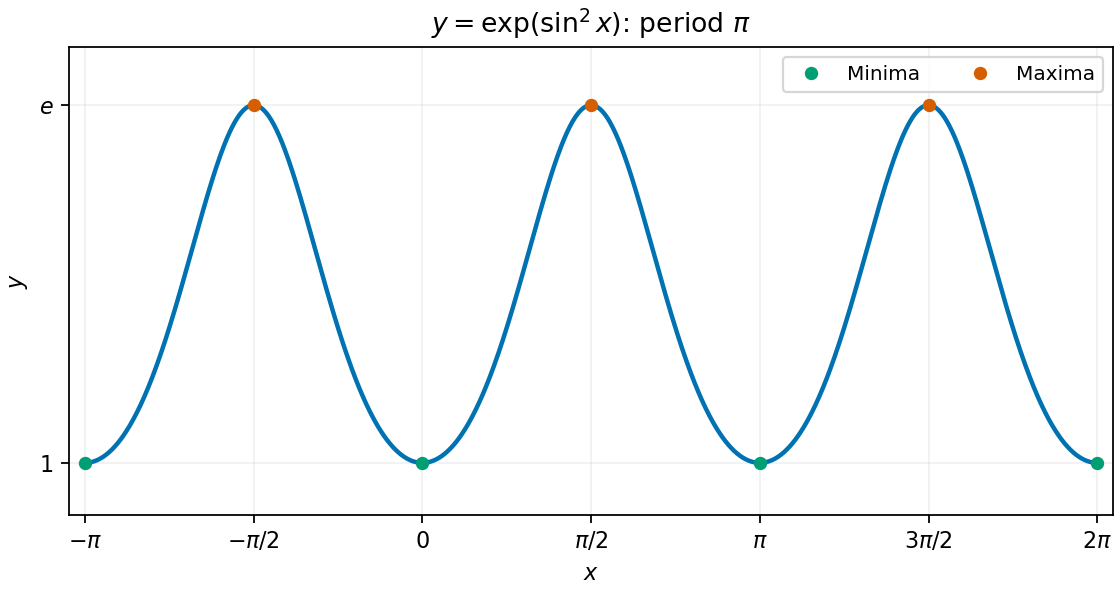
Differentiating givesThe exponential never vanishes, so all stationary points have . At , and ; at , and . ThusThese are global minima and maxima because . None of the stationary points is an inflection point.
The graph is even and periodic with period , bounded between and . It rises from each minimum at to a maximum halfway to the next minimum, then falls back. It has horizontal tangents at all these extrema and repeats smoothly.

For the composite square root, throughout the restricted interval. Differentiate with respect to :The second expression comes from differentiating both and . The endpoints where are excluded here.
Substitution first makes the square-root branch transparent:On the given interval this is exactly , so direct differentiation givesin agreement with the chain-rule calculation. Outside this interval one must retain the absolute value; there are cusps at integer multiples of .
Articles by others on the same topic
There are currently no matching articles.