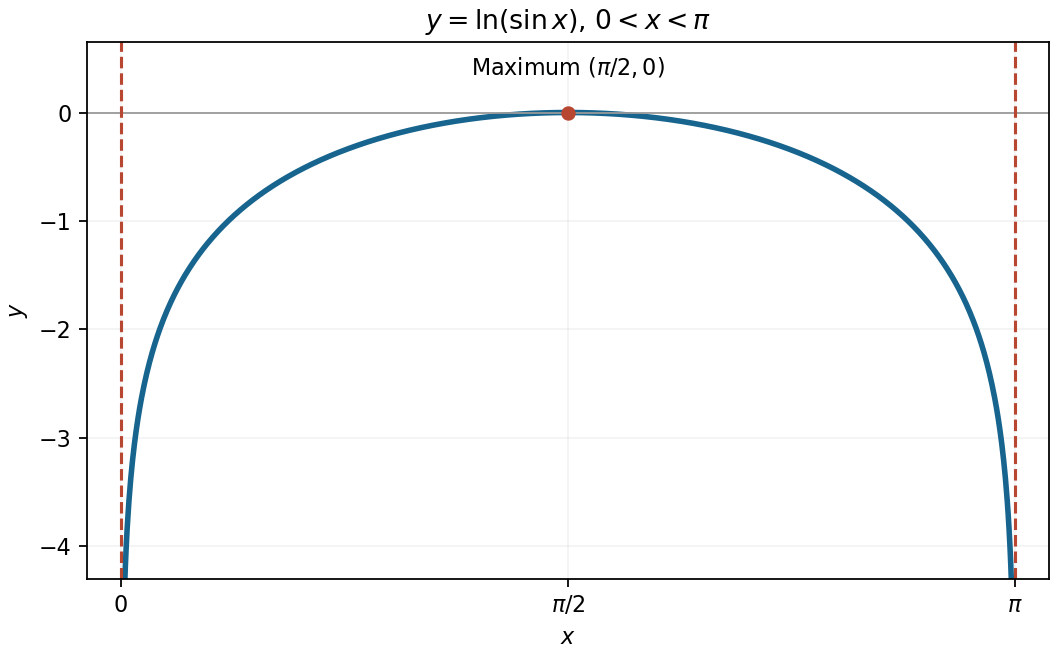
Within the requested interval, the function is symmetric about because . Its derivative is positive before , zero there, and negative afterwards. The negative second derivative shows that this is a strictly concave function. Consequently its unique maximum is . It tends to at both ends, giving vertical asymptotes and .

Articles by others on the same topic
There are currently no matching articles.