The first partial derivatives factor asIf either coordinate vanishes, the other equation forces the other coordinate to vanish as well. If both are nonzero, subtracting the two bracket equations gives , and then . Thus the complete list of stationary points is and the four points .
The Hessian matrix isAt the origin it is , which is a positive-definite matrix. At the four other points its eigenvalues are and , independently of the signs. The second-derivative test therefore givesThere are no local maxima. The minimum at the origin is not global, since as .
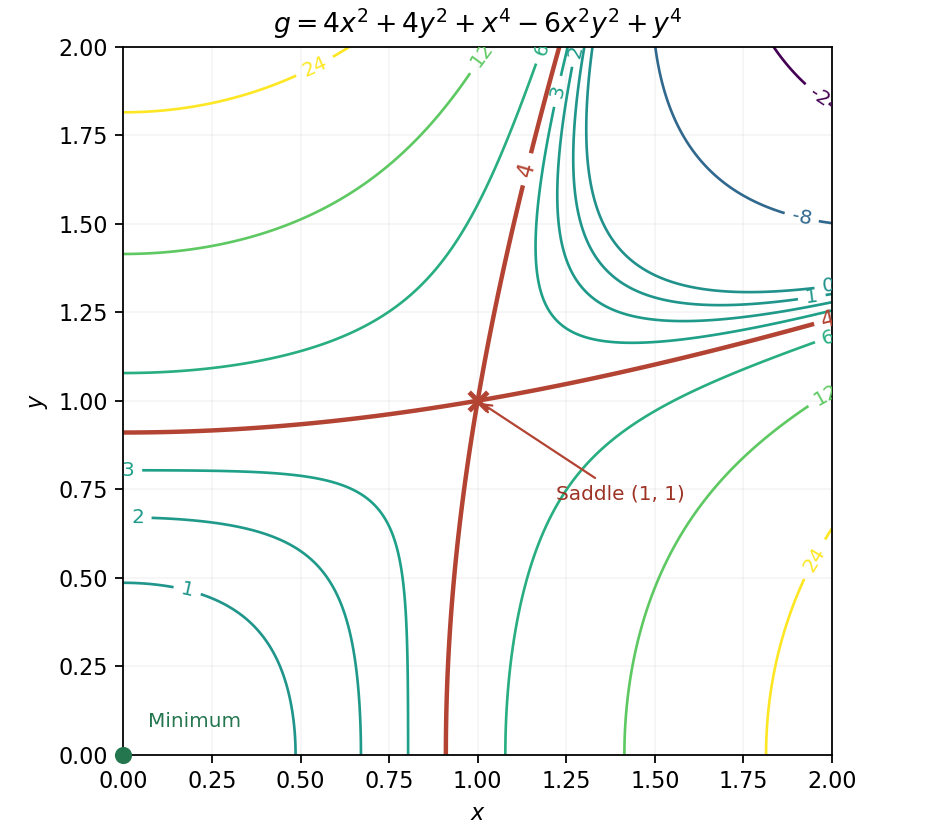
Within the requested first-quadrant square, the stationary points visible in the contour plot are the corner minimum and the saddle . Near the origin, , so the low positive contours look like quarter-circles. Along either coordinate axis, rises monotonically. Along the diagonal, rises to at , returns to zero at , then becomes negative.
The saddle contour crosses at and separates the central positive contours from the outer diagonal region. Negative contours occur toward , where , while the axis corners and have . These checks determine both the contour ordering and the change of connectivity at the saddle; the figure shows these level sets.

Articles by others on the same topic
There are currently no matching articles.